
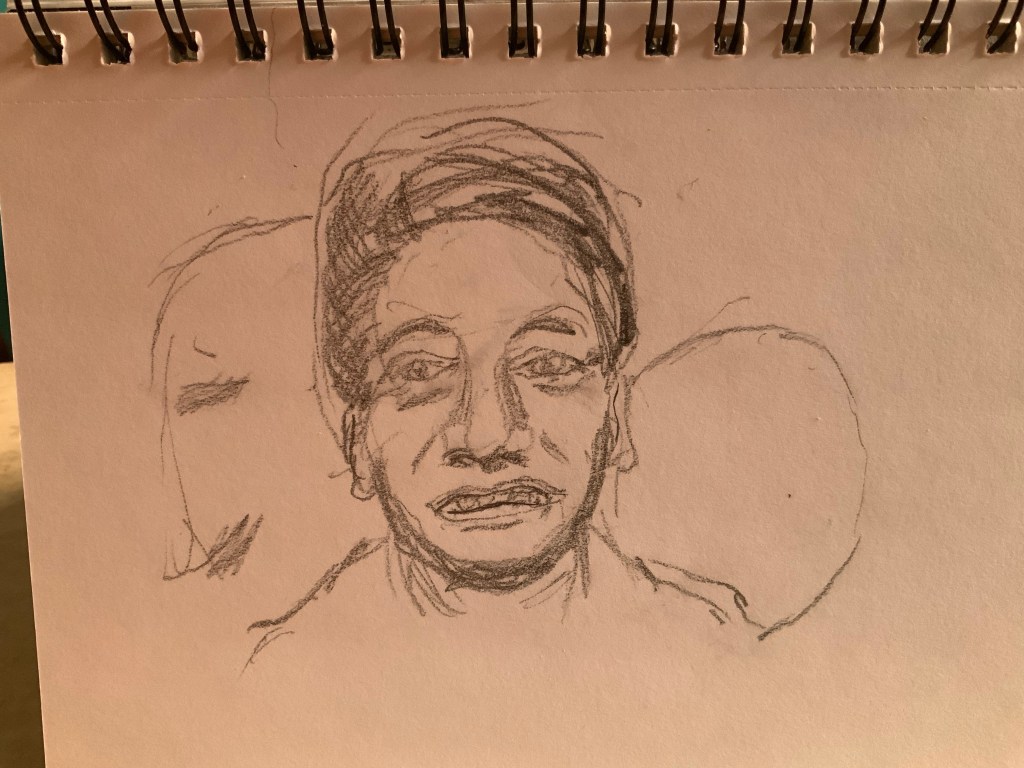
I converse from time to time with a bibliophile. It inspires me to recount a bookish tale.
On the skids from academia I kept either of two books near me as a talisman, carrying one even to bars. They didn’t relate directly to my teaching or my research domain or my committee servitude. They connected me to where I wanted to be, a place in my head, a fantasized detour around my impending dead end.
I didn’t find that detour. Oddly enough the two titles, with the names of their authors, faded from memory. Periodically I’ve sought to drag them out of the quicksands of recollection. Recently they returned to mind of their own accord.
The first book was “Tiempo de silencio” by Luis Martin-Santos, a Basque Spaniard killed in a car wreck in his forties as I recall. It intrigued me that he was a psychiatrist. What I remember of the work is short chapters without clear connection one to the next. It seemed daring and experimental.
The other book was “Los albañiles” by Mexican writer Vicente Leñero. I know nothing about Leñero. His narrative, set in Mexico City among construction workers (I’m relying on memory), read like a fever dream. I dwelt on the text and hovered over it. Its technique and language were challenging. I think it made me feel good to tackle it.
Those books are gone, sold or donated with the rest. I wonder what I would think of them now? I would be tempted to buy them again to read and see.
Read the rune.
(c) 2022 JMN — EthicalDative. All rights reserved







 EthicalDative
Which One Is ‘They’? A Way Almost to Tell
Let’s work together, good citizens: Go ahead and write they instead of he or she if you must, but keep the -s ending on the verb. It will result in phrases such as they wants. People will want to amend it to they want, but stick to your guns. They’ll get used to it, and there’s a good reason. It’s penny-wise and pound-foolish to jettison grammatical number on top of grammatical gender owing to a mere transient dissonance. Number has no sex. Keep it. Persons can be binary-evasive and still remain singular. Saving the -s trues the circle and will dispel ambiguity on occasion.
That’s it. Read no further unless you want proof.
***
Consider this narrative:
Saoirse and Niamh have creative writing degrees. Saoirse earned hers from Indiana, Niamh hers from Cornell. Oisín told Niamh he wanted Saoirse to edit his book.
Purging gender from the narrative, except for the names, we replace hers, he and his with they-forms.
… Saoirse earned theirs from Indiana, Niamh theirs from Cornell. — Context here is sufficient to bind theirs to Saoirse in one case and to Niamh in the other. People don’t earn someone else’s degree, do they?
… Oisín told Niamh they wants Saoirse to edit their book. — There it is: they wants. The -s binds they to Oisín on an Occam’s razor footing.
We’re stuck with ambiguity elsewhere, worse luck. Whose is the book to be edited? Oisín’s? One co-authored by Niamh and Saoirse? One in manuscript by Siobhan, whom we don’t even know and is unmentioned in the narrative? The gender-weighted original is succinctly clear. Its gender-scrubbed version must be encumbered with elaboration of some sort to be airtight. Airtight speech works better than leaky speech, especially in space.
Strop the tongue.
(c) 2022 JMN — EthicalDative. All rights reserved