For “Sad Framed” (2021), Feinstein layered black acrylic paint onto the canvas with a foam brush, evoking veils of mourning. “The situation in America is just untenable,” she said. “I don’t remember this level of misery, lack of care and injustice.” Credit… Hannah Yoon.
By the time [Rochelle Feinstein] arrived at Pratt, she knew she wanted to make art — an awareness inspired in large part by reading Marguerite Yourcenar’s 1951 “Memoirs of Hadrian,” a fictionalized autobiography of the Roman emperor. “I realized that painting was part of history”… She requires only two things from art: “I need to learn, and I need to feel. I want to learn something about where I am in this world, at this moment.”
From left: Part of the diptych “Abstract Vibes” (2021); “Endpapers I” (2021); and “Upcycles” (2021). Credit… Hannah Yoon.
When you start a new piece, where do you begin? With language, usually. How do you know when you’re done? There’s nothing left to do.
Tests for recent works hang on the studio wall. “I never know in the beginning where something is going but when I get to the middle, I can kind of see where the end might be,” Feinstein said. Credit… Hannah Yoon.
(Rose Courteau, “Rochelle Feinstein Makes Work That Is Purposefully Hard to Define,” NYTimes, 1-29-22)
[fudiYta bi-nafsiY]puisses-tu être racheté par mon âme! (formule de politesse à l’époque classique) [“may you (masculine) be redeemed by my soul” (formula of courtesy of the classical age)]. The example is from R. Blachère, “Grammaire de l’Arabe Classique” (1952), p. 333. Arabic verbs have masculine and feminine inflection for all persons except “I” and “we.”
I take it on report that an English monarch is entitled to declare self-referentially, We are not amused. I amuse myself speculating whether the Queen would say We amuse ourself or We amuse ourselves at whist.
In a different context, I wonder about singular they. The issue has real-world consequence because singular they in speech and writing is “trending”; resisting it isn’t a hill I want to die on. What does interest me is how to integrate it into English structures.
Jennifer Huang’s profile in Poetry magazine is a paradigm of vanguard usage. It promotes singular they from reference whose gender is a toss-up (one, someone, person, poet, doctor) to that of a specific, named person:
Jennifer Huang* is a Taiwanese-American writer… They received their MFA from… They live in Michigan, where they are working on a novel. [May 2021]
The following quotation helps create a test:
“When you remove someone from your environment, they will eventually crystalize into the person they are,” she said.
(Skye Rudin, quoted by Jon Wilcox, “Houston artist explores imaginary spaces in Victoria College exhibit,” Victoria Advocate, 1-26-22)
Modify it to a conventionally gendered statement containing a possessive adjective, subject pronoun, reflexive pronoun, subject pronoun (again), object pronoun, and possessive pronoun:
When you remove someone from her environment, she will transform herself into the person she is. The world will accept her and be hers.
or
When you remove someone from his environment, he will transform himself into the person he is. The world will accept him and be his.
Then transgender the statement with singular they:
When you remove someone from their environment, they will transform themselves into the person they are. The world will accept them and be theirs.
This version rings familiar in today’s discourse.
Supplying only a proper name (male or female) adapts it to the Huang model:
When you remove Skye Rudin from their environment, they will transform themselves into the person they are. The world will accept them and be theirs.
This demonstrates a consistent application of singular they as I see it.
Unfinished, untitled work titled “Work Trying to Call Itself ‘In Progress,’” oil on unmeasured old watercolor paper (JMN 2022).
A man’s word is his bond.
It’s an aphorism. States a pithy truth, along the lines of, “When someone makes a promise, he keeps it.” This one floats a model of behavior, an ideal. Not a command, exactly, but it has hortatory weight; exhorts by affirming. It’s a cheer for honor and integrity.
Does this aphorism exclude women? What about: A person’s word is his bond? Or: One’s word is his bond? “His” keeps appearing! One’s word is one’s bond finally unhitches the saying from gender, perceived or implied. Now it’s universal and indiscriminate. In other words, aphoristic. But the matter isn’t closed.
“Man” and “his” may sound too biological to be inclusive. Defaulting to masculine forms where universal application is intended may look like sexism prescribed by male grammarians. A woman’s word is her bond states an equal truth, of course. So does One’s word is her bond. The neutral “one” allows the pivot to either gender — as long as the selected morpheme is singular. I’ve given emphasis to this last condition because it’s widely challenged now.
Many English speakers now might say or write, One’s word is their bond. The possessive call-back to “one” morphs into the plural. It crosses the number boundary. In so doing it transgresses an established norm of syntax, one that prescribes gender and number matching between sets of morphemes:
THIRD-PERSON SINGULAR he, him, himself, his she, her, herself, hers it, its, itself, its THIRD-PERSON PLURAL they, them, themselves, their
The crux of the matter is this: The only person English distinguishes for gender is the third-singular. An example of breaching such match-up is a statement such as The woman cut himself. Most speakers would deem it nonsensical. Many speakers, however, are receptive to a statement such as When a person cuts themselves (or themself?), infection is possible.
Transgendered phraseology takes advantage of the fact that English has an all-encompassing, third-person plural pronoun. I infer that using it reflects linguistically a drive to achieve parity between the sexes in society; also, to escape pigeonholing or disclosure of gender identity imposed by language.
I’m led to review familiar terminology of the language world I inhabit:
Person: first (speaker), second (spoken-to), third (spoken-about) Number: singular, plural (Arabic adds dual) Gender: masculine, feminine (German adds neuter) Animacy: animate, inanimate
It’s to be noted that in theory transgendering is possible within the established bounds of number by saying When a person cuts itself. In practice, it appears, our notion that we’re human is more deeply embedded in our psyches than a quibble over how many we are. If one sins, so to speak, let it be against number and not animacy.
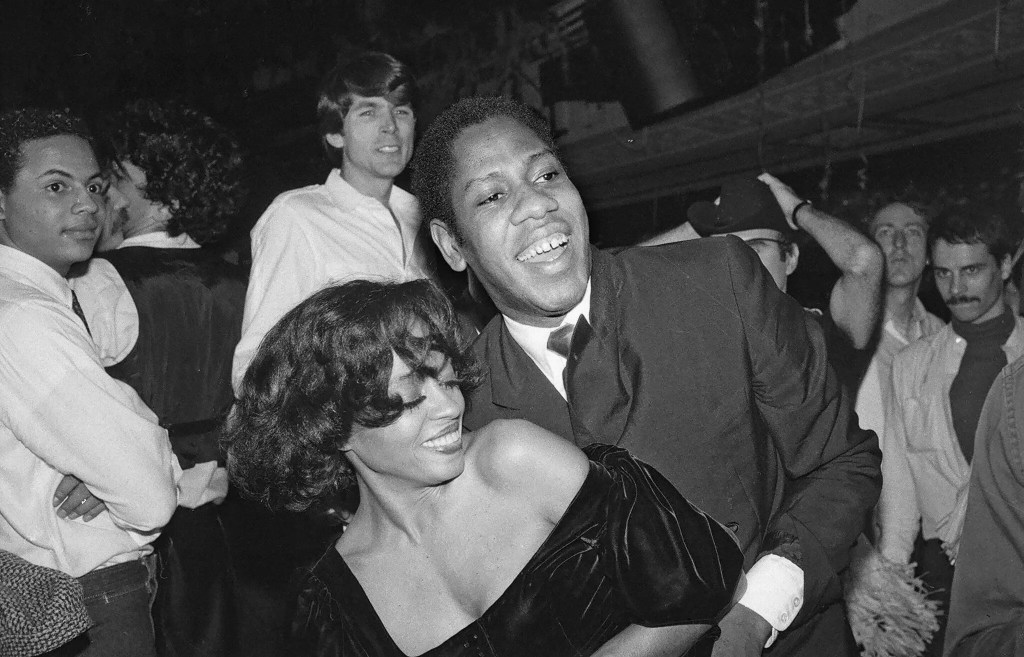
André Leon Talley dancing with Diana Ross at New York’s Studio 54 in 1979. Sonia Moskowitz/Getty Images. [It’s a doppelgänger vibe from out of “The Shining”: A spitting image of me stares moonily out of the frame in a photograph of an event at which I was never present.]
Wallace Stevens said of his poem “On an Old Horn” that, if he had succeeded in saying what he had to say, the reader would get it.
“He may not get it at once, but, if he is sufficiently interested, he invariably gets it.” [1942, quoted by Paul Mariani]
Frank Perfetti’s contributor profile in Poetry magazine reads in its entirety as follows:
Frank Perfetti* writes of the work in this issue, “With a smile I let the viewer draw their own conclusions.” [February 2021]
Stevens’s reader and Perfetti’s viewer emblemize the same fond hypothesis: an audience. Their respective callbacks — “he” and “their” — to a singular instance of that postulate betray a distance traveled over eight decades towards… what to call it?
I need to name the language behavior I’m at pains to converse about in terms of what it is, not what it isn’t. Coining a word — genderflection — in order to document its opposite, as I’ve done earlier, is overly clever, inefficient and vaguely emotive. It betokens a certain resistance to the linguistic behaviors described, coupled with a good-faith effort to channel those feelings through restrained analysis and open-ended contemplation.
It dawns on me that the word I seek is already out there: transgender. Transcend, transgress, translate, transport…transgender. I should have twigged sooner to its transworthiness for my discussion.
“Transgendered” expression is, then, a pressuring of language to discard time-worn, reductive distinctions rooted in biology-plus-culture. Vestigial holdovers of it in English are the third-person singular pronouns “she” and “he.” At the dawn of time, survival may have hinged on reporting whether an approaching human was male or female — one was likelier to rape and pillage than the other. But in the modern day?
There’s a possible precedent for a singular pronoun collapsing into its plural mate and disappearing from the language: It’s when “thou” gave way to “you” for the second person. There’s a loss of precision, which accounts for dialect forms such as “y’all” and “youse” and “you ‘uns” and “you lot” that are alive in speech. If transgendered “they” takes hold, perhaps “they all” or “th’all” is in the offing for talk about explicitly more than one of “them”.
Should certain nouns be next to fall? If words like “man” and “woman” retreat to archaic usage, then A man’s word is his bond becomes A person’s word is their bond, which will be as explicit as it gets, unless disambiguated by amplification: A person’s word is that person’s bond. Efficiency isn’t always the summum bonum in how language rolls.
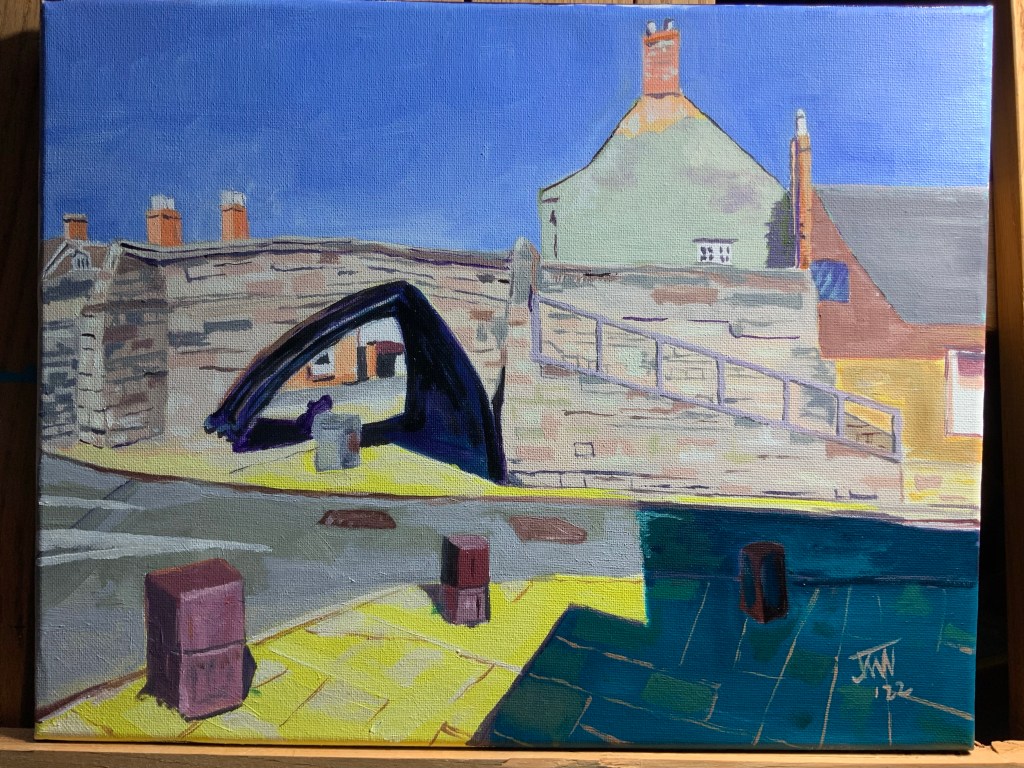
“Crow Shadow,” 11 x 14 in. oil on canvas (JMN 2022)
It’s apparent that contributors to Poetry magazine compose their own biographical snapshots, which allows for a gamut of voicings and modes of self-assertion. A grammar nerd notices how these established and establishing technicians of the word mold language to their purposes. A lively mobilization against “he-she” is observable in recent issues I’ve read. To give it a name, I’ll call it “genderflecting” when gendered pronouns are used in the conventional way.
In non-genderflected reference a singular person talks about themselves in the plural. Jennifer Huang’s profile is one of the best examples I’ve seen:
Jennifer Huang* is a Taiwanese-American writer… They received their MFA from… They live in Michigan, where they are working on a novel. [May 2021]
Here are other instances:
Jinhao Xie* is a UK-based poet… Their poetry, inspired by… [September 2021] Xandria Phillips* is a Whiting Award-winning poet… They are the author of… [July/August 2021] Kemi Alabi* is coeditor of… They live in Chicago. [December 2020] Aubrey King’s* poem is inspired by… They teach at the Jack Kerouac School of Disembodied Poetics. [October 2021] Kitchen McKeown* won… Their debut chapbook is forthcoming… [October 2021] Miriam Karraker* is a writer… Their writing has appeared… [November 2021] Marlanda Dekine Sapient-Soul* (she/her/they/them) is a poet… She is the author… [June 2021]
Gender identity and ethnicity often enter the picture:
Ever Jones* is a queer/trans writer… They are the author of the transliberatory lyric… [November 2020] Tarik Dobbs* is an Arab American, queer writer… They are an MFA candidate… Their chapbook… [May 2021] Aurielle Marie* is a Black and queer poet… Their debut collection… [December 2021]
The student of Spanish notes how adopted ethnic adjectives can be purged of genderflection with “x,” and sometimes not:
V. Ruiz* is a Queer, Xicana bruja [witch]… Their debut is… [February 2021] Elena Ramirez-Gorski* is a Chicanx writer… They are an MFA candidate at… [May 2021] Isabella Borgeson* is a queer, white and Filipina poet… She is cofounder of… [December 2020] Ina Carino* is a Filipinx American poet… [September 2021]
TC Tolbert flies a larkish banner that snaps in its own breeze. I’ve seen “s/he” before, but “they” seems to be winning.
TC Tolbert* (he/him/hey grrrl) is a trans and gender-queer monkey-goat who never ceases to experience a simultaneous grief and deep love any time s/he pays attention to the world. [July/August 2021]
It’s noteworthy that every contributor in this sampling of profiles is marked by an asterisk, which is Poetry’s way of flagging first-timers to the magazine. I take it to signal an opening up to undersung constituencies which are richly represented by LGBTQ+, minority ethnic, Native American, and incarcerated writers.
Is there a better definition of art than the effort, the ache, to explain one’s inner experience and be understood?… I was starting out as a painter, and [Chuck Close] supported and encouraged me. He bought me my first proper oil paint — the exact brands and colors he used (particular brands for particular colors) — and taught me to set up my palette just like his. He showed me how to mix beautiful blacks without using black. He instructed me to treat every area of the canvas equally, not to paint the hair differently from the skin just because it was hair, not to paint the background with less attention than to the subject, to erase hierarchy.
(Ali Silverstein, “I Once Loved Chuck Close. That’s Why I Want to Tell My Story,” NYTimes, 12-27-21)
Proliferation of phrases: — A turn of speech makes my point vividly — I’ll use it. But this other phrase is pungent — I’ll use it too. Yet another is incisive; and one is innovative; and one wry; this one has shock effect; they’re coming to me like hotcakes, I’ll use them all! It’s a rhetorical strategy that can shade from festive elaboration into prolixity. Where the line is crossed may fluctuate according to a given reader’s tolerances. Poet and scholar heidi andrea restrepo rhodes (sic — her LC) is testing mine in an expansive essay on aphasia and poetry published in the eponymous magazine’s watershed October 2020 issue. I haven’t got to the bottom of it yet.
There are homely words and hoity toity words. I too often practice self-abuse here, opting for the latter and piling on verbiage in hopes of camouflaging a humdrum thought. But take a word like “movable.” It’s ordinary and colorless, unlike “mobile” or “portable,” or better yet “itinerant.” “Movable” gets interesting, however, in an unlikely pairing, such as with “feast.” “Movable feast” lands a certain punch that took root and became a trope. It requires discretion and a good ear to invigorate humble words by pairing them unexpectedly. I don’t claim to have those qualities, but Louise Glück does.
What I admire about Glück’s art even when I don’t understand it is its icy concision. Her language is spare, precise, incised, lean; every word, every inflection, every punctuation symbol is rigorously pondered and intentional. She has an ear for pairing ordinary words like “cotton mouth” (a poisonous snake common where I live) and “roughhouse” (rowdy behavior) unexpectedly. Movable feast, moving target. Her poems remind me of the pools of water I puzzled over as a kid when touring the Carlsbad Caverns. Way down in the cold earth they had a preternatural limpidity that made the bottom seem an elbow’s length distant, yet the water was a dozen feet deep. Pennies tossed there were crystalline yet remote. It was haunting and incomprehensible to the naive senses. I simply couldn’t fathom it or get over marveling.
“What was it somebody said that the only thing God could not do was to make a two year old mule in a minute.” (Gertrude Stein) Thanks to OutsideAuthority for the quotation and photo.
<p. 137> “World Breaking Apart” by Louise Glück (“Poems 1962-2012,” 2012)
I don’t care if this post is preposterously long. It’s a barbaric yawp anyway. My original title for a comment about “World Breaking Apart” was “Inconclusive Antecedence.” It was another glib title masking with gobbledygook how puny I feel up against poetry like Louise Glück’s. I was going to dwell on how her poem pivots on an ambiguity of reference for the pronoun “them” when it says “I saw them come apart,.” leaving me in a perplexed limbo of sorts. Yes, that’s me, gasping for sense with words.
I try to affect a certain erudition here. The truth is I know a little about a few things that matter to fewer persons, but where poetry is concerned I feel unfit for it, not up to it, stranded by it, uncertain and afraid of not getting it as I sit, not in a dive, but in my shed on a floodplain of the Guadalupe. There, you see? I’ve signaled obliquely and as if casually that I’ve read a poem by W. H. Auden — it’s part of the pose I adopt. I can say truthfully that I have liked that poem enough to commit it to memory for a time, along with a few others. But as it happens, all my loves are by poets who antedate me by lifetimes, and all, as it happens, have been canonized already, if that word means endorsed by the reading establishment that broadcasts from academies and congresses.
Faced with poetry written by people who are alive now (January 14, 2022), I’m mostly lost at so many levels. And Louise Glück is a living breathing eminence! She teaches in the finest schools and is crowned with every title known to American poetry, most recently the Nobel. If I’m lost by a distinguished voice of my own time and place, I must be truly unfindable. Thomas Lux broke my spirit last night when he introduced her in a recorded reading I stumbled upon. He called her uncompromising and full of mystery, saying mystery is what he wants in poetry. He was a poet himself (rest in peace) and must know, but I’m swamped by mystery at the moment. I could do with some dots that connect without my impotently busting a gut over them.
I’m a proud man. I’d like my poetic lostness to sound sophisticated and serenely cocky, as if the genre somehow owes me something, but in plain terms I simply don’t know what her poems mean. I don’t know what they say. I don’t know what their intention is. I don’t know what I should feel or what heightened awareness I should possess after reading them. I don’t understand them. What I do feel is cowed and whipped, guilty and ashamed at not experiencing the kind of pleasure meant to be gained from the reading of them. The poems help me feel helpless and inferior intellectually, culturally, emotionally, and whatever more freight train of adverbs can be appended to bellyaching. Have you noticed how I didn’t mention the title of Auden’s poem above? It’s a trick of dismissive nonchalance I’m learning from reading poetry: if you have to ask, you can’t afford the question, you’re not an insider to the allusion. I’m forever grateful to Auden for using two words — uncertain and afraid — that mean what they goddamn say. The swear word and disobliging sarcasm I end with here are a sign of how angry I am at Louise Glück (not personally) and at myself for reading her so ineffectually.
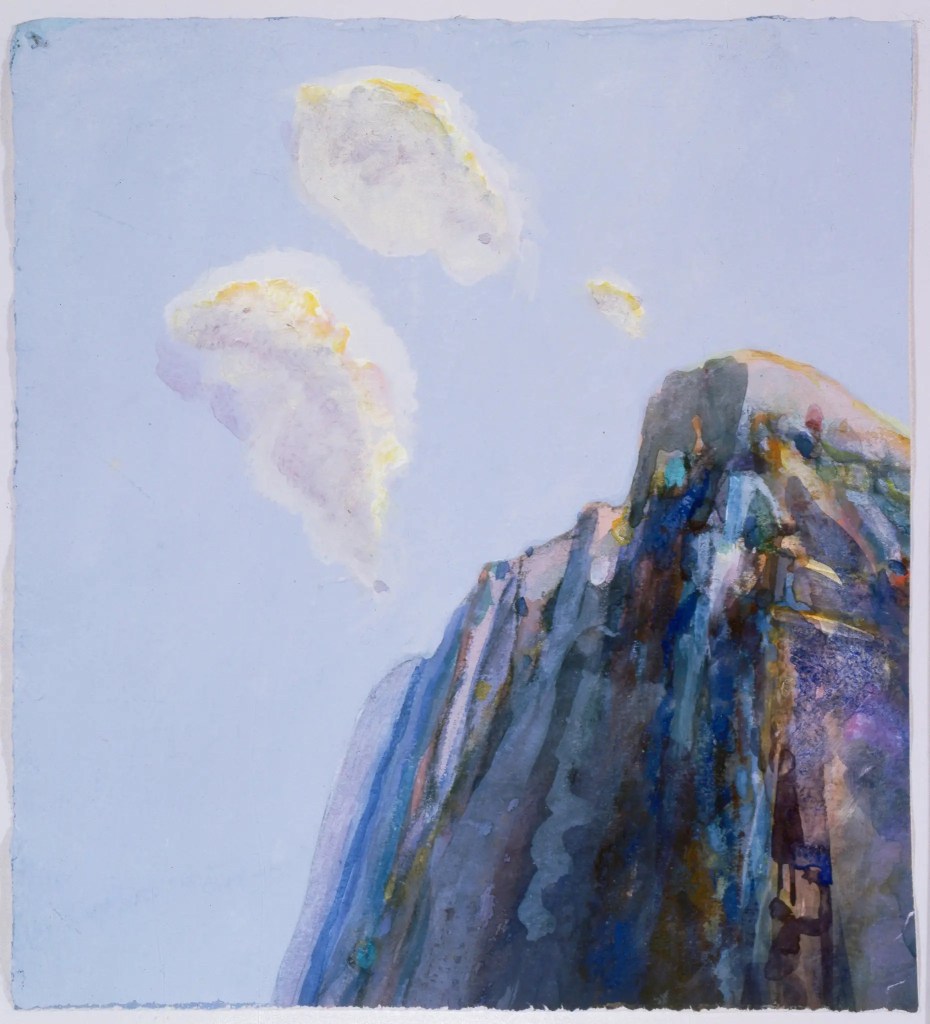
“Untitled (Mountain and Clouds),” circa 1965. Credit… Wayne Thiebaud/Licensed by VAGA at ARS, New York [New York Times].
Wayne Thiebaud (1920-2021) is said to have painted daily to the end. He described himself as driven by “this almost neurotic fixation of trying to learn to paint.”
“It has never ceased to thrill and amaze me,” he said, “the magic of what happens when you put one bit of paint next to another… I wake up every morning and paint… I’ll be damned but I just can’t stop.”
“Flatland River,” 1997. Credit… Wayne Thiebaud/Licensed by VAGA at ARS, NY [New York Times].
Thiebaud called himself a painter. Saying you’re an artist, he said, is “like a priest referring to himself as a saint.” That was for someone else to decide.
[Thiebaud’s] real subject, many critics said, was paint and the act of painting itself: the shimmering color and sensuous texture of thickly applied paint. He laid on paint so heavily that he often carved his signature instead of putting it on with the brush.
“Tulip Sundaes,” 2010. Credit… Wayne Thiebaud/Licensed by VAGA at Artists Rights Society (ARS), NY [New York Times].
Artists whose influence Thiebaud, a lifelong teacher himself, acknowledged include: Thomas Eakins, John James Audubon, Jean-Siméon Chardin, Giorgio Morandi, Edward Hopper, Joaquín Sorolla, and Willem de Kooning. The statement that Thiebaud’s art was “grounded in slow, hard-earned craftsmanship” points to “perspiration” as a factor in making art.
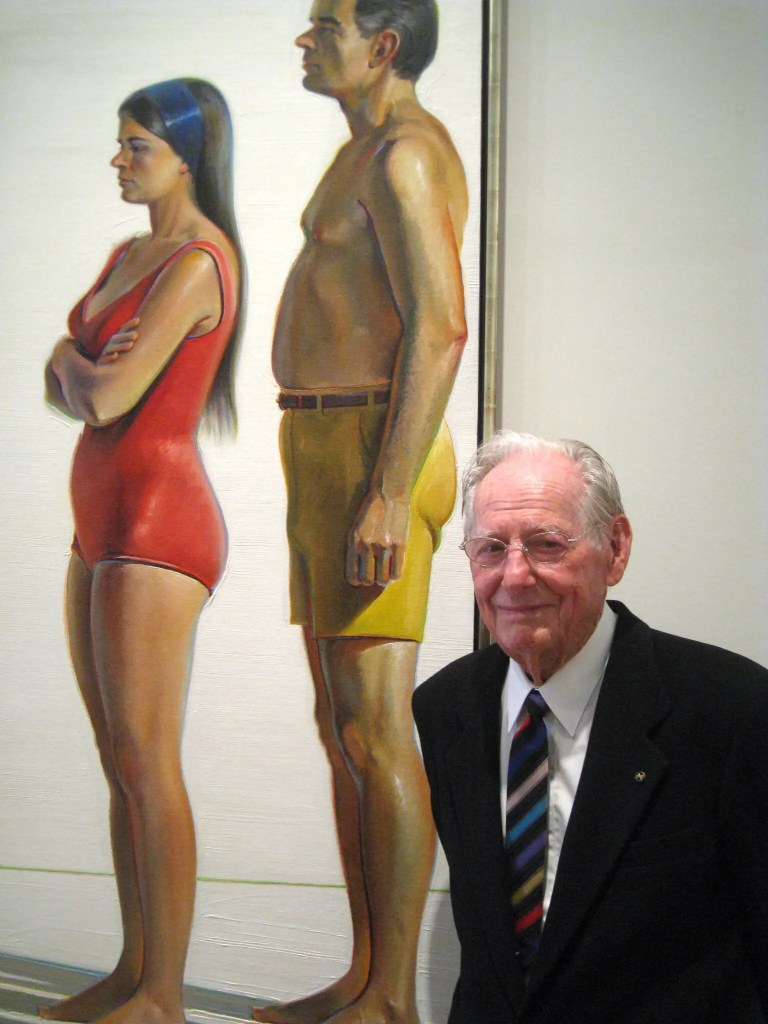
Mr. Thiebaud, with his painting “Swimsuit Figures,” was honored in 2017 at an event held by the American Academy of Arts and Letters. Credit… Jill Krementz [New York Times].
Sources: Associated Press, “Wayne Thiebaud, painter of cakes and San Francisco cityscapes, dies at 101,” theguardian.com, 12-26-21. Michael Kimmelmann, “Wayne Thiebaud, Playful Painter of the Everyday, Dies at 101,” NYTimes, 12-26-21.
In my Arabic grammar I encounter the preposition fiy- illustrated in a “relationship of comparison” (rapport de comparaison).
mA HayAtu-d-dunyA fiY-l-Akhirati illA maTA(un: La vie de ce monde, par rapport à l’autre, n’est que jouissance précaire. [“The life of this world, compared to the next, is but precarious enjoyment.”] R. Blachère et M. Gaudefroy-Demombynes, “Grammaire de l’Arabe Classique,” 1952).
Blachere’s jouissance is matA( from root m-t-( meaning “to carry away” and, in derived forms, “to enjoy.” Its usages meander through enjoyment, property, and stuff. The notion of “precarious” is absent; however, the syntax example is one of many Blachère takes from the Koran. Julio Cortés points out that the immense corpus of commentary crucially supplements how Koranic terms are understood. The delights of this life are deemed ephemeral by common consent.
Here’s the exploding rabbit hole: My dictionary defines the idiom matA(u-l-mar’a, whose second word means “woman,” as cunnus. It’s tagged anat. for “anatomical.”
There’s an ancient English word for cunnus that’s cognate with French con and Spanish coño. I once mocked Western scholars born in Victorian times who resorted to Latin in citing salty medieval verses (especially those composed by women). I’m less exercised now about Roman empire slang. I confess my mother-tongue’s alternative to cunnus grates on my ear. I’m content to let sleeping Latin lie.








 EthicalDative
What ‘Self’ Goes With Royal ‘We’ and Singular ‘They’?
I take it on report that an English monarch is entitled to declare self-referentially, We are not amused. I amuse myself speculating whether the Queen would say We amuse ourself or We amuse ourselves at whist.
In a different context, I wonder about singular they. The issue has real-world consequence because singular they in speech and writing is “trending”; resisting it isn’t a hill I want to die on. What does interest me is how to integrate it into English structures.
Jennifer Huang’s profile in Poetry magazine is a paradigm of vanguard usage. It promotes singular they from reference whose gender is a toss-up (one, someone, person, poet, doctor) to that of a specific, named person:
The following quotation helps create a test:
Modify it to a conventionally gendered statement containing a possessive adjective, subject pronoun, reflexive pronoun, subject pronoun (again), object pronoun, and possessive pronoun:
or
Then transgender the statement with singular they:
This version rings familiar in today’s discourse.
Supplying only a proper name (male or female) adapts it to the Huang model:
This demonstrates a consistent application of singular they as I see it.
(c) 2022 JMN — EthicalDative. All rights reserved