Knots Bound XCVI

[XCVI]
Pienso, esta época en que tú me amaste
I think this epoch in which you loved me
se irá por otra azul sustituida,
will go away, replaced by a blue one,
será otra piel sobre los mismos huesos,
it will be another skin on the same bones,
otros ojos verán la primavera.
other eyes will see the Spring.

Nadie de los que ataron esta hora,
Not one of those who tied this hour,
de los que conversaron con el humo,
of those who conversed with smoke,
gobiernos, traficantes, transeúntes,
governments, traffickers, transients,
continuarán moviéndose en sus hilos.
will continue moving in its threads.

Se irán los crueles dioses con anteojos,
The cruel, bespectacled gods will go away,
los peludos carnívoros con libro,
the hirsute carnivores with books,
los pulgones y los pipipasseyros.
the plant lice and the pipipasseyros.*

Y cuando esté recién lavado el mundo
And when the world is freshly washed
nacerán otros ojos en el agua
other eyes will be born in the water
y crecerá sin lágrimas el trigo.
and wheat will grow without tears.

*Reference to Ricardo Paseyro (1925-2009), Uruguayan poet-diplomat who lived in France and was a “bitter enemy of leftist intellectuals” such as Neruda.

Veinte poemas de amor y una canción desesperada. Cien sonetos de amor
1924, Pablo Neruda y Herederos de Pablo Neruda
1994, Random House Mondadori
Cuarta edición en U.S.A: febrero 2004

[English translation is mine.]

(c) 2020 JMN

Posted in Anthology | Tagged , , , , , | Leave a comment

Ironic Fashion Shoot

For me, what elevates irony over sarcasm is a dose of humor.

I like to imagine each member of this crew, sporting the same scruffy costume, doing the swivel-hip runway strut, flaunting a thousand-yard stare behind their John Lennon shades — just like the best models. An elegant crowd watches appraisingly; curated music pipes ambiently; a silken voice intones presidingly.

It has a delicious pointlessness to it. It’s ironic!

(“3 Art Gallery Shows to See,” NYTimes, 12-2-20)

(c) 2020 JMN

Posted in Commentary | Tagged , , , , | Leave a comment

‘Not Objectionably Reasonable’

EthicalDative must have a focus to offset my wandering attention. I try with mixed results to blog about art and language, and respond elsewhere and otherwise to the rest.

An October 6th article about an appalling event has stayed in my suspense file of quotable specimens because of the phrase “not objectionably reasonable” occurring in a statement issued by the Texas Rangers:

“The preliminary investigation indicates that the actions of Officer Lucas were not objectionably reasonable,” the statement said.

(“Texas police officer charged with murder over killing of black man,” theguardian.com, 10-6-20)

The actions in question include the fatal shooting on October 3rd, 2020, of a 31-year-old man by a 22-year-old police officer in Wolfe City, Texas.

Wisdom says surround quotations with your own thoughts. I’m too prone to assume that what strikes me somehow in the words I cite speaks for itself. I try to correct that here.

“Not objectionably reasonable” says, as far as I can tell: “not reasonable to a degree that would cause objection; not excessively reasonable; just reasonable enough.” Or something like that.

I can’t make sense of “not objectionably reasonable” in its current context or any other. And when language breaks down at crucial and suspiciously convenient moments, paralleling breakdowns in the real world, it seems to me to add spurious, malignant insult to already grave injury.

(c) 2020 JMN

Posted in Commentary, Quotations | Tagged , , , , , | 2 Comments

‘Burden of Representation’

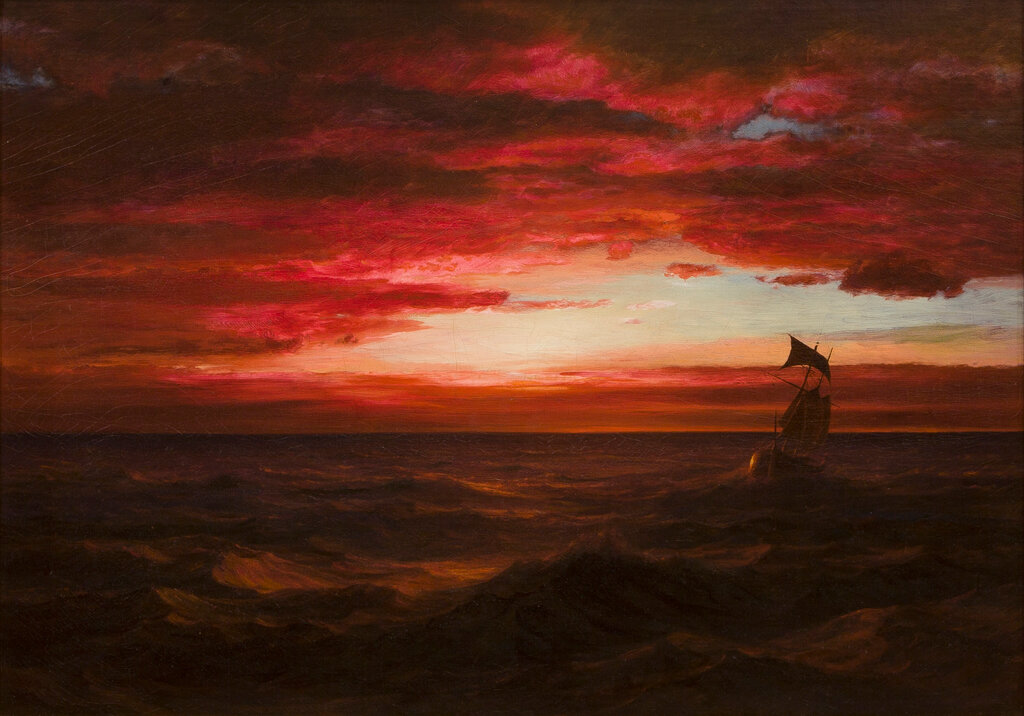
Roberta Smith writes of the Rothko painting that it “presents a glowing stack in brown, red and black on a red ground.”

She describes the Church painting as “an expanse of shockingly deep red sky with a little sun peeping over a choppy black sea tossing a dark ship.”

Smith describes the colors of both paintings as “blunt” and compares them as follows:

Unburdened by representation, Rothko’s suspended blocks of autonomous color accentuate the strangeness of Church’s palette, especially the array of lavenders, pinks and yellows in his skies.

I always profit from Roberta Smith’s art criticism by feeling that I’ve seen art works (even those I like such as these two) a little more clearly after reading her comments. Her phrase “burden of representation” is striking. In my own modest easel practice, the greater challenge would be to paint non-representationally. In those territories, truly, there be dragons.

(c) 2020 JMN

Posted in Commentary, Quotations | Tagged , , , , , | Leave a comment

Pronounce This!

Wrangling among logocrats in the Anglo-Empyrean over how to pronounce something in the common language that separates us is good for a brief detox from the trumpical pandemia.

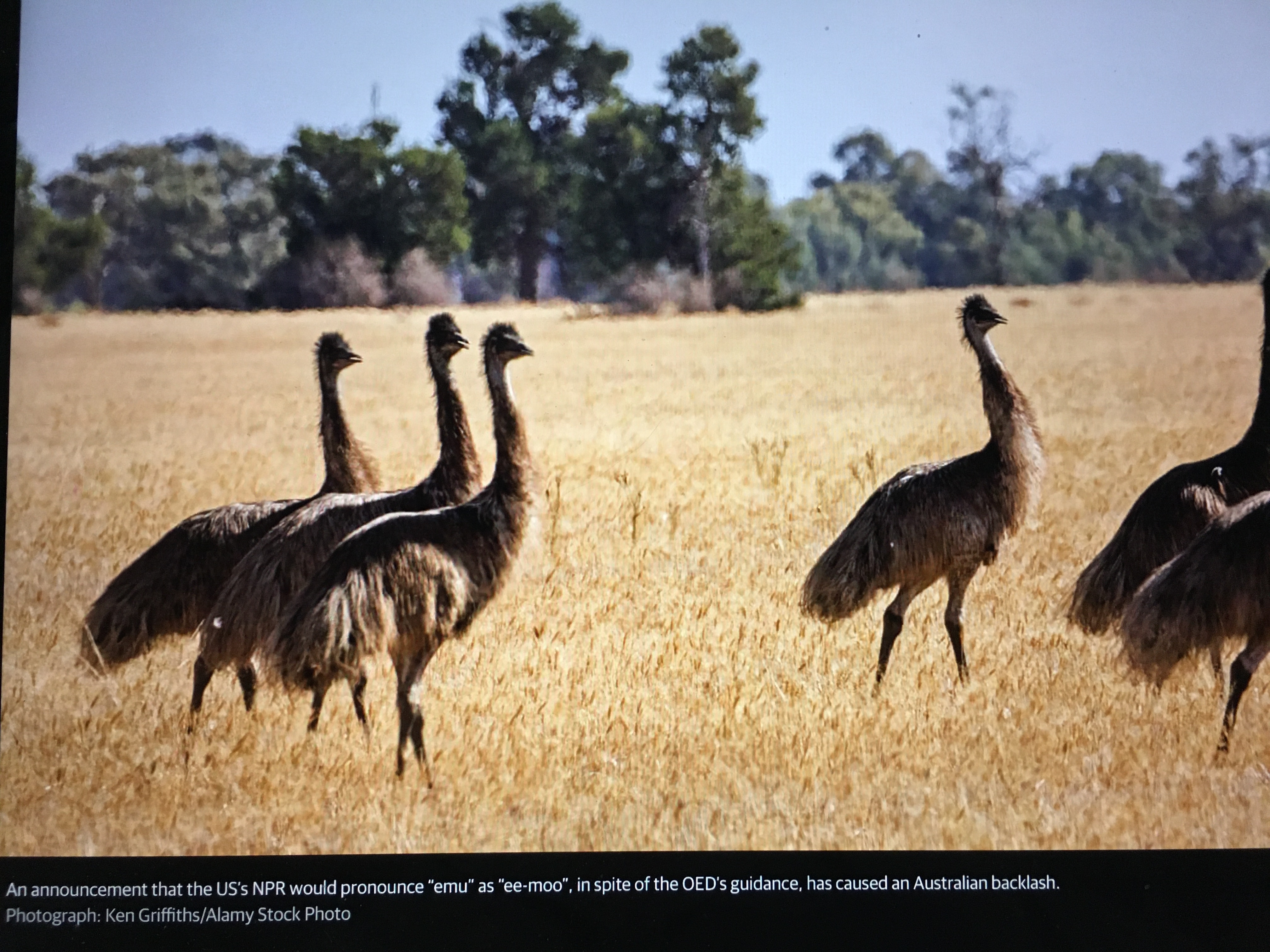
In August a Twitter-turd toss from Down Under landed on National Public Radio for pronouncing “emu” to rhyme with “poo” instead of “pew.”

(A few Texans have imported this native Australian and tried to reimagine it as a monetizable meat-bird. I don’t know that the enterprise has prospered.)

“Emu” is said to be an anglicised-Portuguese name in the first place. Who needs it?

According to reporting from NITV, the Warlpiri mob call emus “yankirri”, and the people of both the Gamilaraay and Wiradjuri nations referred to the bird as “thinawan” or “dinawan”.

(Matilda Boseley, “Ee-moo?! NPR’s ‘absurd’ pronunciation starts new emu war in Australia,” theguardian.com, 8-24-20)

I say let the native nations have the last word. It’s their bird.

(c) 2020 JMN

Posted in Commentary, Quotations | Tagged , , | Leave a comment

Fewer Miracles, Less Time

Beatification occurs when the Pope declares a dead person to be in a state of bliss. It permits public veneration and is the first step towards canonization.

Canonization occurs when the Roman Catholic Church officially admits a dead person into sainthood.

[Pope John Paul II] knocked down the criteria for beatification from two miracles to one, and did the same for canonization. In 1983, he reduced the amount of time required between a person’s death and the start of their canonization process to five years from 50… He produced more than 480 saints, and put enough into the pipeline that Benedict XVI was able to canonize scores more.

(Jason Horowitz, “Sainted Too Soon? Vatican Report Cast John Paul II in Harsh New Light,” NYTimes, 11-14-20)

(c) 2020 JMN

Posted in Quotations | Tagged , , | Leave a comment

Knots Bound XCVII

[XCXVII]
Hay que volar en este tiempo, ¿a dónde?
One must fly at this time, to where?
Sin alas, sin avión, volar sin duda:
With no wings, no airplane, fly without doubt:
ya los pasos pasaron sin remedio,
already the footsteps passed by irredeemably,
no elevaron los pies del pasajero.
they did not raise the passenger’s feet.

Hay que volar a cada instante como
One must fly at each instant like
las águilas, las moscas y los días,
the eagles, the flies and the days,
hay que vencer los ojos de Saturno
one must conquer the eyes of Saturn
y establecer allí nuevas campanas.
and establish there new bells.

Ya no bastan zapatos ni caminos,
Neither shoes nor roads suffice now,
ya no sirve la tierra a los errantes,
earth no longer serves the wanderers,
ya cruzaron la noche las raíces,
already roots crossed the night,

y tú aparecerás en otra estrella,
and you will appear on another star
determinadamente transitoria
determinedly transitory,
convertida por fin en amapola.
changed at last into a poppy.

Veinte poemas de amor y una canción desesperada. Cien sonetos de amor
1924, Pablo Neruda y Herederos de Pablo Neruda
1994, Random House Mondadori
Cuarta edición en U.S.A: febrero 2004
[English translation is mine.]

(c) 2020 JMN

Posted in Anthology | Tagged , , , | Leave a comment

“That Was Now, This Is Then”

The very title of Vijay Sheshadri’s volume of poems, reviewed by David Orr, has the jewel-beam of poetic crystal to it. I keep rolling it on my tongue, as if it makes some kind of sense of the moment. Orr’s phrase about “coiling and liquid” conversation adds crackle to the verve.

The essence of Seshadri’s writing is conversation, and that conversation is coiling and liquid, not diffident.

I’ll meet if you really want to meet.
Me reuniré contigo si de verdad lo deseas.
I’ll even meet in some small café or some
Incluso en cualquier café pequeño o algún
park across the way. But I won’t meet for long,
parque por ahí. Pero no me reuniré largo rato,
and not for a minute will I look at you in your isolation,
ni por un minuto voy a mirarte en tu aislamiento,
your human isolation. Looking at yours makes me look at mine
tu aislamiento humano. Mirar el tuyo me obliga a mirar el mío

transparencies of each other are they, yours and mine —
transparencias uno del otro son, el tuyo y el mío —
and I don’t have time for mine, so how could I have time for yours?
y no tengo tiempo para el mío, así que ¿cómo voy a tenerlo para el tuyo?

(The quoted verse is from Orr’s review. The intercalated translations are mine.)

(David Orr, “A Poet Who Mesmerizes by Zigs and Zags, Hopping From Idea to Idea,” NYTimes, 11-25-20)

(c) 2020 JMN

Posted in Commentary, Quotations | Tagged , , , , , , , , | Leave a comment

Pithy Gristle

David Orr reviews Vijay Sheshadri’s volume of poems “That Was Now, This Is Then” (Graywolf Press).

Reviewers who are poets are especially equipped with spicy pronouncements.

Poetry has a long, proud history of acting as if readers don’t exist. Often this is a good thing… But, of course, to act as if the reader doesn’t exist is exactly that: to act.
La poesía tiene una historia larga y orgullosa de fingir que no existen lectores. Muchas veces es cosa buena… Pero claro, fingir que no existe el lector es precisamente eso: fingir.

To write as an ironist, especially today, is to risk that the reader loses patience with hedging, backtracking, spirals of cleverness. But sometimes the layers of the onion ensure the purity of the tears.
Escribir como ironista, sobre todo hoy día, es arriesgar que el lector pierda paciencia con evasivas, cambios de opinión, espirales de ingenio. Pero a veces las capas de la cebolla aseguran la pureza de las lágrimas.

(David Orr, “A Poet Who Mesmerizes by Zigs and Zags, Hopping From Idea to Idea,” NYTimes, 11-25-20)

Morsels of meaty gristle to chew over and suck the juices, swallow or not.

(Translations are mine.)

(c) 2020 JMN

Posted in Commentary, Quotations | Tagged , , , , , , , , | Leave a comment

Incandescent Kandinsky

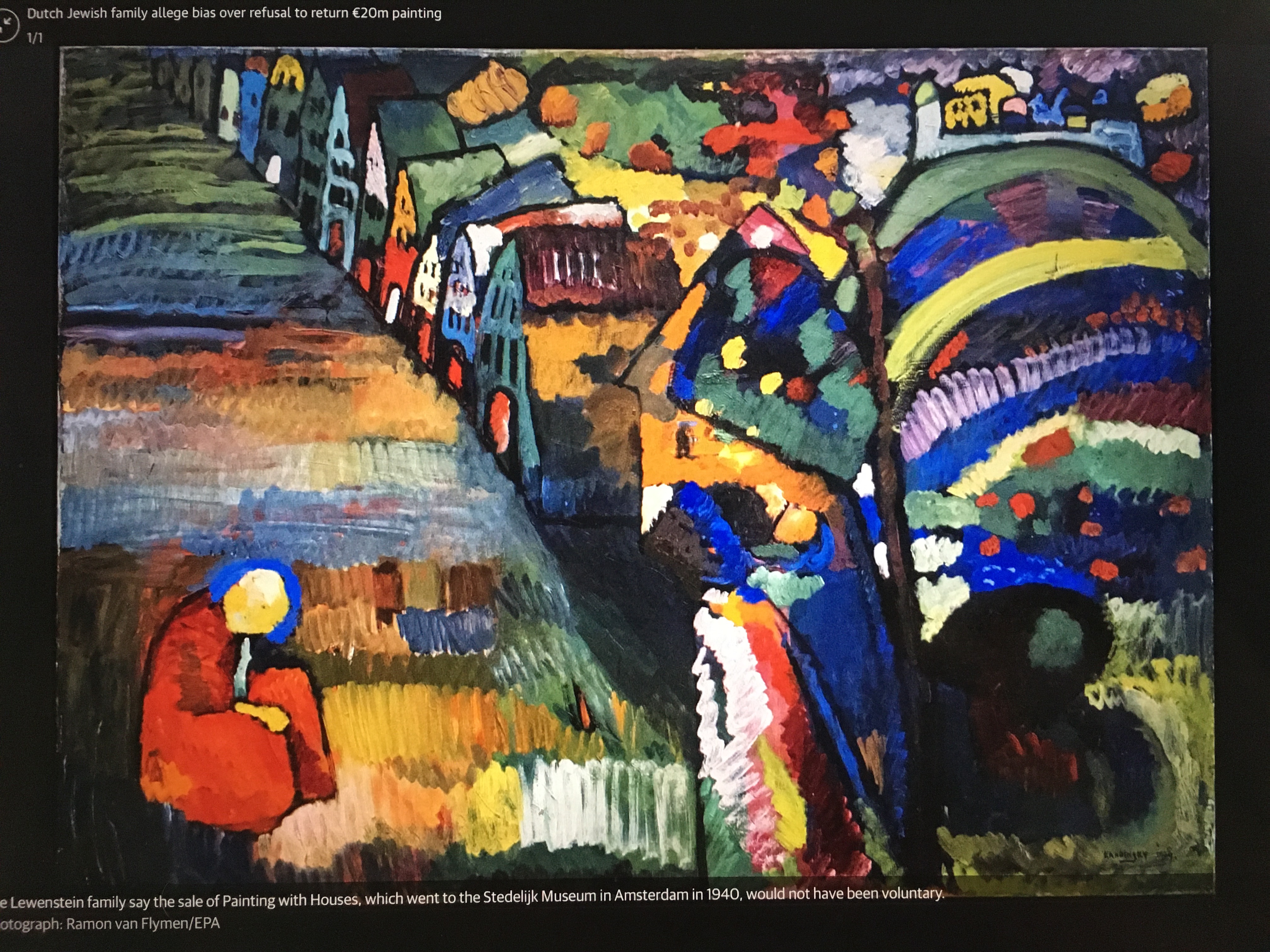
I’ve lost the article from which I clipped this painting — something about vicissitudes and provenance.

No matter, the painting is the thing. It trips and snares me. It’s like a knotty, naughty doodle done with psychedelic syrups from a candy store explosion. Its perfervid figuration is impudent, wickedly nonchalant.

This terrain traversed by the artist on his way to the further reaches: I could stuff my eyes with it.

(c) 2020 JMN

Posted in Commentary | Tagged , , | Leave a comment