

This gallery contains 1 photo.
(c) 2020 JMN

I like this picture.


(Adam Popescu, “There’s a New Artist in Town. The Name Is Biden,” NYTimes, 2-28-20)
(c) 2020 JMN

The NYTimes published, then repudiated, an Op-Ed piece by a Republican senator urging deployment of active-duty troops to quell looting and rioting that intruded upon mostly peaceful protests. Bret Stephens disagrees with the politician’s incitement, but says it was proper for the NYTimes to publish it.
Stephens does not stick his landing, I’m afraid.
The value of Cotton’s Op-Ed … lies in the fact that Cotton is a leading spokesman for a major current of public opinion… To claim that his argument is too repugnant for publication is to write off half of America…
We… have an obligation to keep undeniably hateful ideas, like Holocaust denial or racism, out of the editorial pages [my bolding]… But serious journalism… cannot survive in an atmosphere in which modest intellectual risk-taking or minor offenses against new ideological orthodoxies risk professional ruin.
(Bret Stephens, “What the Times Got Wrong,” NYTimes, 6-12-20)
Stephens says there are “undeniably hateful ideas, like Holocaust denial or racism” that should be banned from the editorial pages. But what if, say, half of America denied the Holocaust? Would a leading spokesman for this “major current of public opinion” then be entitled to a serious editorial platform? That seems like a slippery slope. Half of America, after all, defended slavery.
(c) 2020 JMN
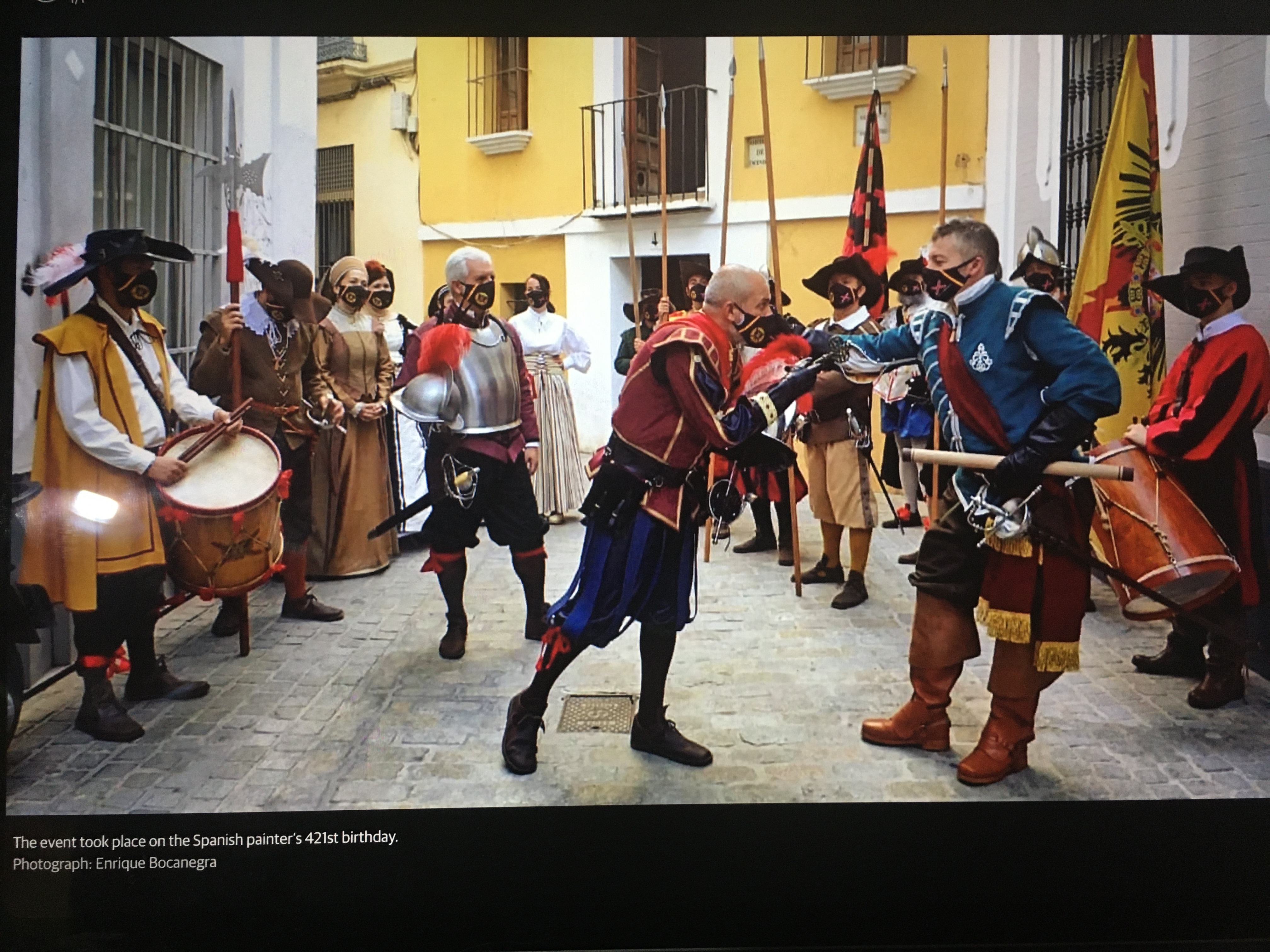
My enduring affection for Spain gets periodic boosts from ceremonies such as this.
On June 6, 2020, a group of Spaniards staged a reenactment of Velazquez’s famous “Surrender of Breda” to commemorate the event itself in the Dutch war of independence as well as the painter’s 421st birthday on June 5.
It was staged a day after the anniversaries, outside the mid-16th-century house where Velázquez was born, and which is being turned into a learning centre and museum dedicated to the artist and his life.
Masks were worn and numbers of persons kept to a minimum in respect for the coronavirus.
Enrique Bocanegra, a journalist and author, is behind a project to restore Velazquez’s birthplace after being inspired by a visit to William Shakespeare’s home in Stratford-upon-Avon.
“We’re just waiting for permission to start the restoration works and we’re hoping to begin later this month,” said Bocanegra. “We’re going to start with the roof but the problem with renovating a 16th-century house is that it’s like opening up a melon – you just never know what you’re going to find inside.”
(Sam Jones, “Veláquez painting brought to life by historical reenactment group in Seville,” theguardian.com, 6-7-20)
(c) 2020 JMN

Violence and gore, revolting and horrific in real life, are revolting and banal in the movies. What’s horrifying is how hard it is to find good horror in entertainment. Edward Tew chainsaws cleanly through the halitosis:
A lot of genre film-makers lazily assume that violence and gore will scare people the most but it never seems to work that way. Atmosphere, dread and the power of suggestion are much more disturbing and this underseen movie deftly uses all three to palm-sweating effect. It feels grounded in reality by refusing to go over the top.
“Creep” is a 2014 film from Blumhouse with Patrick Brice and Mark Duplass. It’s on Netflix in the U.S. and UK.
(Edward Tew, “My streaming gem: why you should watch Creep,” theguardian.com, 6-8-20)
(c) 2020 JMN

“What everybody is talking about right now is, what happened to pneumonia?” he said. “What happened to a lot of deals, a lot of common flu deaths, why is everything being reported Covid now?… We’ve heard that hospitals are getting reimbursed more for Covid cases…”
Perhaps Mr. Brown sensed that I was skeptical. “Right now you’re located in Texas, you’re in North Texas, you’re in the Bible Belt,” he told me. “So people around here have a different philosophy than a lot of people in New York.” Mr. Brown paused for a moment, holding my eyes with a practiced earnestness. “I’m just being honest.”
(Elizabeth Bruenig, “Death and Texas,” NYTimes, 6-5-20)
We Texans often have to remind visitors of where they’re located and where they’re from. It’s a kind of forgetfulness we cure them of with our honesty.
(c) 2020 JMN
Check out this video on YouTube:
“Because it spans a very windy gap across the Bay, the Golden Gate Bridge is now effectively a giant orange wheezing kazoo.”
Citizens have weighed in disparately:
— Can someone explain me why is this eerie sound has been going on for an hour…
— So peaceful…
— So crazy but also kinda beautiful!!…
— We can hear this in our house more than three miles away from the bridge. It’s crazy making…”
Bridge spokesperson Paolo Cosulich-Schwartz has spoken knowingly:
“The new musical tones coming from the bridge are a known and inevitable phenomenon that stem from our wind retrofit project during very high winds… We knew going into the handrail replacement that the bridge would sing during exceptionally high winds… We are pleased to see the new railing is allowing wind to flow more smoothly across the bridge.”
The Guardian has analogized interestingly:
The noise is not the first time a suspension bridge’s physical qualities have raised eyebrows. Central London’s Millennium Bridge, for example, closed days after it opened in 2000 because of dramatic swaying. It reopened a year and a half later.
And I have decided conclusively:
If my choice is to cross a musical bridge or a kinetic one, I will choose the giant wheezing kazoo every time.
(Victoria Bekiempis, “‘A giant wheezing kazoo’: Golden Gate starts to ‘sing’ after design fix,” theguardian.com, 6-6-20)
(c) 2020 JMN
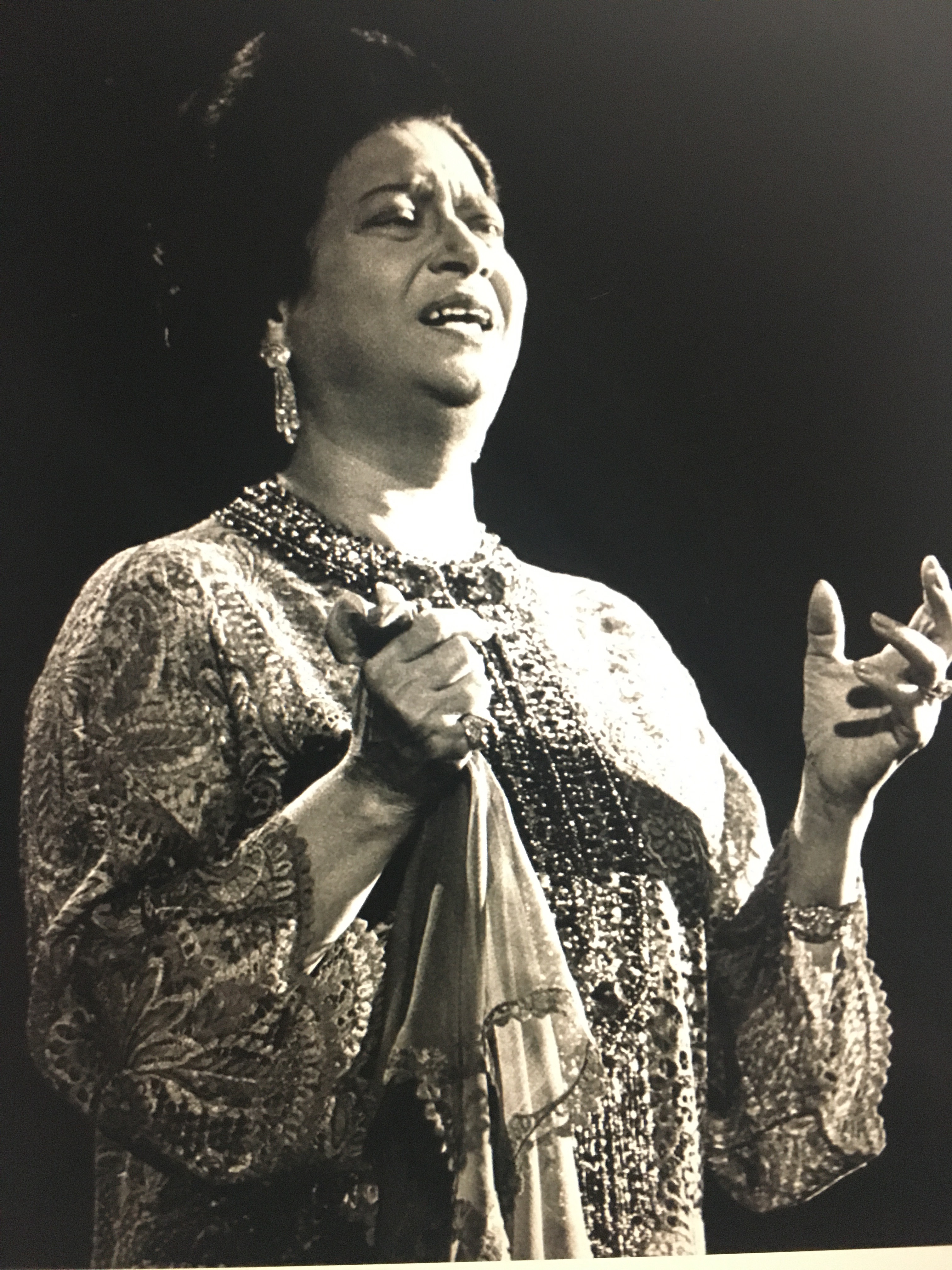
Umm Kulthum died in 1975. I had a passing acquaintance with the singing of this venerated Egyptian artist, but knew nothing of her life. I learn from this article by Tom Faber that Umm Kulthum’s singing was admired by western performers such as Maria Callas, Bob Dylan, and Robert Plant.
I also learn that her biographer Virginia Danielson, an ethnomusicologist, mentions Umm Kulthum’s “possible lesbianism,” saying that she showed little interest in men: “It is very, very likely she had relationships with women.”
Such discussions can be bumpy, and more so concerning deceased idols who span culture divides.
She is not a feminine singer, not at all. Her face lacks the prettiness appropriate to a woman’s face, and her lungs are extraordinarily large. Her breasts are massive, true; but her neck is thick as it encases her enormous throat. She draws, too, because her voice encompasses more than one sex, soaring high as the dome of the womb and falling as low as the well of the testicles. Her voice is saltiness and sweetness: an asexual voice, but a bisexual one, too. The lyrics to her songs are in a masculine voice, but one that encompasses the feminine.
The above remarks by Lebanese novelist Hoda Barakat are quoted by Iraqi writer Musa Al Shadeedi in the Jordanian LGBT magazine My.Kali referenced by Faber. The mention of Umm Kulthum’s possible lesbianism caused the Jordanian government to block the magazine’s website. Al Shadeedi’s comments reflect both temptation and reluctance to probe Umm Kulthum’s rejection of traditional gender roles.
“We don’t talk about strong or masculine women in our history… We only discuss [Umm Kulthum] as a singer… I don’t see how dragging dead people out of the closet will fix our society today… But we can ask: if she was lesbian, would that change how we see her? This might help people reconsider how they react to such taboos.”
In terms of reactions to such taboos, astonishing in its way is that of Columbia literature professor Edward Said, the Palestinian-American author of “Orientalism.”
“During her lifetime, there was talk about whether or not [Umm Kulthum] was a lesbian, but the sheer force of her performances of elevated music set to classical verse overrode such rumours.”
The remark is cited by Al Shadeedi from Said’s “Homage to a Belly-Dancer” in the London Review of Books (September 13, 1990). It is an extended tribute to Tahia Carioca. As Said warms to his subject, he makes this comment (not quoted by Al Shadeedi):
Whereas you couldn’t really enjoy looking at the portly and severe Um Kalthoum, you couldn’t do much more than enjoy looking at fine belly-dancers, whose first star was the Lebanese-born Badia Massabni, also an actress, cabaret-owner and trainer of young talent. Badia’s career as a dancer ended around World War Two, but her true heir and disciple was Tahia Carioca, who was, I think, the finest belly-dancer ever.
His remarks suggest that lesbianism and belly-dancing occupied two widely separate rungs of Professor Said’s sensibility.
(Tom Faber, “‘She exists out of time’: Umm Kulthum, Arab music’s eternal star,” theguardian.com, 2-28-20)
(c) 2020 JMN

Life in these United States leads to comfort where you can find it: In this case, the theory by police that this is an isolated killing and not a spree killing.
Seven adults were found shot dead last night, June 4, 2020, in Valhermoso Springs, Alabama, near Huntsville. (“Valhermoso” means “pretty valley.”)
Four dead men and three dead women had multiple gun-shot wounds in a single-level, ranch-style residence. (Ranch-style homes became popular in the 1950s as a post-war white middle class settled into leafy suburbs around the country.)
“We believe it is an isolated, and not a spree, killing,” said a spokesman for the sheriff’s office.
“It is a horrific scene,” said the county coroner, but there is more comfort from police: It’s thought there is “no immediate threat to the public in the area.”
So: Not a spree killing — they’re of the worse kind — and no threat to the public in the area that could be deemed immediate; that tracks as good news in these United States.
(Christine Hauser, “7 People Dead in Alabama Shooting, Police Say,” NYTimes, 6-5-20)
(c) 2020 JMN
 EthicalDative
The Opposite of Death
The sweetest, life-affirming eruption of ebullience I’ve encountered today comes from Jon Stewart. The subject is his learning to play drums in middle age.
[Interviewer] Do you make sure to practice your rudiments and paradiddles?
I have a teacher, and I do my paradiddles and my rudiments, and then we throw a James Brown song on there. Suddenly I’m Stubblefield. [NYTimes note: The drum legend Clyde Stubblefield was a key — maybe the key — component of James Brown’s band from 1965 to 1970.] When I get my left foot to do a thing independent of my right hand — it’s the opposite of death [my bolding]. You don’t get that feeling as much when you’re older. I also get to be present in my life. When I became less myopically focused, things became more fulfilling.
(David Marchese, “Jon Stewart Is Back to Weigh In,” NYTimes, 6-15-20)
(c) 2020 JMN