A page from Lyndon Johnson’s senior year college yearbook. Credit… Corbis, via Getty Images.
The “club” of Sarah Vowell’s title is clarified in the subtitle of this article: “They’re the graduates of public universities, and they’ve stepped into the void of presidential leadership.”
President Lyndon Johnson was a graduate of Southwest Texas State College in San Marcos, now named Texas State University. He signed the Higher Education Act of 1965 there, landmark legislation which “provided colleges funds for teachers, equipment and libraries, and offered needy students Pell grants, loans and jobs in the work-study program.”
“This is a proud moment in my life,” Mr. Johnson said that day. “I am proud to have a part in the beginning that this bill provides, because here a great deal began for me some 38 years ago on this campus… I worked at a dozen different jobs, from sweeping the floors to selling real silk socks. Sometimes I wondered what the next day would bring that could exceed the hardship of the day before. But with all of that, I was one of the lucky ones — and I knew it even then.” He urged the students and faculty before him, “You should carry the memory and the meaning of this moment with you throughout your life.”
(Sarah Vowell, “Joe Biden and the Great Leaders of 2020 Are Part of a Club,” NYTimes, 8-13-20)
The philosopher Isaiah Berlin once said he occupied the “extreme right-wing edge of the left-wing movement.” If that’s good enough for Isaiah Berlin, it’s good enough for me.
(David Brooks, “This Is Where I Stand,” NYTimes, 8-13-20)
The poem is “Entire Known World So Far” by Carl Phillips (Poetry, July/August 2020).
I share thoughts about my readings with a correspondent who returned the following in email:
The part of the poem you copied out – where it talks of the wind, I had pictures in my mind of clouds with faces of puffed out cheeks blowing a ship along, as to be found in children’s books, but nothing, no nothing, came to mind with stags at the helm. I did like the sudden zoom-in to a dog’s underpaw though. I can see why poetry bewilders so many people and puts them off from engaging with it. It is not clear what is expected of the reader, there is a great anxiety of not getting it and being stupid, but also distrust at being thought stupid. Also laziness and an unwillingness to engage with things we don’t know what they are immediately. It is amazing how poetry has continued with all this against it! If you discover more about the stag, let me know.
Here is the part of the poem I copied out:
What’s meant to be wind emerges from what’s / presumably a god’s mouth, as if people / thought that way, once, as I have read they did, / though I have never believed it. Yes, / the stag inexplicably there on a raft / at sea, how the light catches in the runneled / fur of a dog’s underpaw as he steers / across dream; yes, the gods and their / signs if you want everywhere — // but the wind is the wind.
My correspondent says succinctly what I create pretentious language to skirt — that most of the poems I am reading in Poetry (the magazine) lose me in varying degrees — leave me feeling fallen flat, left out, perplexed, unfulfilled.
I only know to keep letting it happen and to question how and why poets do this, then to distill my baffled gleanings in evasive blog posts along the way.
The poem says other things and ends with this:
But the world is not like a human body. // Or the dark that, just past twilight, overtakes a canyon. // Or the shiver of sleigh bells on the collar / of an invisible donkey scratching itself / in the dark, / in the cold of it — // donkey bells…
The ending ellipsis is the poem’s, not mine. I’ve discovered nothing more about the stag, by the way.
A line of people in June seeking help in Kentucky with their unemployment claims. Credit… Bryan Woolston/Reuters.
… The working-class emphasis is the only way out of the demographic doom loop. If the party sticks with its old white high school-educated base, it will die. They just aren’t making enough old white men. To have any shot of surviving as a major party, the G.O.P. has to build a cross-racial alliance among working-class whites, working-class Hispanics and some working-class Blacks.
(David Brooks, “Where Do Republicans Go from Here?” NYTimes, 8-7-20)
The first bearded vulture born among the crags of Spain’s Picos de Europa mountains in 75 years has left the watchful gaze of her parents and taken to the sky.
The chick, named Bienvenida (Welcome), was born in March to Deva, a 10-year-old female, and and Casanova, a 13-year-old male. … The bird is known in Spanish as the quebrantahuesos, or bone-breaker, because of the way it drops bones from a great height so they shatter and yield their marrow.
(Sam Jones, “Rare bearded vulture chick born in Picos de Europa flies the nest,” theguardian.com, 8-6-20)
“Rare” because the bird has been hunted to near extinction, as men will do.
The poem is “A Gazetteer of the Backyard (In Which Pedanius Dioscorides Takes Stock”) by Sylvia Legris (Poetry, March 2020).
It’s a Pernambuco of a backyard.
Over a span of dogged spells with this rhapsody of nature-naming I hit upon the expedient of looking up and listing terms novel to me, which were legion. It was to be a praise act with which to needle the sprawl of what this is. I gave up on that, it spread me too thin. But I do admire Legris’s achievement. I do feel taken for a ride.
The poem is divided into 3 parts with uppercase titles:
PART 1. UPROOTED THE EARLY SKY PART 2. A PERENNIAL SAGA (BEFORE THE BLUE LAKE BUSH BEANS, THE BOLERO HYBRID CARROTS, THE MAESTRO PEAS, THE RUBY QUEEN BEETS) PART 3. ASCLEPIADS
Here’s a taste:
Perseids seed the 3b hardiness zone. A zone of zahara starlight zinnias. Double clusters and heliotropes, sunflowers under Swift-Tuttle showers. Orbits of high heaped cloudberries. A royal poet of a sky! … My rows bode bad with wode whistle, cheatgrass, bad man’s oatmeal and yolky toadflax — a blunder garden! The missteps, the false alyssum, the prolifically prolix knapweed… a pervasive invasive creep. Taproots tapping my optimism. … Gardens of orthic dark brown soil. Calcareous dark brown. Eluviated dark brown. Humic gleysols… Gardens of nearly level topography. Of topography gently sloping or roughly undulating. Moderately sloping or gently rolling. Strongly sloping or moderately rolling. Steeply sloping or strongly rolling. … What I wish you could see in this crudely rendered drawing…
A metrical line from plant to poet to the god of physicians. A geology of medicine and herb. Not companion planting but conviviality. Plants doting on stones, metals smitten with flowers.
The Kunsthaus Bregenz in western Austria exhibits “Unprecedented Times,” comprised mostly of works produced by artists as the virus spread and they sheltered in place this year.
“Grita” (2010) by Markus Schinwald. Credit… Markus Schinwald/Artists Rights Society (ARS), New York and Bildrecht, Wien.
The only work created pre-pandemic is by the Austrian artist Markus Schinwald, who for years has modified 19th-century portrait paintings by adding accessories to their subjects — often fictional prosthetics such as fake noses, but also fabric masks. The elegantly masked “Grita” and “Meron” now seem eerily prescient.
“Meron” (2008) by Markus Schinwald. Credit… Markus Schinwald/Artists Rights Society (ARS), New York and Bildrecht, Wien.
… “Unprecedented Times” highlights the anxieties and uncertainties of life in a pandemic. Boredom, doubt, and isolation weave through the works, some of which also offer glimpses into how artists produce under pressure.
(Kimberley Bradley, “What Worried Artists in Lockdown? The Same Things as Everyone Else,” NYTimes, 8-5-20)
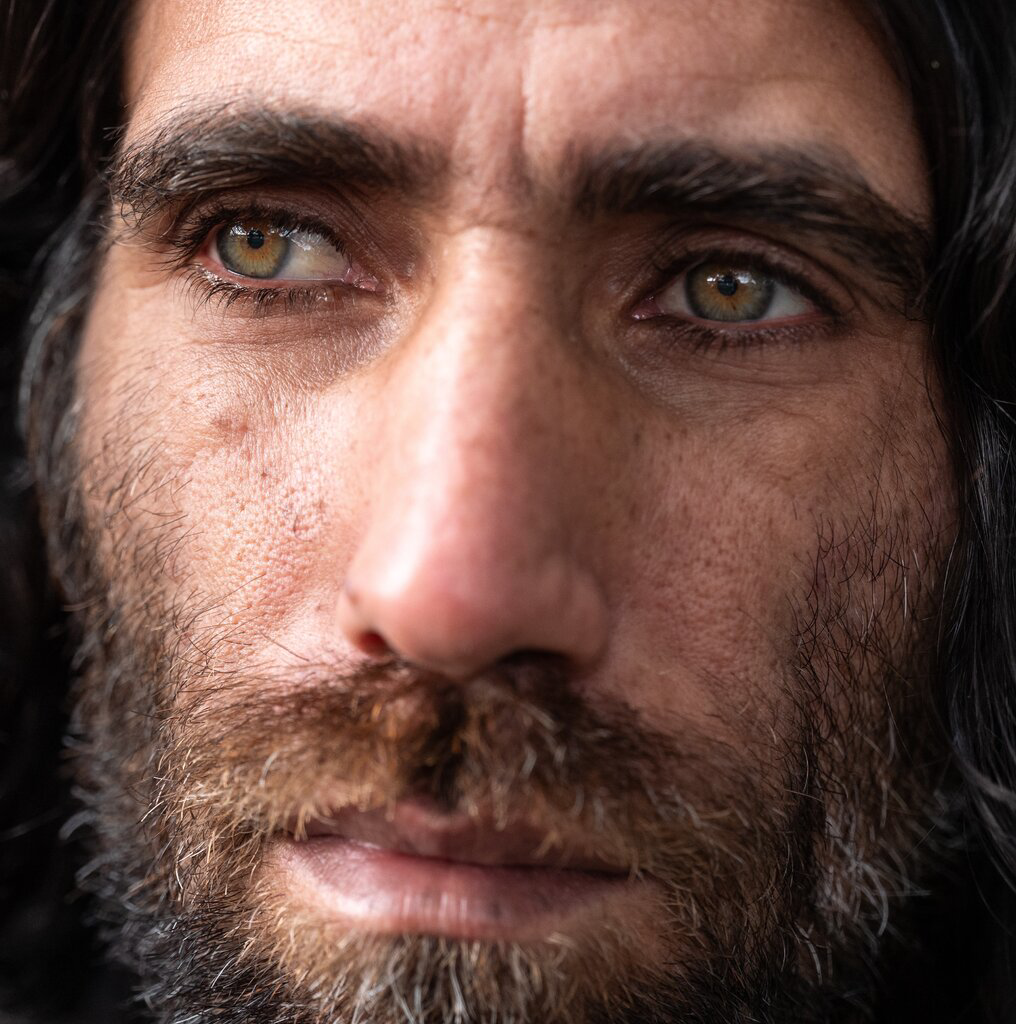
Behrouz Boochani’s book, “No Friend but the Mountains,” won the prestigious Victorian Prize for Literature in 2019 while he was still detained on Manus Island. Credit… Birgit Krippner for The New York Times.
Behrouz Boochani wrote his book with desperate means from imprisonment in a brutal Australian camp for migrants. A collaborator from outside who helped assemble the book terms it a work of “horrific surrealism.”
Boochani’s book challenges readers to acknowledge that we are living in the age of camps. The camps lie scattered throughout the Middle East, cluster on Greek islands and stretch like an ugly tattoo along the U.S.-Mexican border. Camps sprawl through Bangladesh, Chad and Colombia. People are suspended in a stateless and extralegal limbo on the tiny Pacific island nation Nauru, in Guantánamo and in the Syrian town of al-Hawl. At no time since humans first drew borders have there been more migrants and refugees than today. Countless individual lives weave into a collective panorama of displacement and statelessness and detention. These truncated journeys are a defining experience of our times.
The pandemic is giving many of us — confined, restricted, bored, afraid, angry, deprived, hungry, ill, depressed, domiciled if we are lucky — the taste of a “defining experience of our times”: carceral encampment.
(Megan K. Stack, “Behrouz Boochani Just Wants to Be Free,” NYTimes, 8-4-20)
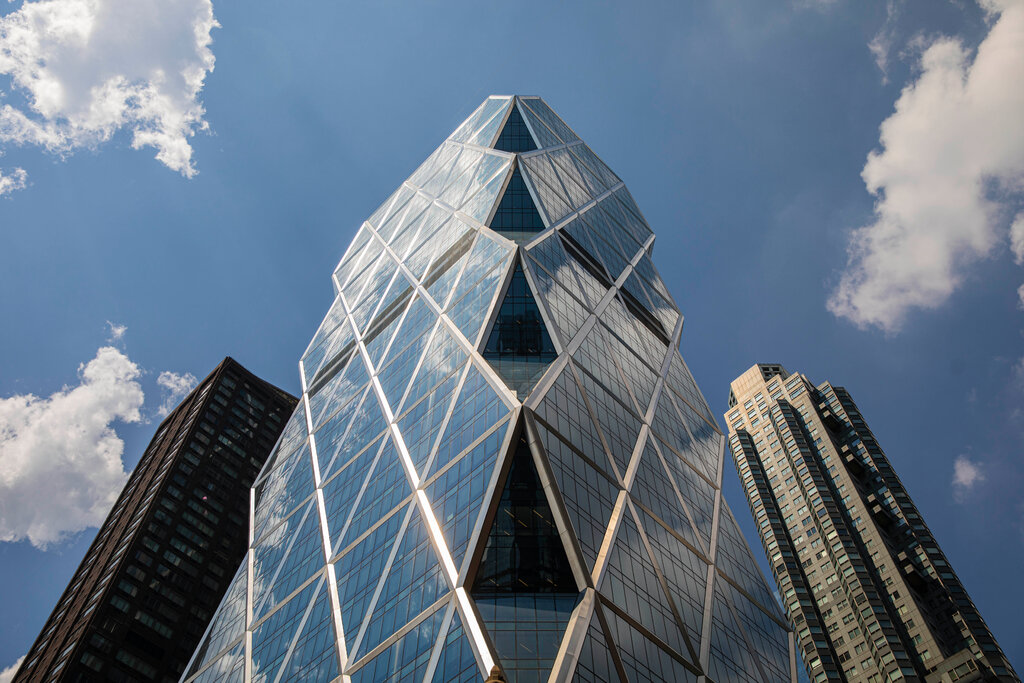
The Hearst Tower in Manhattan. As media companies go, Hearst Communications is discreet, without the public dramas of its more glamorous rival, Condé Nast. Credit… Hiroko Masuike/The New York Times.
Mr. Young, who did not reply to email inquiries for this article, previously told The Times that the accusations against him were “either untrue, greatly exaggerated or taken out of context.”[My bolding]
This type of assertion is oddly chinky and incriminating. It purports to profess innocence without actually doing so — as if hoping no one will notice.
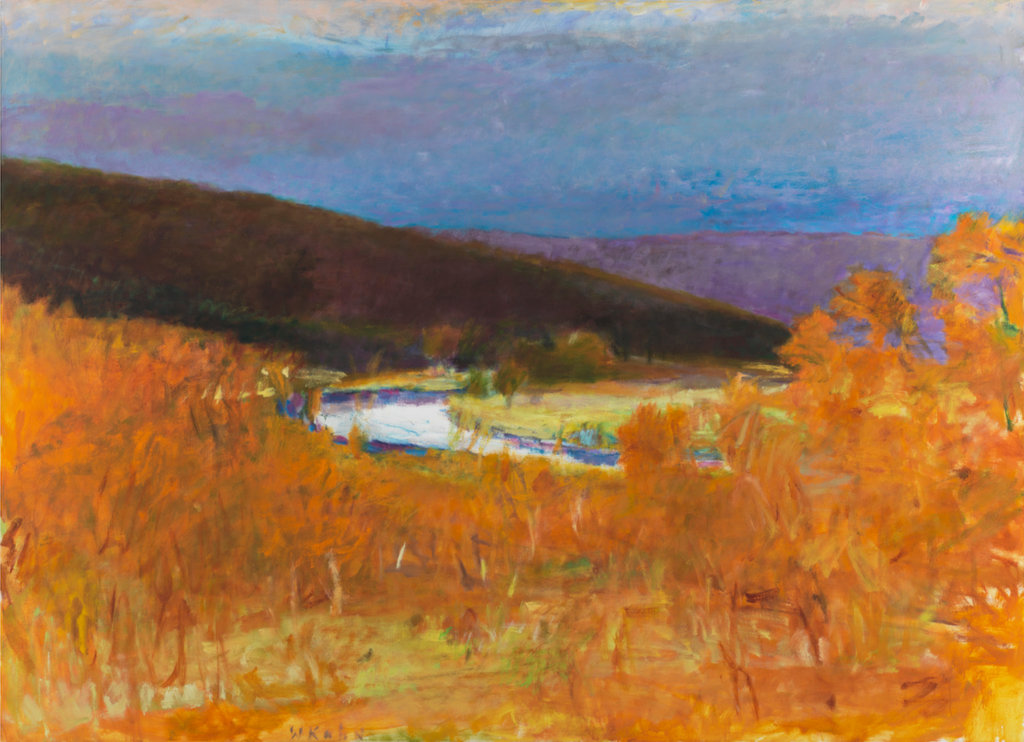
Mr. Kahn’s “Difficult to Enter” (oil on canvas, 2019). “My choice of color,” he said, “is dictated by tact and decorum stretched by an unholy desire to be outrageous” [my bolding]. Credit… Wolf Kahn/Miles McEnery Gallery.
“Stretched by an unholy desire to be outrageous.” More than I care to admit, my pleasure in reading art criticism can amount to quivering at a splash of brandished lingo. I also quiver to Kahn’s paintings, which remind me of English Midlands landscape.
“These are not colors that sunlight finds in nature; they are colors that an aroused sensibility finds, with joy, in the act of painting.” (Peter Schjeldahl, quoted in the article)
“The Lamoille River at Ten Bends” (oil on canvas, 1990). Credit… Wolf Kahn/Miles McEnery Gallery.
“The paint spills and runs,” The New York Times wrote of [Kahn’s first solo show in 1953], “color crackles with vivacity and the brush might just as well have been guided by a tornado as by hand. Yet this is no manner for manner’s sake. Kahn is a high-spirited, lyrical artist who paints the way he does because a leonine manner seems to fit exactly his response to what he sees.”
As one who often treats the easel as a place to attack visual problems, I note the “leonine” manner that responds to the seen rather than trying to dominate it.
“Thicket II” (oil on canvas, 1996). Credit… Wolf Kahn/Miles McEnery Gallery.
In an interview with the gallerist Jerald Melberg in 2011, [Kahn] described working on a painting in Italy in 1963, trying to create a modern-day version of van Gogh walking through an Italian landscape.
“I kept moving the figure,” Mr. Kahn said. “First it was here. Then it was there. And then finally I put it over here. Then finally I painted it out altogether.”
“As soon as I painted the figure out, I was happy,” he added. “Because I felt free.”
(Neil Genzlinger, “Wolf Kahn, Who Painted Vibrant Landscapes, Is Dead at 92,” NYTimes, 3-24-20)








Mother Power
The “club” of Sarah Vowell’s title is clarified in the subtitle of this article: “They’re the graduates of public universities, and they’ve stepped into the void of presidential leadership.”
President Lyndon Johnson was a graduate of Southwest Texas State College in San Marcos, now named Texas State University. He signed the Higher Education Act of 1965 there, landmark legislation which “provided colleges funds for teachers, equipment and libraries, and offered needy students Pell grants, loans and jobs in the work-study program.”
“This is a proud moment in my life,” Mr. Johnson said that day. “I am proud to have a part in the beginning that this bill provides, because here a great deal began for me some 38 years ago on this campus… I worked at a dozen different jobs, from sweeping the floors to selling real silk socks. Sometimes I wondered what the next day would bring that could exceed the hardship of the day before. But with all of that, I was one of the lucky ones — and I knew it even then.” He urged the students and faculty before him, “You should carry the memory and the meaning of this moment with you throughout your life.”
(Sarah Vowell, “Joe Biden and the Great Leaders of 2020 Are Part of a Club,” NYTimes, 8-13-20)
(c) 2020 JMN