This late-February news item, which is ancient now in pandemic time, struck me as emblematic of a longer-running rhetorical contagion infecting mass communication: the incitement by vested or corrupt interests to a leap of ignorance rather than to informed prudence.
Belgian prosecutors have issued an alert over a woman who died after taking a sip of wine from a bottle suspected of being used to transport the drug MDMA… The original bottle has a black cork with the Black & Bianco logo,” the prosector said. “The bottle found had a different cork…” The owner of the company told the Dutch broadcaster Omroep Brabant there was no reason to think more bottles had been manipulated.[my bolding]
(Daniel Boffey, “Belgian woman dies after taking sip of MDMA-laced wine,” theguardian.com, 2-27-20)
Where death, literally, can be the wage of supposition, what responsible merchant urges potential consumers of his product to suppose that, out of hundreds or thousands of similar bottles, only one was manipulated?
It’s a trick question, of course. No such merchant is responsible.
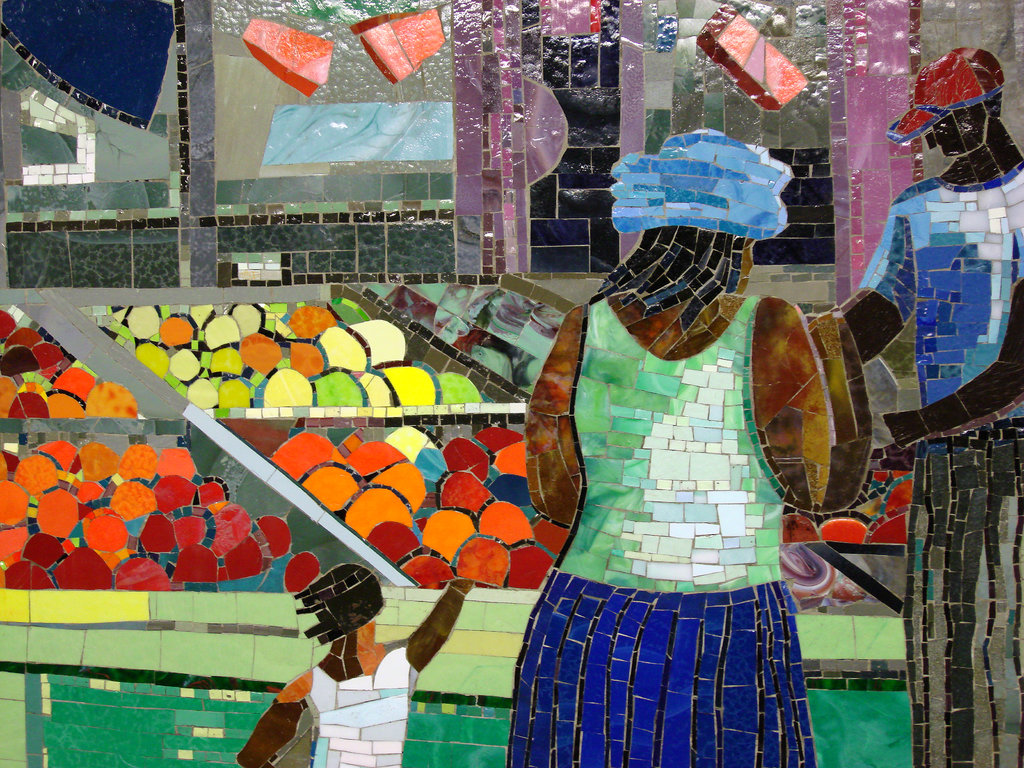
A detail from Louis Delsarte’s mural, “Transitions,” installed at the Church Avenue subway station in East Flatbush, Brooklyn. It depicts community life around the West Indian American Day Parade. Credit… Rob Wilson.
Mr. Delsarte moved out West for a time in the 1970s, painting murals in and around Laguna Beach, Calif., living on a commune and settling in Arizona…
Mr. Delsarte in 2018. “I try to elevate the spirit of man and the spirit of humanity,” he said. Credit… Djeneba Aduayom.
Long after he went back East, leaving his hippie days behind him, Mr. Delsarte retained that era’s gentle optimism and earnest belief in peace and love… But unlike many fancy-free hippies, Mr. Delsarte was rigorously productive, creating a large body of work over the decades.
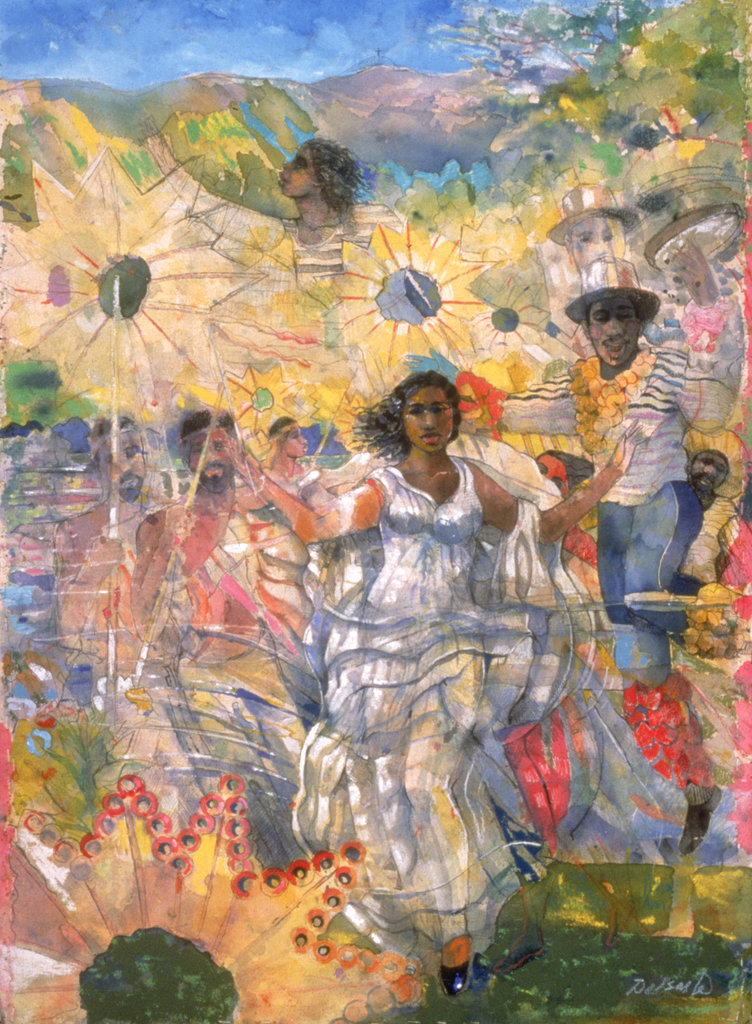
“Carnival,” a watercolor by Mr. Delsarte from 1976. Credit… Louis Delsarte.
In an interview in Time magazine in 2019, Mr. Delsarte offered this self-assessment of his work: “I try to work toward peace, to say that art is the meaning of love, that living on earth is a spiritual quest…”
(Steven Kurutz, “Louis Delsarte, a Muralist of the Black Experience, Dies at 75,” NYTimes, 5-15-20)
Rather than fostering some new sense of civic unity, the virus is just as likely to worsen inequality further [my bolding].
(Farhad Manjoo, “San Francisco Beat the Virus. But It’s Still Breaking My Heart,” NYTimes, 5-13-20)
Calling out infelicities of style is a chancy job. It makes a man thoughtful… and a little lonely. Some thoughts fly, some don’t. As my friend the helicopter pilot says, “It’s all a numbers game. You go up safe X times, come down safe X times. On good days X is even.”
“Worsen” repels furthering. Once worse, a thing’s augmented badness wants gauging with a different stick. Good style dictates a pivot to “increase.”
Saying the virus is just as likely to “increase” inequality works, because it introduces a spiraling potentiality for alpha-periphrasis around intensifiers such as “abysmal,” “abject,” and the ever-popular “apocalyptic.”
Wait. If inequality is trained now on apocalyptic levels, is “worsen…further” really out of bounds? I’m inclined to cut it some slack. America’s virus one-ups the rule book today.
The ending of a poem I’ve read recently goes thus:
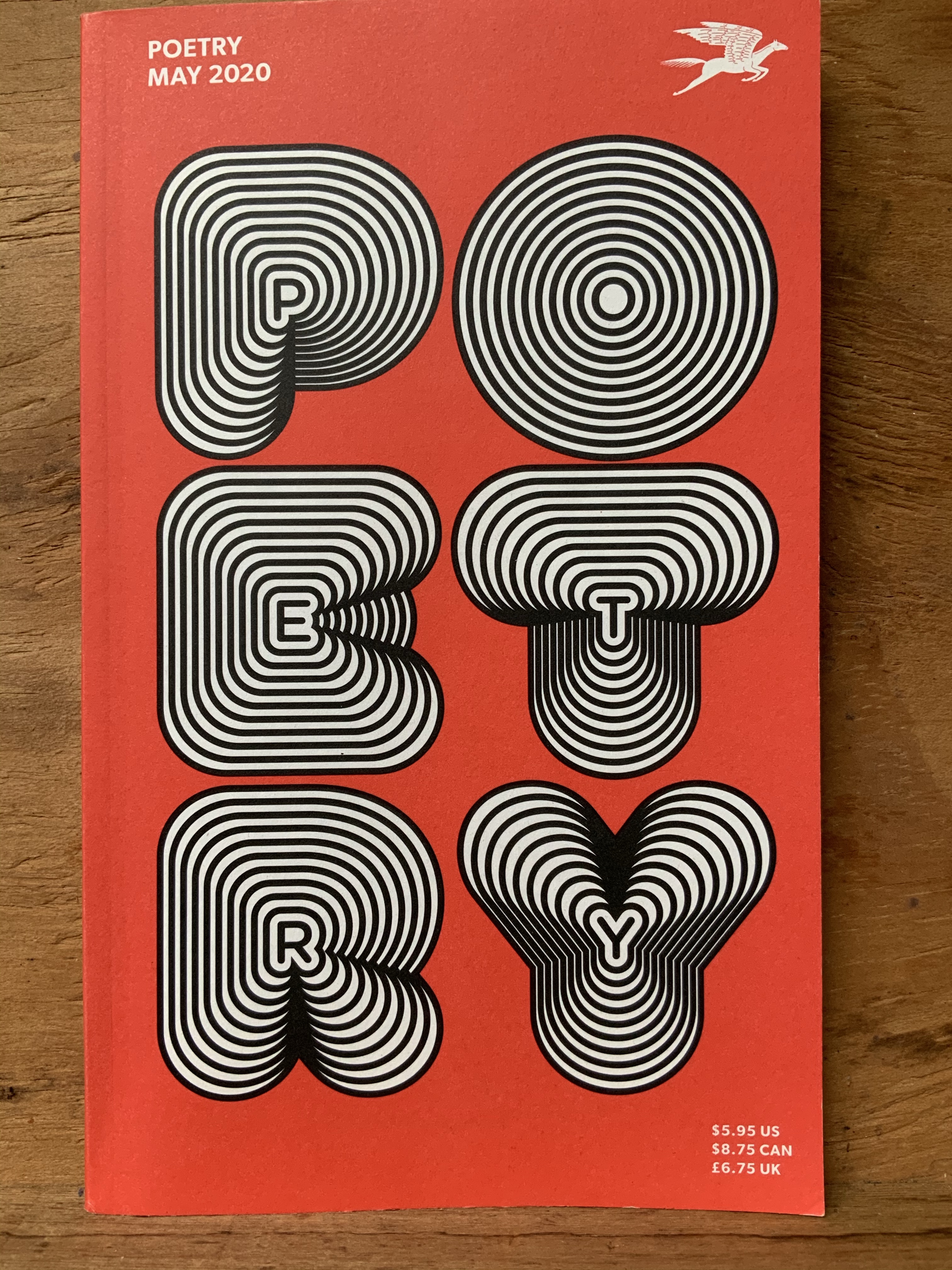
On the plus, foods in hispanophone kitchens taste richer when spoken. zanahoria for carrot. melocotón names peach. many cubans say fruta bomba for papaya. mitt romney once claimed he loves papaya on miami cuban radio, unaware it means pussy. que clueless, que jokes, when we speak before we know.
(Kyle Carrero Lopez, “(slang)uage,” Poetry, May 2020).
In the contributor notes Kyle Carrero Lopez is listed as a Black Cuban-American born and raised in North Jersey, now living in Brooklyn.
His poem titled “(slang)uage” pokes two fingers in the peepholes of all the o’graphical niceties — typo-, ortho-, lexico-, pepsico, et al. — that you rode in on. And what Romney said he loved is Cuban slang for snatch!
The poem sends me back to my kid culture, where we dreamed of taking a girl’s cherry. It would have been awesome at 14 to hear an old guy say he loved cherries, unaware it means virginity. Pussy traps for pinche interlopers. ¡jajaja!
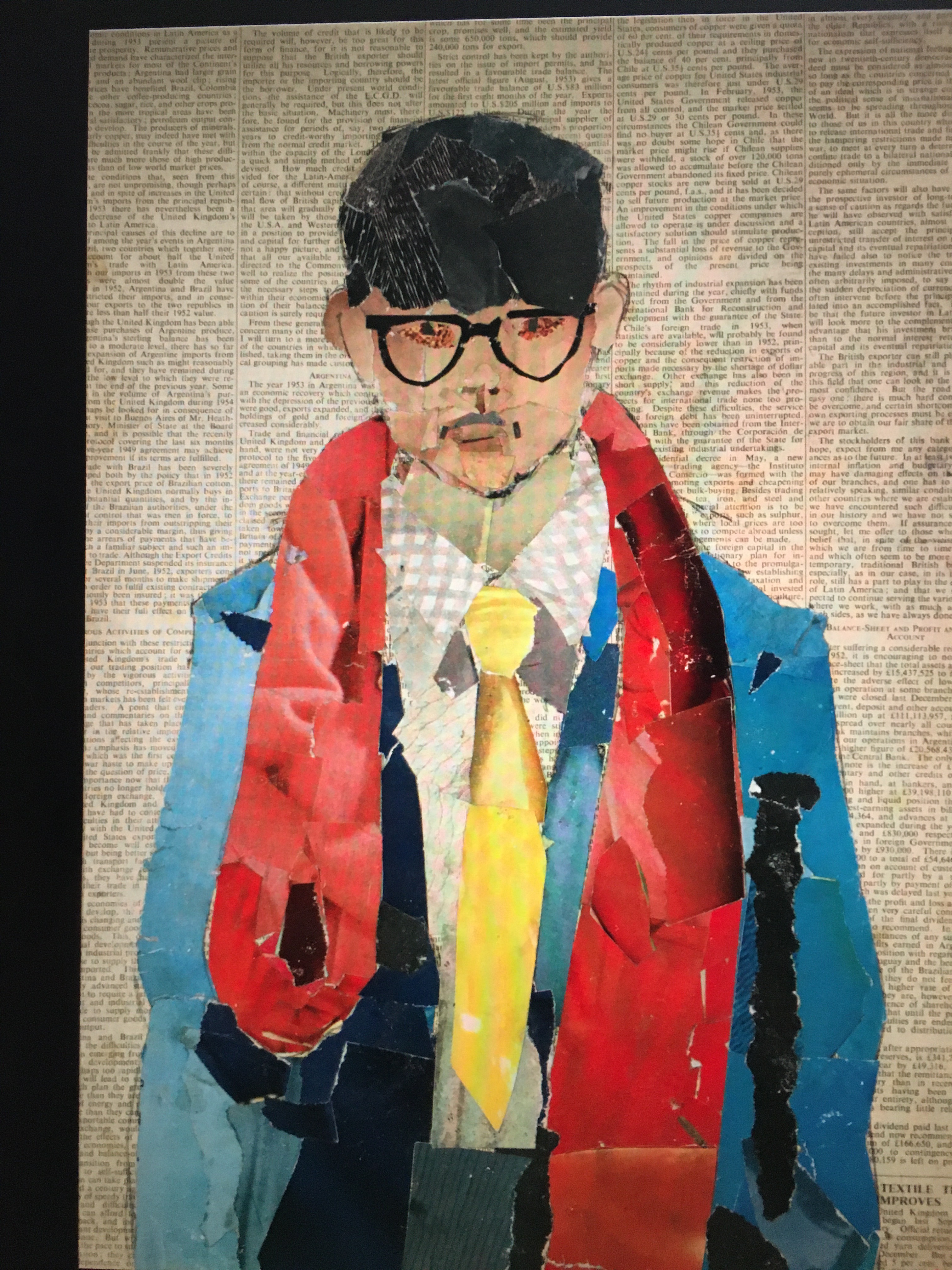
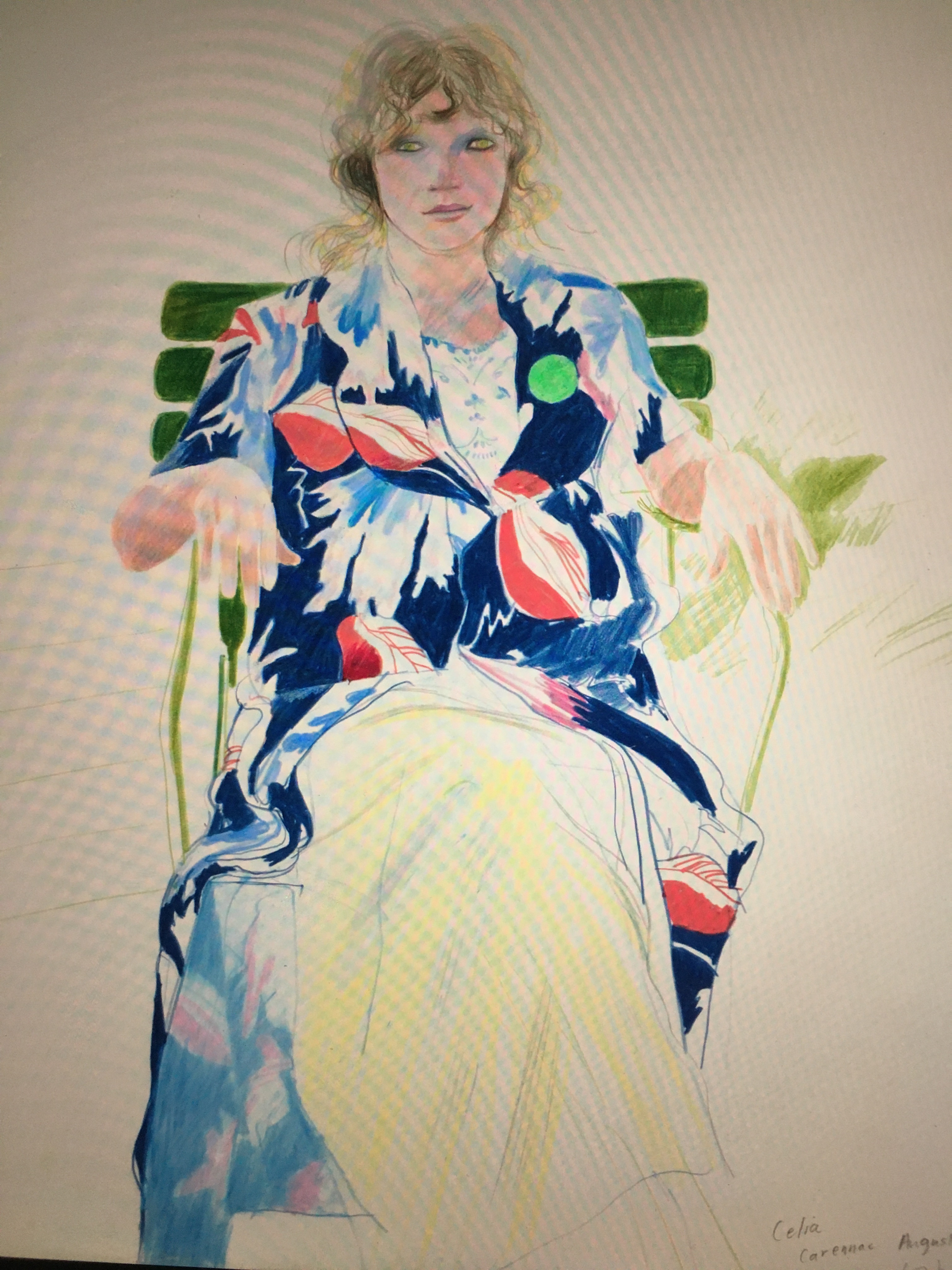
[Celia Birtwell] and Hockney have a fond and teasing relationship. She does a wonderful imitation of him and giggles at how he thinks he “discovered trees.”
(Hadley Freeman, “Hockney muse Celia Birtwell: ‘Nobody else has ever asked to draw me,’” theguardian.com, 2-25-20)
Nurses and National Health Service workers outside the Chelsea and Westminster Hospital in London last Thursday during the weekly “clap for carers” to honor their service during the pandemic. Credit… Andrew Testa for The New York Times.
Genesis Britons have… trusted in the N.H.S. since 1948, when it was created by a Labour government after World War II to forge a country that would eradicate the “five evils”: want, disease, squalor, ignorance and idleness.
Pantheon We all have respect for nurses, who are ‘angels,’ and doctors, who are ‘gods’ — that is the same as in lots of other countries… But here it is bound up with the institution they work for…”
Doctrine … While patients have little idea of the financial plumbing behind the scenes, they like the basic principle that “people who are ill should have access to high-quality care.”
Church “The N.H.S. is almost holy… It’s become the new Church of England.”
Hell … Most Britons tend to compare their system with America’s and recoil in alarm… “If you are not able to afford care in the U.S., you are often in a dire situation…”
(Stephen Castle, “‘The New Church of England’: Coronavirus Renews Pride in U.K.’s Health Service,” NYTimes, 5-12-20)
While I resist drawing lines between pornography and art, if forced to offer a distinction I might say that pornography, like propaganda, wants us to feel a single thing. Art is made of contraries, of ambivalence and ambiguity; it never wants us to feel a single thing. If I want the reader to be aroused by a particular scene, I also want them to be troubled by that arousal, to question or investigate it, to be moved by a more complicated pleasure.
(Garth Greenwell, “‘I wanted something 100% pornographic and 100% art’: the joy of writing about sex,” theguardian.com, 5-8-20)
Greenwell tickles me with gesturing at where porn and propaganda converge. Eschew not only obfuscation but also simplisticism. I like to echo him that porn and prop are univalent, and then to wonder why art, besides contrariety and ambiguity, isn’t made also of multivalence: multi- or “many,” after all, is more than ambi- or “both.”
However, ambivalence is an attribute of the observer — of his or her sentient or cognitive dimension — whereas multivalence is an attribute of the observed — of the sensed dimension. So which one makes art? It’s complicated — and there it is! — the troubling arousal.
Above, Hiroyoshi Chinzei, the owner and operator of Hidaka Washi, with the world’s thinnest paper. Credit… Kazuhiro Nogi/Agence France-Presse — Getty Images.
I’m glad to know about tengujo, the thinnest paper in the world, and to learn a bit about how it’s made. One of its numerous uses is in repairing and preserving old documents in places such as the Library of Congress, the Louvre, the British Museum and the Yale Center for British Art.
Paper deteriorates for many reasons: fungi, moisture, heat, light, atmospheric pollutants… With many Western writings before the 20th century, the ink itself was eating through the paper, in a process called iron gall ink corrosion.
Soyeon Choi is head paper conservator at the Yale Center for British Art, and has worked in the field for morel than 20 years.
Trying to aggressively mend a document is risky because long-term chemical and physical effects are highly variable and relatively unknown. “The more and more I am in this field, I feel that I should do less and less,” Ms. Choi said.
(Oliver Whang, “The Thinnest Paper in the World,” NYTimes, 5-5-20)
Ms. Choi’s comment evokes for me a kind of Hippocratic oath of conservatorship: First do no harm.
That’s the instruction that John McLaughlin recalls Miles Davis giving him. It was on the occasion of his being pressed precipitately into service to collaborate in Davis’s milestone album “Bitches Brew” recorded in August 1969.
“I just closed the score and started playing: no rhythm, no harmony, just playing the melody and casting my fate to the wind. He loved it… He would hit a couple of chords on the piano and say: ‘What do you hear? Do you hear a riff? A bass line?’
(Jim Farber, “‘It sounded like the future’: behind Miles Davis’s greatest album,” theguardian.com, 2-24-20)
Jim Farber’s article gives a taste of the bracing environment surrounding Davis’s project and of his interactions with fellow musicians. (I can say, ruefully, that I would be able to comply quite well with Mr. Davis’s instruction, but not as happily as John McLaughlin.)





 EthicalDative
Nor Reason Not to Think
This late-February news item, which is ancient now in pandemic time, struck me as emblematic of a longer-running rhetorical contagion infecting mass communication: the incitement by vested or corrupt interests to a leap of ignorance rather than to informed prudence.
Belgian prosecutors have issued an alert over a woman who died after taking a sip of wine from a bottle suspected of being used to transport the drug MDMA… The original bottle has a black cork with the Black & Bianco logo,” the prosector said. “The bottle found had a different cork…” The owner of the company told the Dutch broadcaster Omroep Brabant there was no reason to think more bottles had been manipulated. [my bolding]
(Daniel Boffey, “Belgian woman dies after taking sip of MDMA-laced wine,” theguardian.com, 2-27-20)
Where death, literally, can be the wage of supposition, what responsible merchant urges potential consumers of his product to suppose that, out of hundreds or thousands of similar bottles, only one was manipulated?
It’s a trick question, of course. No such merchant is responsible.
(c) 2020 JMN