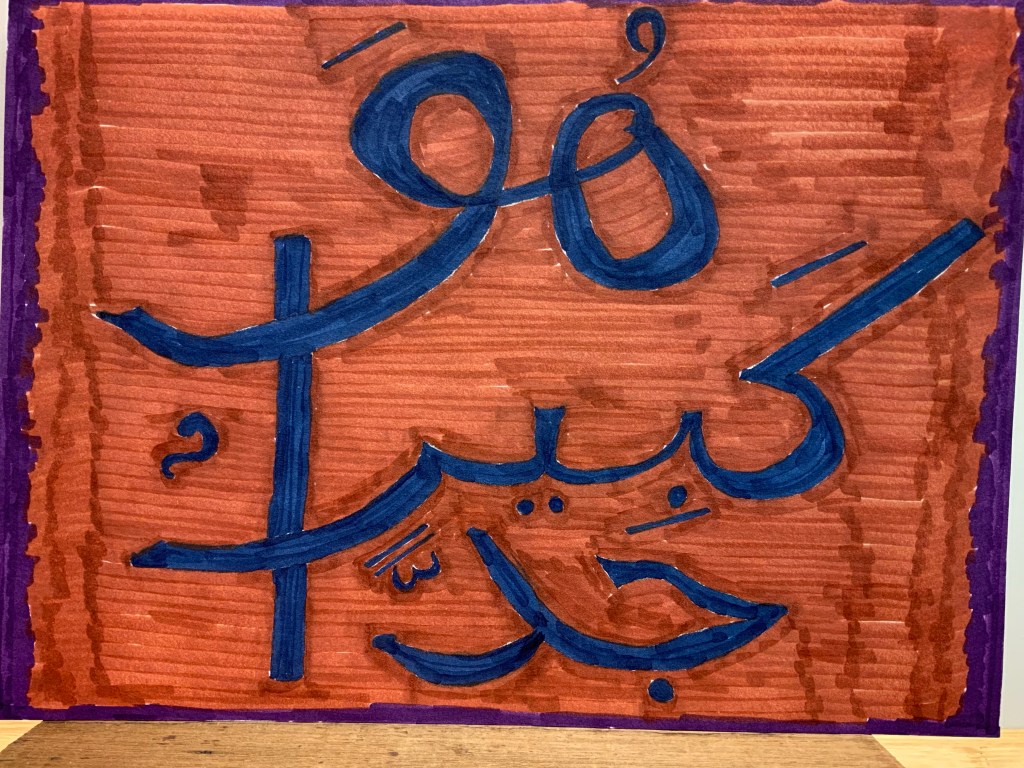
[fudīta bi-nafsī] puisses tu être racheté par mon âme ! (formule de politesse à l’époque classique) [“may you be redeemed by my soul!” (polite formula in the classical era)], Blachère, Grammaire de l’Arabe Classique, 1952.]
Consulting an Arabic dictionary involves looking up a word’s “root,” usually comprising three consonants. Words formed from the root are listed, with their translations, along with idioms in which the word occurs. What the root is may not be apparent on first blush, so lookup can entail a check of competing options. The roving linguist may glimpse, in passing, terminology that induces reflection. I wasn’t seeking it, for example, but I found [faDDa bakāra(t)a-hā], to deflower a girl.
[faDDa bakārata-hā]. to deflower a girl (Hans Wehr: A Dictionary of Modern Written Arabic, ed. J Milton Cowan, 2nd ed., 1966. It’s an “enlarged and improved version of Wehr’s Arabisches Wörterbuch für die Schriftsprache der Gegenwart published in 1952, including the author’s supplement.
The verb [faDDa] means to break or force open. The dictionary calls [bakāra(t)] virginity; other sources list maidenhead and hymen. As I see it, the phrase could be read as “to break the hymen.” The literal Arabic is plainspoken, at least, whereas the florid tropes of “deflowering” and “virginity” affixed to the phrase in Western culture (French défloration, Spanish desvirgar, etc.) are synonymous with despoilment — the sullying of purity. Compare it to the cliché in which a mature woman who initiates a bashful young male may be credited with “making a man of him.”
On the other hand, there are pleasant surprises such as [lā fuDDa fūka], how well you have spoken!
[lā fuDDa fūka] how well you have spoken!
It’s a passive use of [faDDa] which, depending on your choice of variant, might be translated literally: “your mouth [muzzle, orifice, aperture, hole, vent, embouchure, mouthpiece…] was not broken open [pried, forced, undone, snapped, scattered, dispersed, perforated, pierced…]. If pressed to provide a tonal equivalent for it, I might venture a Texan idiom such as “You ain’t just a-woofin’.” It would take a feel for Arabic which I don’t possess to know whether it struck the right note.
Detail, “Vexillophilia,” oil on canvas, 18 x 24 in. (JMN 2020)
Blachère (364) describes how Arabic expresses the “absolute superlative” — i.e., the uttermost degree of something, with no comparison:
Par des noms au cas direct indéterminé de valeur adverbiale dont le sens primitif est paroxysme, degré suprême, rendus en franç. par très, fort… [By certain nouns in undetermined accusative case with adverbial value whose primitive sense is paroxysm, supreme degree, rendered in French by “very,” “exceedingly”…]
“Grammaire de l’Arabe Classique (1952)
[jidd(an)] “seriously,” [gaAya-t(an)] “extremely,” and [nihaAya-t(an)] “finally.”
The three adverbs cited are: [jidd(an)] “seriously,” [gaAya-t(an)] “extremely,” and [nihaAya-t(an)] “finally.” Blachère’s example is: [huwa kabiYr(un) jidd(an)]il est fort gros [he is exceedingly big].
[huwa kabiYr(un) jidd(an)]il est fort gros [he is exceedingly big].
A variant could be: [kaAna gaAya-t(an) fiY-l-kibri], literally “he was of an extreme limit of bigness.”
[kaAna gaAya-t(an) fiY-l-kibri], literally “he was of an extreme limit of bigness.”
Since [gaAya-t(an)] shares a root with verb [gayyaY] meaning “to hoist a flag,” the barbarism “he was flag-hoistingly big” can be entertained, conveying a whiff of the affiliation between pushed limits and flags.
If you could meet any writer, dead or alive, who would it be? And what would you want to know? It seems to me that the author plays a kind of secondary role in this whole business of literature. Authors are generally less interesting than their books. After attentively reading a book you shouldn’t really have any questions for the author, aside from the most banal: Do they write in pen or on a laptop? Do they write in the morning or the evening? Do they prefer coffee or tea? Dogs or cats?
Do books serve a moral function, in your view? How so? I don’t know if I would call it a moral function, but literature definitely teaches empathy and compassion and how to see the world from other points of view. This is a great skill, and a gift that means those who read are smarter, more aware, more capable of understanding complicated matters than those who don’t read.
(Translated from the Polish by Jennifer Croft, “Why Olga Tokarczuk Likes to Read T.S. Eliot in Translation,” NYTimes, 2-10-22)
I’ve little practice handwriting Arabic. Even less am I schooled in the monastic rigors of calligraphy. I do confess to an effort to “draw” Arabic. My models are the characters as they appear in printed texts. I savor their swoops … Continue reading →
May you be redeemed by my soul! An Arabic formula of courtesy in the classical era. One of my efforts to “draw” Arabic.
A YouTube personality named Isla Rose candidly discusses her male-to-female transition experience, both the affective and the clinical sides. She remarks how the related hormone therapies can diminish responsiveness in intercourse; she must be “very interested” in what’s going on in order to have a peak experience. Implicit in the remark, I think, is that the other party to the encounter must be interesting.
Isla Rose’s remark lingers with me as I ponder how to improve my reading of poetry. As does a comment by painter Rochelle Feinstein that what she requires from a work of art is to learn something and to feel something.
I expect to be required to bring a high level of attention and focus to a good poem — to be interested. How does a poem meet the condition, for its part, of inciting interest? More precisely, what traits or behaviors must the poem bring to its encounter with one who neither writes nor teaches poetry in order to tempt me to invest in it and win through to a consummation, a discovery, a fulfillment of some sort? The question engages me deeply, but is it uppermost in the mind of the poet?
Poetry prizes are awarded by juries of “established” poets. Podcasts teem with conversations of adepts who hail from institutions, collectives, editorships, laureateships, residencies and the like. Poets introduce other poets with fulsome recitations of distinctions and publications; read their poems and other poets’ poems; talk among themselves about their wellsprings; quote other poets fluently, and agree how impressed they are with one another and with their peers. When the cordiality doesn’t cloy, the podcasts have their interest. But I’m wary of letting lore and evangelism intrude on my own solitary confrontation with the thing that poets are up to, which is the poem.
As a relative newcomer to the feast of contemporary poetry, I’m nagged by the suspicion that there are more poets than readers. I’d like to enlist in the latter cohort; I’m content to enjoy the company of few. I aspire to hitch an innate obsession with language to as much acumen as I can muster for the undertaking to chew on my contemporaries’ words and get at their juices. I’d like to discover for myself answers to the question posed in my title.
For “Sad Framed” (2021), Feinstein layered black acrylic paint onto the canvas with a foam brush, evoking veils of mourning. “The situation in America is just untenable,” she said. “I don’t remember this level of misery, lack of care and injustice.” Credit… Hannah Yoon.
By the time [Rochelle Feinstein] arrived at Pratt, she knew she wanted to make art — an awareness inspired in large part by reading Marguerite Yourcenar’s 1951 “Memoirs of Hadrian,” a fictionalized autobiography of the Roman emperor. “I realized that painting was part of history”… She requires only two things from art: “I need to learn, and I need to feel. I want to learn something about where I am in this world, at this moment.”
From left: Part of the diptych “Abstract Vibes” (2021); “Endpapers I” (2021); and “Upcycles” (2021). Credit… Hannah Yoon.
When you start a new piece, where do you begin? With language, usually. How do you know when you’re done? There’s nothing left to do.
Tests for recent works hang on the studio wall. “I never know in the beginning where something is going but when I get to the middle, I can kind of see where the end might be,” Feinstein said. Credit… Hannah Yoon.
(Rose Courteau, “Rochelle Feinstein Makes Work That Is Purposefully Hard to Define,” NYTimes, 1-29-22)
[fudiYta bi-nafsiY]puisses-tu être racheté par mon âme! (formule de politesse à l’époque classique) [“may you (masculine) be redeemed by my soul” (formula of courtesy of the classical age)]. The example is from R. Blachère, “Grammaire de l’Arabe Classique” (1952), p. 333. Arabic verbs have masculine and feminine inflection for all persons except “I” and “we.”
I take it on report that an English monarch is entitled to declare self-referentially, We are not amused. I amuse myself speculating whether the Queen would say We amuse ourself or We amuse ourselves at whist.
In a different context, I wonder about singular they. The issue has real-world consequence because singular they in speech and writing is “trending”; resisting it isn’t a hill I want to die on. What does interest me is how to integrate it into English structures.
Jennifer Huang’s profile in Poetry magazine is a paradigm of vanguard usage. It promotes singular they from reference whose gender is a toss-up (one, someone, person, poet, doctor) to that of a specific, named person:
Jennifer Huang* is a Taiwanese-American writer… They received their MFA from… They live in Michigan, where they are working on a novel. [May 2021]
The following quotation helps create a test:
“When you remove someone from your environment, they will eventually crystalize into the person they are,” she said.
(Skye Rudin, quoted by Jon Wilcox, “Houston artist explores imaginary spaces in Victoria College exhibit,” Victoria Advocate, 1-26-22)
Modify it to a conventionally gendered statement containing a possessive adjective, subject pronoun, reflexive pronoun, subject pronoun (again), object pronoun, and possessive pronoun:
When you remove someone from her environment, she will transform herself into the person she is. The world will accept her and be hers.
or
When you remove someone from his environment, he will transform himself into the person he is. The world will accept him and be his.
Then transgender the statement with singular they:
When you remove someone from their environment, they will transform themselves into the person they are. The world will accept them and be theirs.
This version rings familiar in today’s discourse.
Supplying only a proper name (male or female) adapts it to the Huang model:
When you remove Skye Rudin from their environment, they will transform themselves into the person they are. The world will accept them and be theirs.
This demonstrates a consistent application of singular they as I see it.
Unfinished, untitled work titled “Work Trying to Call Itself ‘In Progress,’” oil on unmeasured old watercolor paper (JMN 2022).
A man’s word is his bond.
It’s an aphorism. States a pithy truth, along the lines of, “When someone makes a promise, he keeps it.” This one floats a model of behavior, an ideal. Not a command, exactly, but it has hortatory weight; exhorts by affirming. It’s a cheer for honor and integrity.
Does this aphorism exclude women? What about: A person’s word is his bond? Or: One’s word is his bond? “His” keeps appearing! One’s word is one’s bond finally unhitches the saying from gender, perceived or implied. Now it’s universal and indiscriminate. In other words, aphoristic. But the matter isn’t closed.
“Man” and “his” may sound too biological to be inclusive. Defaulting to masculine forms where universal application is intended may look like sexism prescribed by male grammarians. A woman’s word is her bond states an equal truth, of course. So does One’s word is her bond. The neutral “one” allows the pivot to either gender — as long as the selected morpheme is singular. I’ve given emphasis to this last condition because it’s widely challenged now.
Many English speakers now might say or write, One’s word is their bond. The possessive call-back to “one” morphs into the plural. It crosses the number boundary. In so doing it transgresses an established norm of syntax, one that prescribes gender and number matching between sets of morphemes:
THIRD-PERSON SINGULAR he, him, himself, his she, her, herself, hers it, its, itself, its THIRD-PERSON PLURAL they, them, themselves, their
The crux of the matter is this: The only person English distinguishes for gender is the third-singular. An example of breaching such match-up is a statement such as The woman cut himself. Most speakers would deem it nonsensical. Many speakers, however, are receptive to a statement such as When a person cuts themselves (or themself?), infection is possible.
Transgendered phraseology takes advantage of the fact that English has an all-encompassing, third-person plural pronoun. I infer that using it reflects linguistically a drive to achieve parity between the sexes in society; also, to escape pigeonholing or disclosure of gender identity imposed by language.
I’m led to review familiar terminology of the language world I inhabit:
Person: first (speaker), second (spoken-to), third (spoken-about) Number: singular, plural (Arabic adds dual) Gender: masculine, feminine (German adds neuter) Animacy: animate, inanimate
It’s to be noted that in theory transgendering is possible within the established bounds of number by saying When a person cuts itself. In practice, it appears, our notion that we’re human is more deeply embedded in our psyches than a quibble over how many we are. If one sins, so to speak, let it be against number and not animacy.
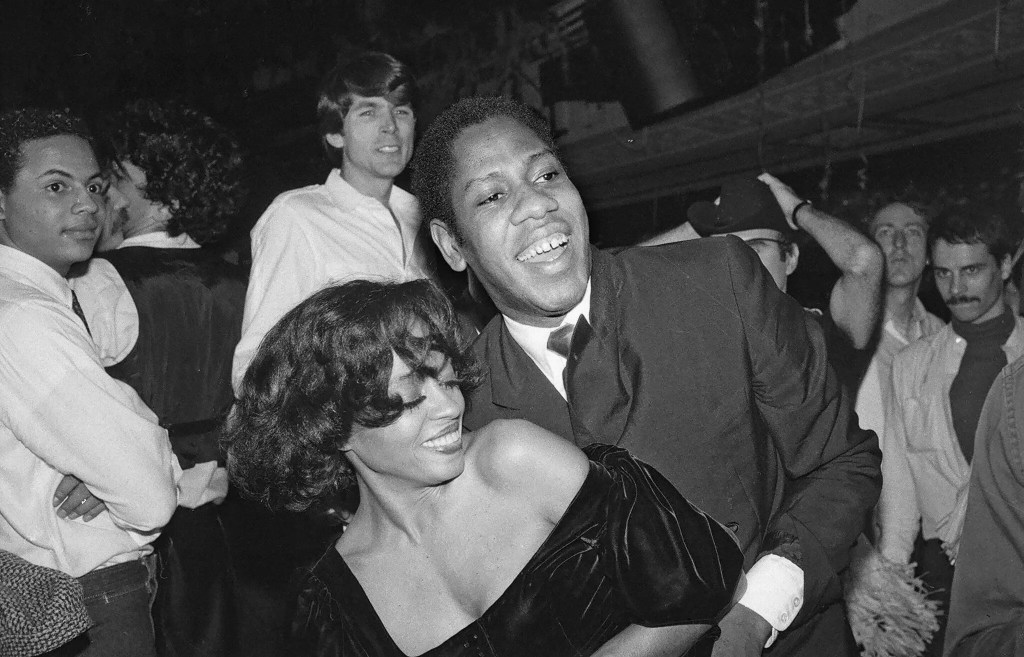
André Leon Talley dancing with Diana Ross at New York’s Studio 54 in 1979. Sonia Moskowitz/Getty Images. [It’s a doppelgänger vibe from out of “The Shining”: A spitting image of me stares moonily out of the frame in a photograph of an event at which I was never present.]
Wallace Stevens said of his poem “On an Old Horn” that, if he had succeeded in saying what he had to say, the reader would get it.
“He may not get it at once, but, if he is sufficiently interested, he invariably gets it.” [1942, quoted by Paul Mariani]
Frank Perfetti’s contributor profile in Poetry magazine reads in its entirety as follows:
Frank Perfetti* writes of the work in this issue, “With a smile I let the viewer draw their own conclusions.” [February 2021]
Stevens’s reader and Perfetti’s viewer emblemize the same fond hypothesis: an audience. Their respective callbacks — “he” and “their” — to a singular instance of that postulate betray a distance traveled over eight decades towards… what to call it?
I need to name the language behavior I’m at pains to converse about in terms of what it is, not what it isn’t. Coining a word — genderflection — in order to document its opposite, as I’ve done earlier, is overly clever, inefficient and vaguely emotive. It betokens a certain resistance to the linguistic behaviors described, coupled with a good-faith effort to channel those feelings through restrained analysis and open-ended contemplation.
It dawns on me that the word I seek is already out there: transgender. Transcend, transgress, translate, transport…transgender. I should have twigged sooner to its transworthiness for my discussion.
“Transgendered” expression is, then, a pressuring of language to discard time-worn, reductive distinctions rooted in biology-plus-culture. Vestigial holdovers of it in English are the third-person singular pronouns “she” and “he.” At the dawn of time, survival may have hinged on reporting whether an approaching human was male or female — one was likelier to rape and pillage than the other. But in the modern day?
There’s a possible precedent for a singular pronoun collapsing into its plural mate and disappearing from the language: It’s when “thou” gave way to “you” for the second person. There’s a loss of precision, which accounts for dialect forms such as “y’all” and “youse” and “you ‘uns” and “you lot” that are alive in speech. If transgendered “they” takes hold, perhaps “they all” or “th’all” is in the offing for talk about explicitly more than one of “them”.
Should certain nouns be next to fall? If words like “man” and “woman” retreat to archaic usage, then A man’s word is his bond becomes A person’s word is their bond, which will be as explicit as it gets, unless disambiguated by amplification: A person’s word is that person’s bond. Efficiency isn’t always the summum bonum in how language rolls.
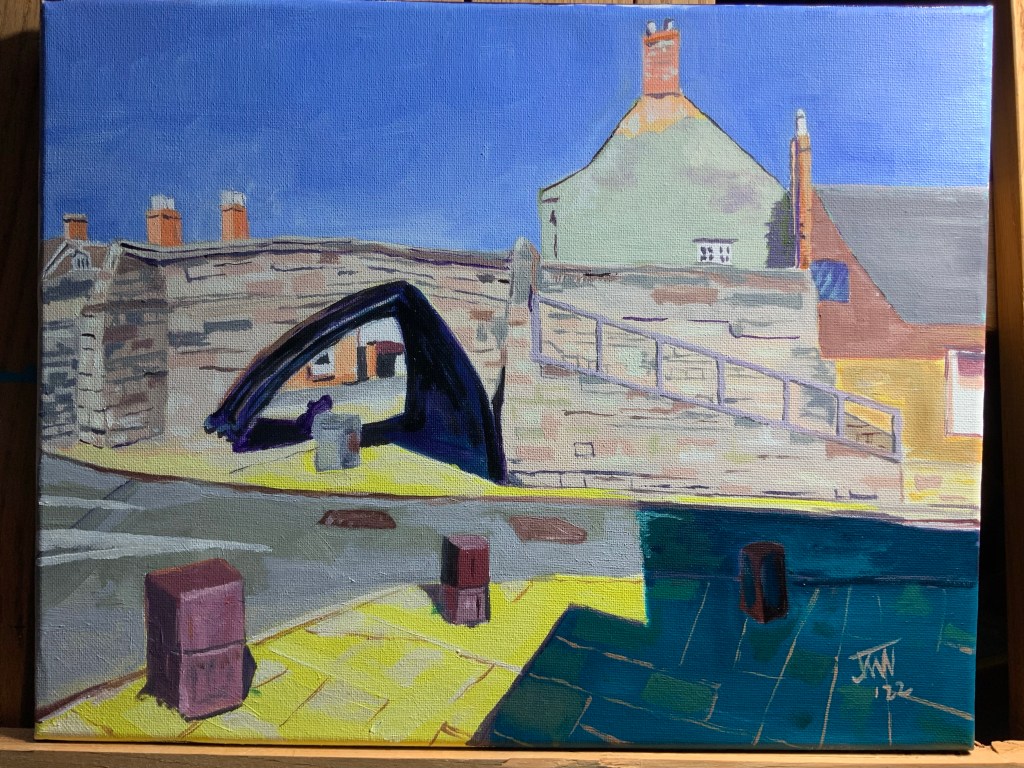
“Crow Shadow,” 11 x 14 in. oil on canvas (JMN 2022)
It’s apparent that contributors to Poetry magazine compose their own biographical snapshots, which allows for a gamut of voicings and modes of self-assertion. A grammar nerd notices how these established and establishing technicians of the word mold language to their purposes. A lively mobilization against “he-she” is observable in recent issues I’ve read. To give it a name, I’ll call it “genderflecting” when gendered pronouns are used in the conventional way.
In non-genderflected reference a singular person talks about themselves in the plural. Jennifer Huang’s profile is one of the best examples I’ve seen:
Jennifer Huang* is a Taiwanese-American writer… They received their MFA from… They live in Michigan, where they are working on a novel. [May 2021]
Here are other instances:
Jinhao Xie* is a UK-based poet… Their poetry, inspired by… [September 2021] Xandria Phillips* is a Whiting Award-winning poet… They are the author of… [July/August 2021] Kemi Alabi* is coeditor of… They live in Chicago. [December 2020] Aubrey King’s* poem is inspired by… They teach at the Jack Kerouac School of Disembodied Poetics. [October 2021] Kitchen McKeown* won… Their debut chapbook is forthcoming… [October 2021] Miriam Karraker* is a writer… Their writing has appeared… [November 2021] Marlanda Dekine Sapient-Soul* (she/her/they/them) is a poet… She is the author… [June 2021]
Gender identity and ethnicity often enter the picture:
Ever Jones* is a queer/trans writer… They are the author of the transliberatory lyric… [November 2020] Tarik Dobbs* is an Arab American, queer writer… They are an MFA candidate… Their chapbook… [May 2021] Aurielle Marie* is a Black and queer poet… Their debut collection… [December 2021]
The student of Spanish notes how adopted ethnic adjectives can be purged of genderflection with “x,” and sometimes not:
V. Ruiz* is a Queer, Xicana bruja [witch]… Their debut is… [February 2021] Elena Ramirez-Gorski* is a Chicanx writer… They are an MFA candidate at… [May 2021] Isabella Borgeson* is a queer, white and Filipina poet… She is cofounder of… [December 2020] Ina Carino* is a Filipinx American poet… [September 2021]
TC Tolbert flies a larkish banner that snaps in its own breeze. I’ve seen “s/he” before, but “they” seems to be winning.
TC Tolbert* (he/him/hey grrrl) is a trans and gender-queer monkey-goat who never ceases to experience a simultaneous grief and deep love any time s/he pays attention to the world. [July/August 2021]
It’s noteworthy that every contributor in this sampling of profiles is marked by an asterisk, which is Poetry’s way of flagging first-timers to the magazine. I take it to signal an opening up to undersung constituencies which are richly represented by LGBTQ+, minority ethnic, Native American, and incarcerated writers.





 EthicalDative
Nosegay of ‘Droit de Seigneur’
Consulting an Arabic dictionary involves looking up a word’s “root,” usually comprising three consonants. Words formed from the root are listed, with their translations, along with idioms in which the word occurs. What the root is may not be apparent on first blush, so lookup can entail a check of competing options. The roving linguist may glimpse, in passing, terminology that induces reflection. I wasn’t seeking it, for example, but I found [faDDa bakāra(t)a-hā], to deflower a girl.
The verb [faDDa] means to break or force open. The dictionary calls [bakāra(t)] virginity; other sources list maidenhead and hymen. As I see it, the phrase could be read as “to break the hymen.” The literal Arabic is plainspoken, at least, whereas the florid tropes of “deflowering” and “virginity” affixed to the phrase in Western culture (French défloration, Spanish desvirgar, etc.) are synonymous with despoilment — the sullying of purity. Compare it to the cliché in which a mature woman who initiates a bashful young male may be credited with “making a man of him.”
On the other hand, there are pleasant surprises such as [lā fuDDa fūka], how well you have spoken!
It’s a passive use of [faDDa] which, depending on your choice of variant, might be translated literally: “your mouth [muzzle, orifice, aperture, hole, vent, embouchure, mouthpiece…] was not broken open [pried, forced, undone, snapped, scattered, dispersed, perforated, pierced…]. If pressed to provide a tonal equivalent for it, I might venture a Texan idiom such as “You ain’t just a-woofin’.” It would take a feel for Arabic which I don’t possess to know whether it struck the right note.
(c) 2022 JMN — EthicalDative. All rights reserved