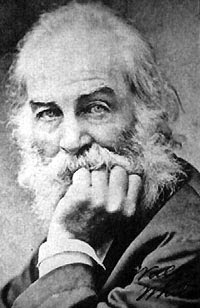
Versión castellana del poema “Crossing Brooklyn Ferry” (1856) de Walt Whitman. Texto inglés — www.poetryfoundation.org.
Years ago, Pepe Portillo, a classmate at the University of Barcelona, loaned me a volume of Dylan Thomas’s poetry translated into Spanish — or “Castellano” in the idiom of my fellow undergraduates at the Facultad de Filosofía y Letras. I remember thinking, “What a doomed undertaking that of romancing the Welshman’s English.”
Back to the present, and this project: romancing Whitman’s American. One doomed undertaking deserves another. What could go wrong in a pandemic? At a minimum it opens me further to a thrilling gust of poetry — winded long and strong — and to grapple with lending to sweet voice an acquired tongue. As to which, comment on where my Spanish runs off the rails is welcome. Hauntingly for me, a cosmologist once said of a colleague’s learned paper: “This isn’t right; this isn’t even wrong.” Yikes.

The poem has 9 parts of differing lengths. All of part 1 follows here.
(1)
Flood-tide below me! I see you face to face!
¡Pleamar allá abajo! ¡Te veo cara a cara!
Clouds of the west — sun there half an hour high — I see you also face to face.
Nubes del oeste — allá salido el sol desde hace media hora — os veo también cara a cara.
Crowds of men and women attired in the usual costumes, how curious you are to me!
Muchedumbres, hombres y mujeres, vestidos de traje usual, ¡qué curiosos sois para mí!
On the ferry-boats the hundreds and hundreds that cross, returning home, are more curious to me than you suppose,
Abordo de las lanchas los centenares sucesivos que cruzáis, rumbo a casa, sois más curiosos para mí de lo que suponéis,
And you that shall cross from shore to shore years hence are more to me, and more in my meditations, than you might suppose.
Y los que cruzaréis de orilla a orilla en años venideros, más para mí sois, y mayormente en mis meditaciones, de lo que acaso supongáis.
[Y más vendrá, estimado lector, “si Dios quiere.” JMN]
(c) 2021 JMN. All rights reserved



 EthicalDative
A Whiff of Wittgenstein
“For a healthy politics to flourish it needs reference points outside itself — reference points of truth and a conception of the common good… When everything becomes political, that is the end of politics.” Making everything politics “totally distorts your ability to read reality.”
(Moshe Halbertal, Hebrew University religious philosopher)
(Thomas L. Friedman, “Can You Believe This Is Happening in America?” NYTimes, 2-23-21)
At first blush it seems like a paradox to say that when everything is politics, politics disappears.
The comment may provide a clue, however, to understanding a point of Ludwig Wittgenstein’s thought (which I am struggling to grasp):
The world is determined by the facts, and by these being all the facts (TLP 1.11)
For the totality of facts determines both what is the case, and also all that is not the case. (TLP 1.12)
In his gnomic fashion Wittgenstein seems to imply that in order to perceive what something is, we must also perceive what it is not.
Deprived of their “is-not-ness,” things lose their definition; by flooding our logical and linguistic space, they cease to be.
We then lose our way.
(c) 2021 JMN