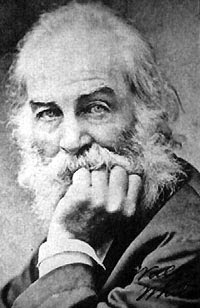
Versión castellana del poema “Crossing Brooklyn Ferry” (1856) de Walt Whitman
English text at http://www.poetryfoundation.org
Spanish Interpretation by JMN

[Translator’s note: Though officially Spanish has imported the word “ferry,” I haven’t been happy with using it in the title of my rendering of Whitman’s poem. Conjoined with “Brooklyn” it just jangles with too much English. So I’ve shortened my title to “Travesía.” It’s pure, and I like the fluid semantic range of a “crossing” or “crossing over,” with its latency of skepticism for narrowly prescriptive boundaries.]
A middle third, give or take, of part 3, follows. Don’t forget, there are 9 parts.
(…3…)
I too many and many a time cross’d the river of old,
Yo también tantísimas veces atravesé el río antaño,
Watched the Twelfth-month sea-gulls, saw them high in the air floating with motionless wings, oscillating their bodies,
Observé las gaviotas del duodécimo mes, las vi flotar en el aire a gran altura con alas inmóviles, oscilando sus cuerpos,
Saw how the glistening yellow lit up parts of their bodies and left the rest in strong shadow,
Vi cómo el amarillo reluciente iluminaba porciones de sus cuerpos, dejando lo demás en sombra fuerte,
Saw the slow-wheeling circles and the gradual edging toward the south,
Vi los círculos que giraban lentamente y el avance poco a poco hacia el sur,
Saw the reflection of the summer sky in the water,
Vi el reflejo del cielo estival en el agua,
Had my eyes dazzled by the shimmering track of beams,
Quedé con ojos deslumbrados por el sendero encendido de rayos,
Look’d at the fine centrifugal spokes of light round the shape of my head in the sunlit water,
Observé los finos radios centrífugos de luz que rodeaban la imagen de mi cabeza en el agua soleada,
Look’d on the haze on the hills southward and south-westward,
Observé la neblina sobre las colinas hacia el sur y el suroeste,
Look’d on the vapor as it flew in fleeces tinged with violet,
Observé el vapor mientras volaba en hilos lanudos teñidos de violeta,
Look’d toward the lower bay to notice the vessels arriving,
Miré hacia la bahía inferior para fijarme en las embarcaciones que llegaban,
Saw their approach, saw aboard those that were near me,
Las vi acercarse, vi abordo a aquéllos que estaban cerca de mí,
Saw the white sails of schooners and sloops, saw the ships at anchor,
Vi las velas blancas de goletas y balandras, vi los barcos anclados,…
[… a continuarse]
(c) 2021 JMN. All rights reserved




 EthicalDative
The Humble Art
I support the premise, aspirationally, that translation “involves being a writer,” to quote this article. The premise piggybacks on something I took on board long ago — that the first asset of a capable translator is to write well in his or her native tongue; then comes fluency in the “foreign” one.
Ann Goldstein translates Elena Ferrante’s novels. She worked at The New Yorker copy desk for over 40 years, and learned Italian in the mid-1980s by attending an evening class with several colleagues. She wanted to read Dante in the original. The class spent a year each on “Inferno,” “Purgatory,” and “Paradise.”
”Before retiring in 2017, Goldstein did all her translations at night or over weekends and vacations.”
Goldstein describes herself as a highly literal translator. Being so is no mean feat. Discernment and judgment are involved; a translator must be a good reader as well as writer. The editor-in-chief of Ferrante’s U.S. publisher says: “It takes a great deal of humility and a great deal of courage to represent so closely what an author wrote in the original language.”
I admire Goldstein’s venturesome spirit respecting her craft. “I’m willing to try anything,” she said of the work she’s drawn to. “I don’t think it’s necessary to have an affinity for the writer….” It’s a stance that seems to gravitate against cultural silos.
Goldstein has remained in New York City through the pandemic, keeping busy with translation work. She still meets with her fellow Italian students, after all these years, over Zoom. “The idea was to read Dante,” she said, “and here we are, reading Dante again.”
(Joumana Khatib, “Reading Elena Ferrante in English? You’re Also Reading Ann Goldstein,” NYTimes, 8-21-20)
(c) 2021 JMN