Pope John Paul II greeting worshipers in St. Peter’s Basilica at the Vatican in 1999. Credit… James Hill for The New York Times.
Beatification occurs when the Pope declares a dead person to be in a state of bliss. It permits public veneration and is the first step towards canonization.
Canonization occurs when the Roman Catholic Church officially admits a dead person into sainthood.
[Pope John Paul II] knocked down the criteria for beatification from two miracles to one, and did the same for canonization. In 1983, he reduced the amount of time required between a person’s death and the start of their canonization process to five years from 50… He produced more than 480 saints, and put enough into the pipeline that Benedict XVI was able to canonize scores more.
(Jason Horowitz, “Sainted Too Soon? Vatican Report Cast John Paul II in Harsh New Light,” NYTimes, 11-14-20)
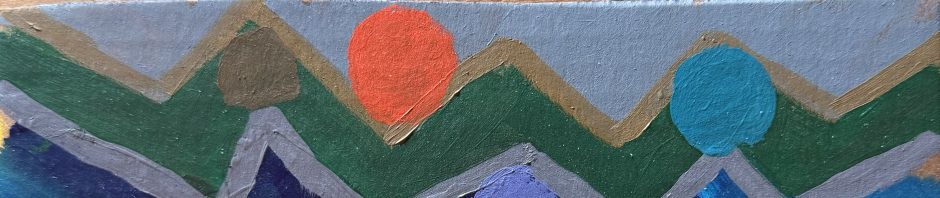
“Knots Bound,” oil on canvas, 16 x 20 in. (JMN 2020)
[XCXVII] Hay que volar en este tiempo, ¿a dónde? One must fly at this time, to where? Sin alas, sin avión, volar sin duda: With no wings, no airplane, fly without doubt: ya los pasos pasaron sin remedio, already the footsteps passed by irredeemably, no elevaron los pies del pasajero. they did not raise the passenger’s feet.
Hay que volar a cada instante como One must fly at each instant like las águilas, las moscas y los días, the eagles, the flies and the days, hay que vencer los ojos de Saturno one must conquer the eyes of Saturn y establecer allí nuevas campanas. and establish there new bells.
Ya no bastan zapatos ni caminos, Neither shoes nor roads suffice now, ya no sirve la tierra a los errantes, earth no longer serves the wanderers, ya cruzaron la noche las raíces, already roots crossed the night,
y tú aparecerás en otra estrella, and you will appear on another star determinadamente transitoria determinedly transitory, convertida por fin en amapola. changed at last into a poppy.
Veinte poemas de amor y una canción desesperada. Cien sonetos de amor 1924, Pablo Neruda y Herederos de Pablo Neruda 1994, Random House Mondadori Cuarta edición en U.S.A: febrero 2004 [English translation is mine.]
Vijay Seshadri’s poems are smart, funny, intricate and chock-full of irony. Credit… Lisa Pines.
The very title of Vijay Sheshadri’s volume of poems, reviewed by David Orr, has the jewel-beam of poetic crystal to it. I keep rolling it on my tongue, as if it makes some kind of sense of the moment. Orr’s phrase about “coiling and liquid” conversation adds crackle to the verve.
The essence of Seshadri’s writing is conversation, and that conversation is coiling and liquid, not diffident.
I’ll meet if you really want to meet. Me reuniré contigo si de verdad lo deseas. I’ll even meet in some small café or some Incluso en cualquier café pequeño o algún park across the way. But I won’t meet for long, parque por ahí. Pero no me reuniré largo rato, and not for a minute will I look at you in your isolation, ni por un minuto voy a mirarte en tu aislamiento, your human isolation. Looking at yours makes me look at mine tu aislamiento humano. Mirar el tuyo me obliga a mirar el mío — transparencies of each other are they, yours and mine — transparencias uno del otro son, el tuyo y el mío — and I don’t have time for mine, so how could I have time for yours? y no tengo tiempo para el mío, así que ¿cómo voy a tenerlo para el tuyo?
(The quoted verse is from Orr’s review. The intercalated translations are mine.)
(David Orr, “A Poet Who Mesmerizes by Zigs and Zags, Hopping From Idea to Idea,” NYTimes, 11-25-20)
David Orr reviews Vijay Sheshadri’s volume of poems “That Was Now, This Is Then” (Graywolf Press).
Reviewers who are poets are especially equipped with spicy pronouncements.
Poetry has a long, proud history of acting as if readers don’t exist. Often this is a good thing… But, of course, to act as if the reader doesn’t exist is exactly that: to act. La poesía tiene una historia larga y orgullosa de fingir que no existen lectores. Muchas veces es cosa buena… Pero claro, fingir que no existe el lector es precisamente eso: fingir.
To write as an ironist, especially today, is to risk that the reader loses patience with hedging, backtracking, spirals of cleverness. But sometimes the layers of the onion ensure the purity of the tears. Escribir como ironista, sobre todo hoy día, es arriesgar que el lector pierda paciencia con evasivas, cambios de opinión, espirales de ingenio. Pero a veces las capas de la cebolla aseguran la pureza de las lágrimas.
(David Orr, “A Poet Who Mesmerizes by Zigs and Zags, Hopping From Idea to Idea,” NYTimes, 11-25-20)
Morsels of meaty gristle to chew over and suck the juices, swallow or not.
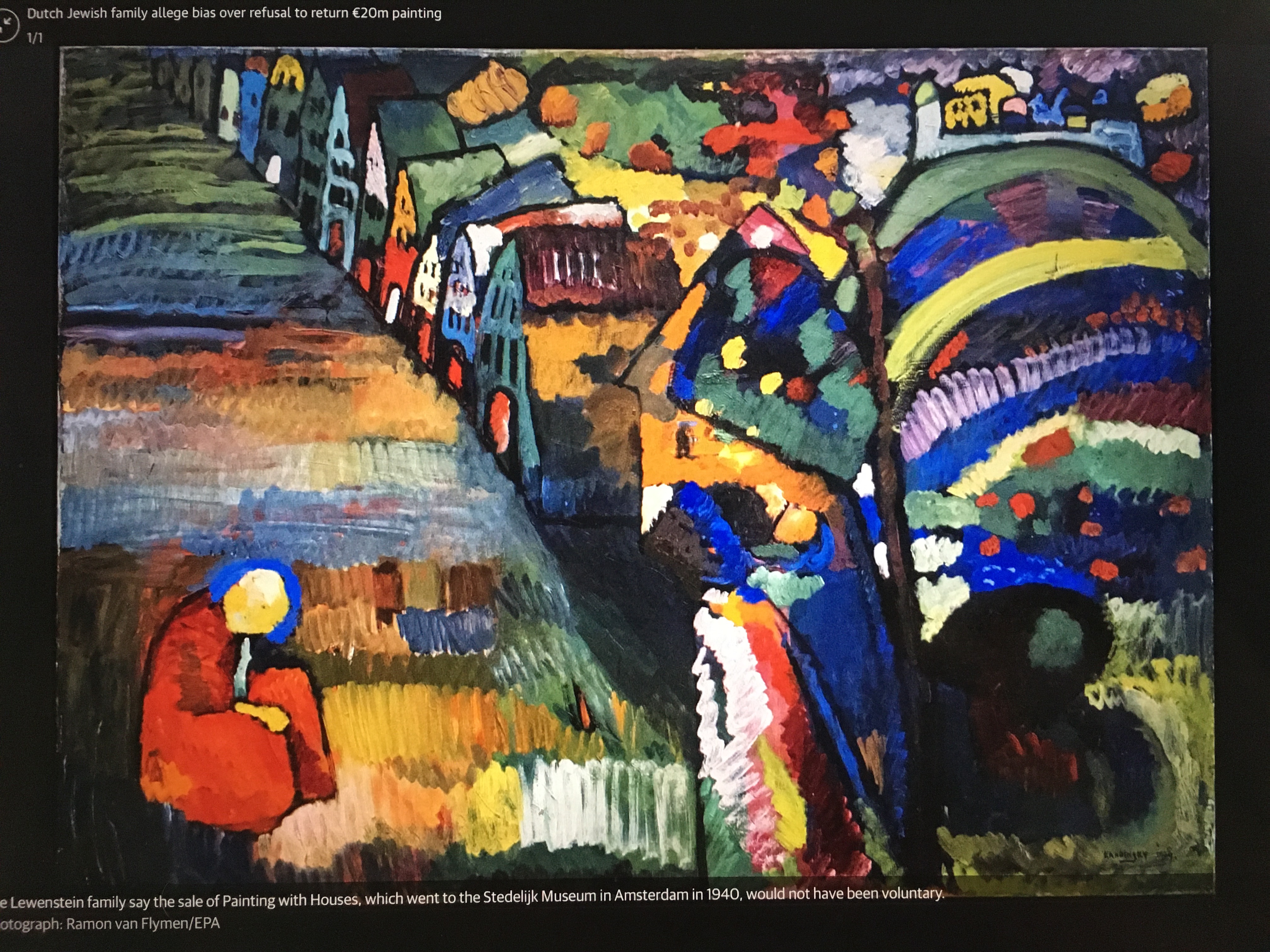
I’ve lost the article from which I clipped this painting — something about vicissitudes and provenance.
No matter, the painting is the thing. It trips and snares me. It’s like a knotty, naughty doodle done with psychedelic syrups from a candy store explosion. Its perfervid figuration is impudent, wickedly nonchalant.
This terrain traversed by the artist on his way to the further reaches: I could stuff my eyes with it.
A country club in Suffolk County hosted a wedding attended by 91 people, officials said. Credit… The Suffolk Times.
Ninety-one people broke the state’s 50-person limit at an October wedding held at the North Fork Country Club in Cutchogue, NY. Afterwards, 30 tested positive for the virus and 156 wound up quarantined.
In a second New York event in September, at least 80 people attended a “high-end” Sweet 16 party that left 37 people testing positive and 270 quarantined.
County officials fined an opulent catering hall, the Miller Place Inn, $12,000 for hosting [the]… party.
(Ed Shanahan, “Wedding and Birthday Party Infect 56, Leaving Nearly 300 in Quarantine,” NYTimes, 10-28-20)
This nondescript article was mundane and banal by late October; the world by then was rife with anecdote about the privileged classes flouting restrictions imposed on the restive, snarling masses. What caught my attention was the unprofessional rhetoric of the journalism, a rare lapse by NYTimes standards.
However, the article set me to thinking of the Fitzgerald quote I remembered as “The rich are different from you and me.” Assuming it to be from “The Great Gatsby,” I looked it up and learned that it’s from his 1926 story “The Rich Boy.”
“Let me tell you about the very rich. They are different from you and me. They possess and enjoy early, and it does something to them, makes them soft where we are hard, and cynical where we are trustful, in a way that, unless you were born rich, it is very difficult to understand. They think, deep in their hearts, that they are better than we are because we had to discover the compensations and refuges of life for ourselves. Even when they enter deep into our world or sink below us, they still think that they are better than we are. They are different. ”
Lèse-maj·es·té: “the insulting of a monarch or other ruler.”
Oliver Dowden, the UK culture secretary, wants Netflix to play a “health warning” before The Crown so viewers are aware that the historical drama is a work of fiction.
“It’s a beautifully produced work of fiction, so as with other TV productions, Netflix should be very clear at the beginning it is just that … Without this, I fear a generation of viewers who did not live through these events may mistake fiction for fact.”
At present viewers are warned that the show contains nudity, sex, violence and suicide references, and is suitable for viewers who are 15 and older.
Formerly a Tastee-Freez, this site in Meadville, Miss., was the last place Charles Eddie Moore and Henry Hezekiah Dee were seen alive. The two Black men, both 19, were abducted by Ku Klux Klan members, tortured and drowned in the Mississippi River in 1964.
Inside the Victoria Colored School, in Victoria, Tex.
A “segregation wall,” built to separate customers of color, at the Templin Saloon in Gonzales, Tex. The wall was left standing to remind patrons of the saloon’s history.
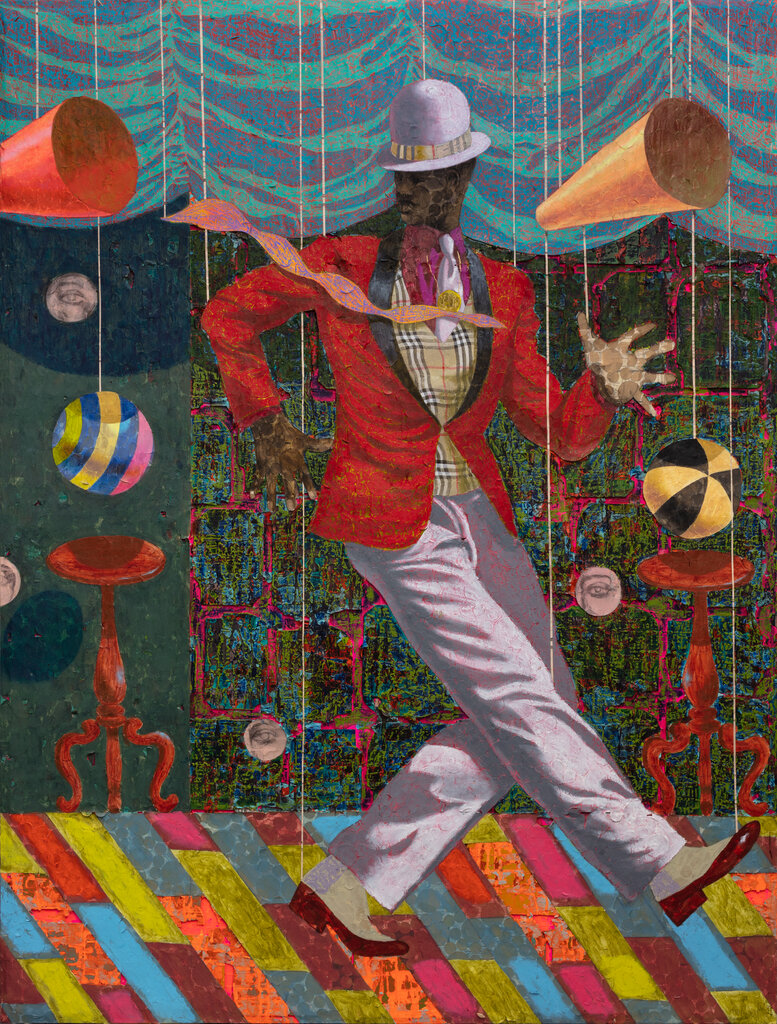
Derek Fordjour with his studio team and collaborators including the puppet artist Nick Lehane. Credit… Rafael Rios for The New York Times.
“I love learning other ways to have a conversation,” Mr. Fordjour said after the rehearsal, a collaboration with the puppet artist Nick Lehane. “Painting has its utility, but performance is another register.”
Derek Fordjour, “STRWMN,” 2020. His paintings, notable for their layered textures and materials, grapple with complex themes of race, inequality and American society, using imagery from carnivals, parades and other celebratory settings. This materials includes cardboard, oil pastel and foil on newspaper mounted on canvas. Credit… Derek Fordjour and Petzel.
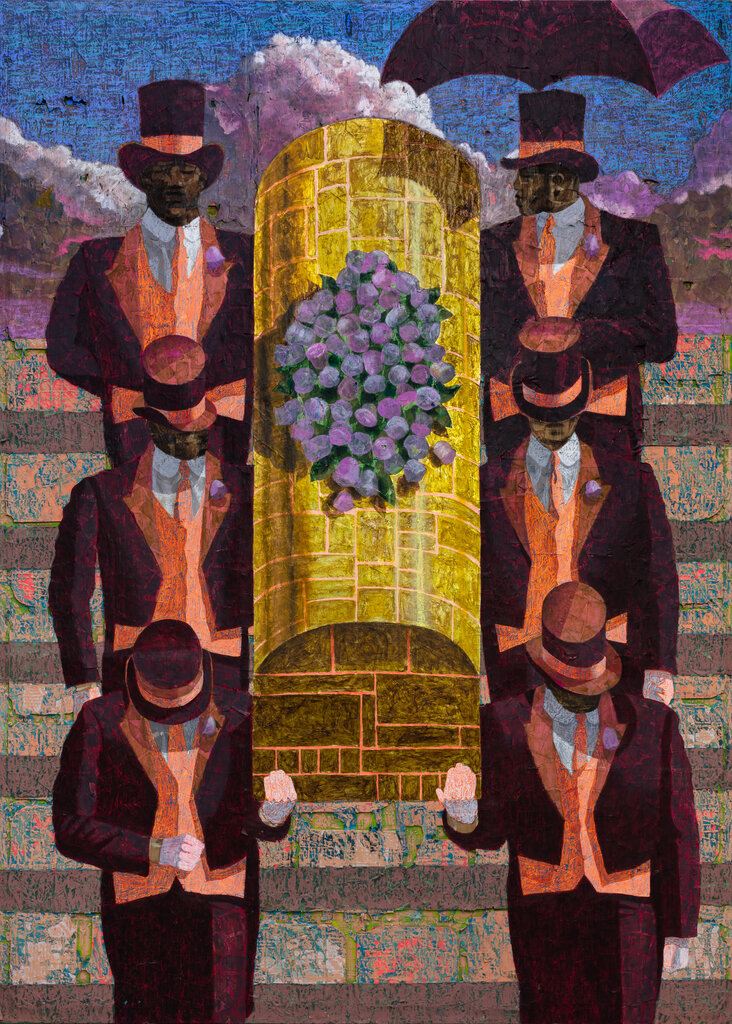
“… Black funerary tradition is on my mind,” he added. “Thinking about all the people who were not able to have funerals.”
“Pall Bearers,” 2020, was inspired by the ornate funeral of George Floyd in Houston. Credit… Derek Fordjour and Petzel.
… He covers a canvas or wood board with cardboard tiles, foil and other materials, and wraps it in newspaper (always The Financial Times, for its warm, salmon hue). The process repeats several times, with Mr. Fordjour applying washes of paint, then tearing and carving the accumulating surface as he goes.
(Siddhartha Mitter, “Derek Fordjour, From Anguish to Transcendence,” NYTimes, 11-19-20)










 EthicalDative
“That Was Now, This Is Then”
The very title of Vijay Sheshadri’s volume of poems, reviewed by David Orr, has the jewel-beam of poetic crystal to it. I keep rolling it on my tongue, as if it makes some kind of sense of the moment. Orr’s phrase about “coiling and liquid” conversation adds crackle to the verve.
The essence of Seshadri’s writing is conversation, and that conversation is coiling and liquid, not diffident.
I’ll meet if you really want to meet.
Me reuniré contigo si de verdad lo deseas.
I’ll even meet in some small café or some
Incluso en cualquier café pequeño o algún
park across the way. But I won’t meet for long,
parque por ahí. Pero no me reuniré largo rato,
and not for a minute will I look at you in your isolation,
ni por un minuto voy a mirarte en tu aislamiento,
your human isolation. Looking at yours makes me look at mine
tu aislamiento humano. Mirar el tuyo me obliga a mirar el mío
—
transparencies of each other are they, yours and mine —
transparencias uno del otro son, el tuyo y el mío —
and I don’t have time for mine, so how could I have time for yours?
y no tengo tiempo para el mío, así que ¿cómo voy a tenerlo para el tuyo?
(The quoted verse is from Orr’s review. The intercalated translations are mine.)
(David Orr, “A Poet Who Mesmerizes by Zigs and Zags, Hopping From Idea to Idea,” NYTimes, 11-25-20)
(c) 2020 JMN