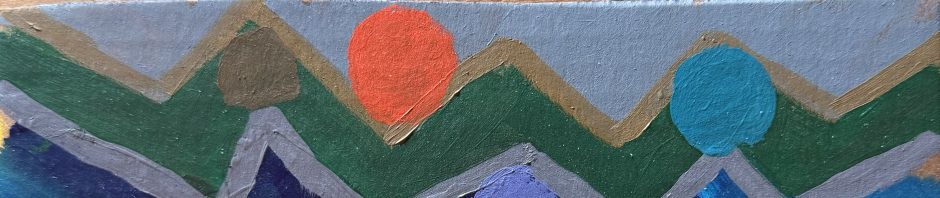
Duong Tuong (1932-2023), oil on canvas, 16×20 in. (JMN 2023). Poet and translator Duong Tuong translated nearly 60 foreign works into Vietnamese. They include works by Proust, Emily Brontë, Nabokov, Camus, Sartre, Céline, Chekhov, Murakami, Günter Grass and Tolstoy. Mr. Tuong said his most often quoted line, which could be used as his epitaph, was, “I am on the side of tears.” … The phrase represented his belief that it is the duty of all people to address the suffering, weakness and oppression in the world, and to “make the tears stop flowing.” (Seth Mydans, “Duong Tuong, Who Opened Western Works to Vietnamese Readers, Dies at 90,” New York Times, 3-9-23)
“All we can do now is pray.” Famous last words. Prayer is the recourse of the desperate when there’s no recourse. It’s the last croak from the isthmus of the fauces before humanity lies facedown in the mud.
(Margaret Renkl, “An Open Letter to Governor Lee on the Slaughter of Our Children,” New York Times, 3-29-23)
Religion hangs decorator drapes in the recreation room of despair and discreetly draws them against the flames outside the window. Religion helps us go all dimpled and dappled like a Gerard Manley Hopkins epiphany while tots absorb bullets from the magazines of Hell.
“We can’t control what [wrongdoers] do,” [Tennessee governor] Bill Lee said.
(Mike Baker et al., “After Mass Shootings, Republicans Expand Access to Guns, New York Times, 3-30-23)
My Catalan grandson works for a company that makes flight simulator software. He’s experiencing the headaches of integrating C++ enhancements into decades-old legacy code written in Fortran. He complains of the lack of notes in the old code whereby programmers are supposed to document their thinking. I promised him I would share with him, as a memento, some of the code I wrote in Java to make interactive learning and practicing software for my high school Spanish classes. I took reasonable care to leave a trail of logic breadcrumbs in it.
I called my program LALO as an acronym for “LAnguage Learning Operation.” “Lalo” is also a HIspanic nickname I heard growing up. I didn’t realize until now that, according to the internet, it can stand for Eduardo, Eladio, Gerardo, Wenceslao, or Gonzalo!
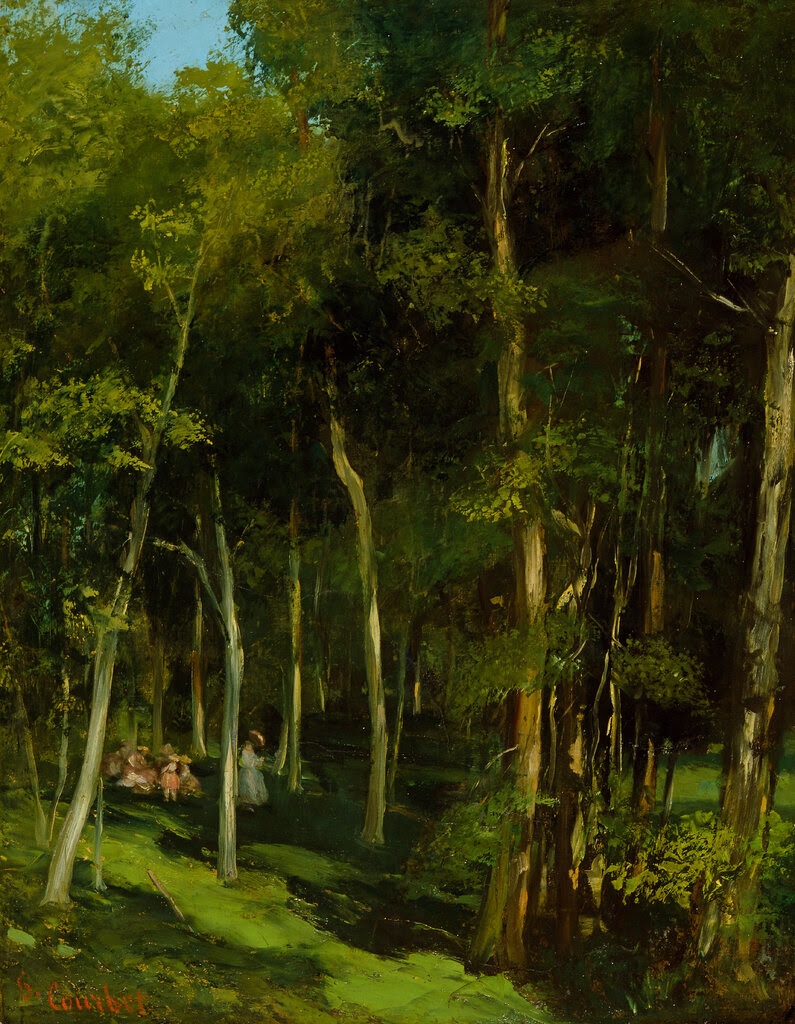
A government panel in Britain has recommended that the Fitzwilliam Museum return Gustave Courbet’s “La Ronde Enfantine,” painted circa 1862, to the heirs of a man who fled the Nazis. Credit… The Fitzwilliam Museum, Cambridge.
I savor the deep dark greeniness and people-dwarfing scale of the forest in this painting by Courbet. The syrupy light on the tree trunks is eyeball lickable.
(Julia Jacobs, “He Lost a Courbet Fleeing the Nazis. His Heirs Are Getting It Back,” New York Times, 3-28-23)
The obligatory cancels its strophe. Let me get a grip, and begin in this other patch where the air is.
“I caught a whiff of poem on the wind straightaway, which is an exceedingly rare smell for one who snorts at verse that doesn’t knock him down. ‘Blue Door’ opened me up like a can of whatever I contain, emptied me out and started filling me with itself. In my dispensable estimation, Ann Lauterbach earns her MacArthur with this construct. It’s piercing and full of sass, tempered in pitch, beyond explicable, so breathable it literally makes me cry.”
The above were my first words after reading “The Blue Door.” What got me in its grip was a sustained sequence of complete sentences. I don’t deny that some of “The Blue Door” is inscrutable (to me), but could that be where verse leaps to poem after all, when it defeats scrutiny yet sweeps me up?
Too many questions spoil the poem.
The poem-as-poem cannot reply. Which is why we need more voices, even
as we know what happens when there are more voices. Noise, argument, rupture.
Why not a single voice, one that represents everyone? Poem? Are you listening? … If only the field could retract into a new beginning, intact, complex,
the geography of the many seeding the plural world with accord,
good replicating good; evil, singular, kept to its barren agenda.
Prayers and wishes could then speed our recovery from the uninhabitable
scald of the venal market…
Speech this hard wrought oxygenates the soul in a peculiar moment: Many humans chafe now at being arguably binary, yet Silicon Valley is handing keys to the voices between our ears over to the binary machine that is (de)generative AI. Spook language is foisted upon a world already strangling in babble, and the gods are ROFL-ing at the mess.
Not to be hysterical or polemical. Not to
confuse personal anxiety with the future…
Meanwhile.
The poem surges over the end-stopped “meanwhile” as if breaching a levee.
I have begun to wish I had done things differently, never to have begun with such sad disclosures.
Absent the stanza, the difficult vocabulary…
… These
discrepancies confuse the grammatical
police. They do not know what to arrest.
Touché! I’m a grammar cop — it’s the vocation talking. If the poem taunts my ilk, I will wear the shoe.
The southern sky has turned peachy…
If you listen carefully, you can hear the thrum
of insomniac wings pulsating between episodes of cloud.
By quoting selectively I doubtless profane the poem and pulverize Ann Lauterbach’s unity of conception, but I don’t grasp that unity myself; I experience her poem as patches of excitement interspersed with bitter-sweet tickle of cognitive predicament. The poem has enlisted me somehow not to fight the tickle, to accept that it states the incomprehensible between bouts of the peachy. Is that the same is saying that it enlists trust in its seriousness? Look at how the blue door “opens the night sky” in a strange way of putting itself to rest:
Is writing a way of stalling for time, to delay the tasks in the next room…? Poem is too busy to answer. Words are like small magnets, pulling other words toward them, one by one, so the singles gather and as they gather they attest to an alignment that will become meaning. What was it you said about naming? It makes a way between unbeing and being, the definite flowing into the circulating infinite, the blue door opening the night sky.
I say writing is a way to delay extinction of voices like this we hope are ours.
I’ve looked into what the exaggerated gaps between words or phrases in lines of verse are all about, curious whether or not they should affect my reading and, if so, how. A writer named Emilia Phillips calls them visual caesuras — a term I find slightly absurd — and says they could as well be line breaks.
A turgid article about white space at POFO quotes John Cage from his “Lecture on Nothing.” Its black space (!) is so engaging that I captured several screenfuls of it and transcribed some of the words to my notes, discarding the unruly white bits fractiously separating them.
Here’s what Cage wrote:
The text is printed in four columns to facilitate a rhythmic reading. Each line is to be read across the page from left to right, not down the columns in sequence. This should not be done in an artificial manner (which might result from an attempt to be too strictly faithful to the position of the words on the page), but with the rubato which one uses in everyday speech.
Cage’s advice for reading his text seems applicable to verse: ignore eccentric spacing and read in your own voice. I confess to feeling bullied, distracted and interfered with by writers who over-curate their verses with ruptured typography. If your conceit is too ethereal for candid representation, re-think it!
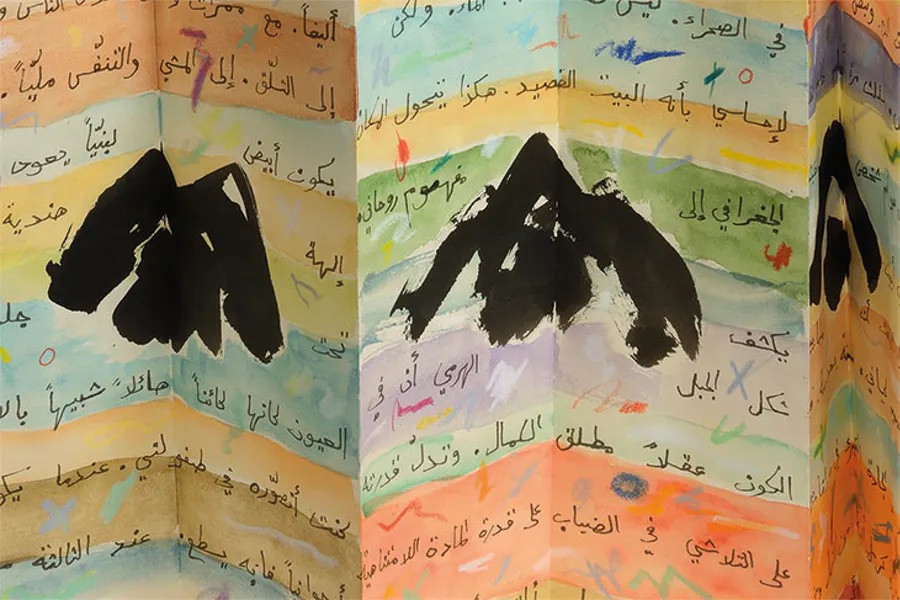
I’m attracted, however, to Etel Adnan’s conception of the purpose served by the leporello, the fanfold device mentioned in a previous post here: The basic idea is about slowing down the way we look at things, about intensifying our experience.
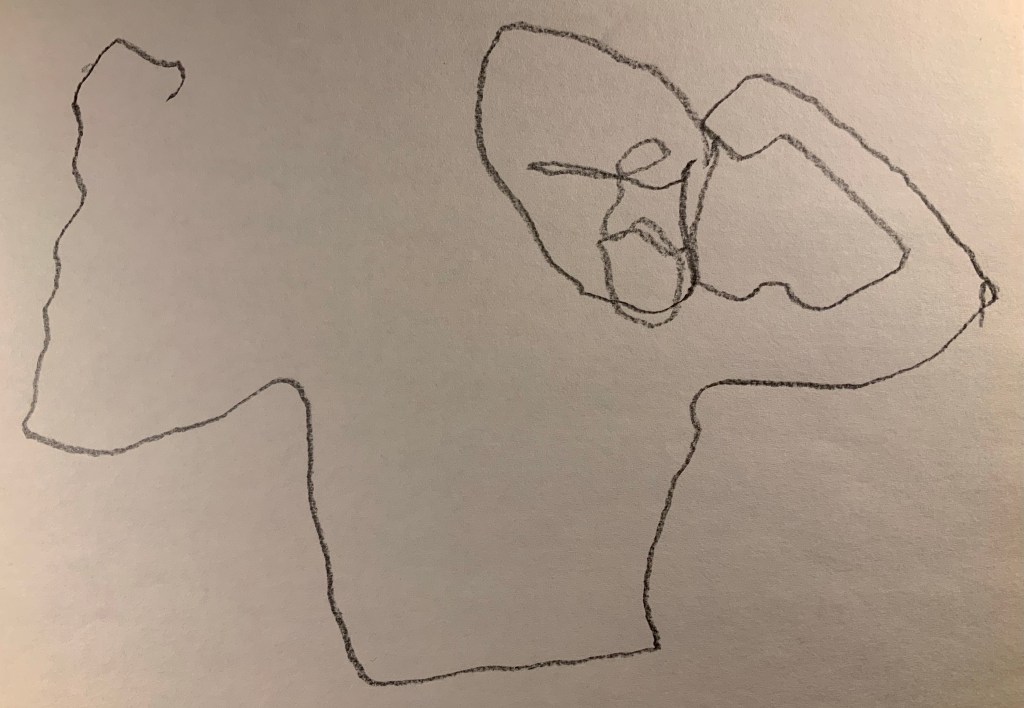
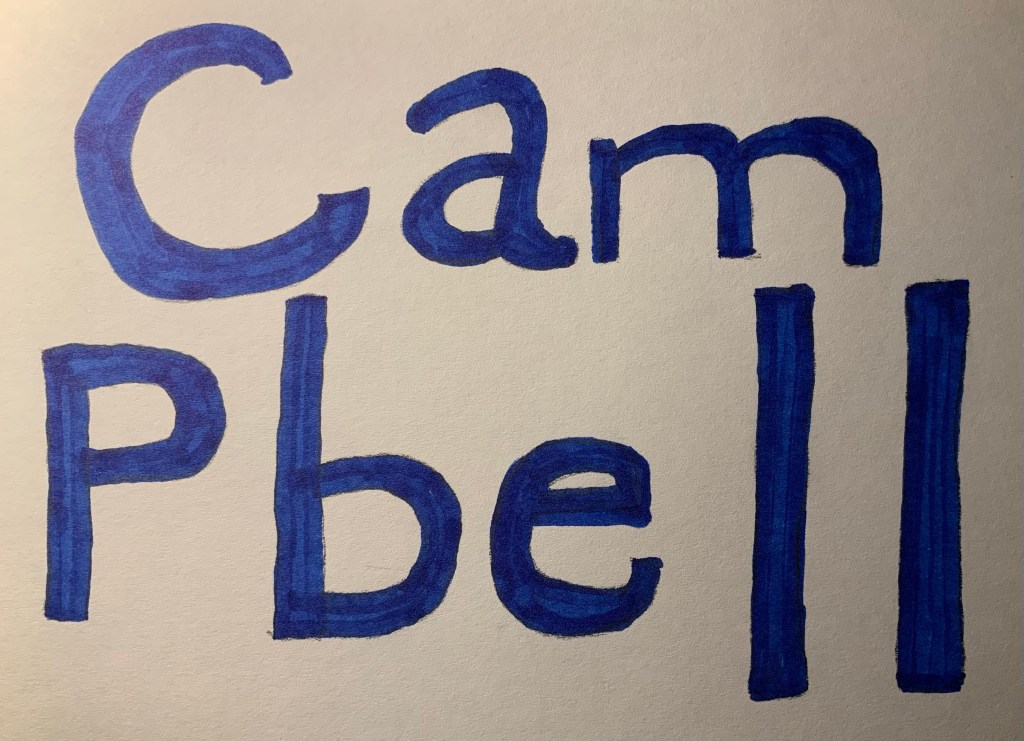
This is a doodle from last year that went nowhere. It reflects my foolish obsession with Scottish ancestry. While living, my dad obtained from somewhere a document saying that my family’s clan was associated with the MacLeods, MacFies and Campbells. What does that mean? Connected through marriage? As an undergrad I spent a summer in Mexico City. One of my classes at the national university, taught by Ermilo Abreu Gómez, was on the “novela de la Revolución.” A guest lecture was given by author Nellie Campobello. She was a Campbell! I elect association with her.
[Billy Collins] sat on a bench and watched some students playing Wiffle ball on a quad. “You have to be interested in the playfulness of poetry to want to keep writing it,” he said. Then, as if to shoo away the fatalism, he added that he has already written a hundred poems for his next collection, not all of them short.
(Bob Morris, “A New York Poet Laureate in Deepest, Darkest Florida,” The New Yorker, 3-13-23)
Lebanese-American painter-poet-novelist Etel Adnan (1925-2021) was interviewed by Gabriel Coxhead for the June 2018 issue of Apollo. I’m drawn to her work for how it mingles Arabic language, painting and poetry.
Perhaps most interesting, in terms of her parallel practices of art and writing, is the display’s focus on what she refers to as ‘leporellos’ – a term for a sort of pleat-folded, concertina-style book, typically many pages long. It’s a format she began experimenting with while living in California, after coming across leporellos in a Japanese store there… “The guy in the shop told me it was for putting photographs in! But when I saw it, I knew that what I wanted to do was write Arab poetry.”
She doesn’t mean, though, that she used the leporellos to write her own poetry – not initially, at least. She tells me how she was part of the generation in Lebanon who was taught only in French at school, and punished for speaking Arabic, while at home she spoke Turkish and Greek. So she never became fluent enough in Arabic to compose in it (her own poems tend to be composed in English). It was other contemporary Arabic writers, then, whose poetry she turned to for her leporello pieces – and what attracted her, besides each poems’ [sic] meaning, was the process of transcription itself. “The flexibility of the Arabic script excited me. In Arabic, you have greater freedom to manipulate writing, visually. You can stretch letters out, you can put one letter on top of another.” She also added watercolours, coiling delicate, washy patterns around the words or through them – turning the texts into visual art, essentially. “In this way I discovered that the act of writing is also an act of drawing.”
A noun or pronoun, with a participle in agreement, may be put in the ablative to define the time or circumstances of an action. This construction is called the Ablative Absolute… The Ablative Absolute is an adverbial modifier of the predicate. It is, however, not grammatically dependent on any word in the sentence: hence its name absolute (absolūtus, i.e. free or unconnected). A substantive in the Ablative Absolute very seldom denotes a person or thing elsewhere mentioned in the same clause.
World fills up. Imperious pace. Vagrant matter into the humming. Pooled at the feet, what soul went down! What inventory mud slippage tracks, marked shells anointed there! The ravenous real flowering above torsion of waves. Unexpected threshold thrown open: crossed.
Other phrasings can be inferred. For example: Vagrant matter into the humming, pooled at the feet. What soul went down! Etc.
I have an affection for the verb “cohere” — the state of being joined up, of hanging together. I also like “construe,” which is a feat of elucidation resulting from analysis. Whether it’s a painting or a verse that one reads, does it overstate the case to say reading is construal in pursuit of coherence? We’re meaning seekers; we want to claw message from noise. Figuring out what relationship words have to one another conduces to signal reception. One way to confirm we’ve been signaled is to restate message in our own terms, albeit paraphrase is a widely deprecated expedient. I like to think of it as translation.
“Door” is a sustained interjection built with declamatory ecce language: Behold! I speculate that a confluence of intensely perceived marine stimuli triggered a private ecstasy, a flash of insight into plenitude and convergence, a breakthrough to transcendent understanding, a “door of perception” moment which the writer sought to freeze-frame in haiku-esque shorthand. Terse headline language cascades through elusive dependencies, disputable enjambments, and a succession of power words — imperious, vagrant, soul, anointed, ravenous, torsion. Where I glimpse poem at last is in the ravenous real. I’m smitten with substantivized “real” and how it flows participially into a flowering above torsion of waves. Ecce coherence!
Whatever they say about “connecting” with an audience, writers who identify as poets fulfill themselves first. Perhaps “Door” scores artistic achievement by forcing me to come to terms with it to this extent, at this cost in spent treasure of life-moments. The question a reader must ask always is, “How does verse-speech fulfill me?”
Richter’s “Abstraktes Bild (Abstract Painting),” from 2016. Credit… via Gerhard Richter and David Zwirner.
… Each [painting] presents so much information that you have to move in close for further contemplation and deciphering, trying to figure out how the paintings were made and which of their weird little details are accidental, which deliberate. They can feel almost like exquisite texts to be read[my bolding]. But instead of words, you follow painterly events of different sizes; one color gives way to another; smooth passages blur adjacent colors and then break apart into patchy areas that resemble reptile skin or tiny islands that expose multiple layers of color. Sometimes the blue layer with which Richter usually starts a work is visible, or it may be scraped far down to reveal nearly bare canvas.
“Painterly events”! I found exhilarating the spectacle of a prominent art critic delving into the grit of paintings to probe their “information.” It reassures me that, analogously, my reflex to decipher verse at a grammar level in pursuit of its “poetry” may not be goofy.
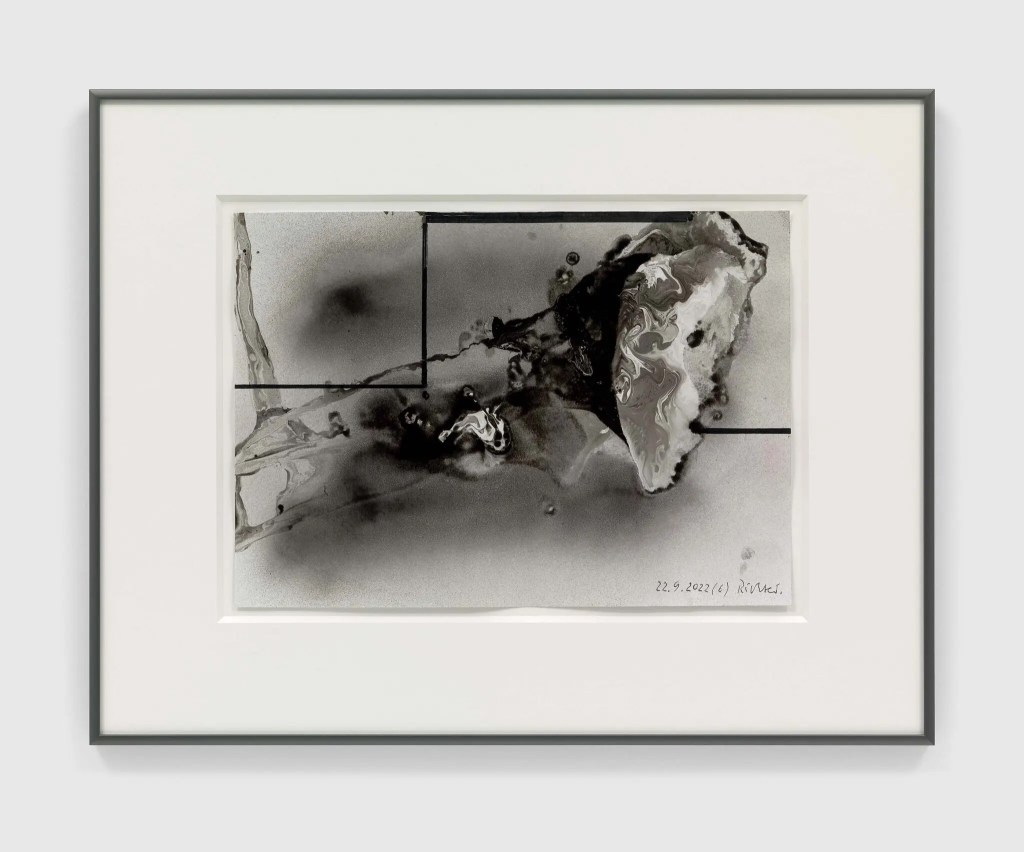
An interesting detail is that Richter, aged 85, says he finds painting tiring now and will devote his energies to drawing. His drawings slap me in the face with a reality that I struggle in all honesty to fathom, ratify and prosecute in my own trivial practice: Drawing is important; what you draw is not.
“22.9.2022 (6),” an ink and pencil drawing from 2022. Credit… via Gerhard Richter and David Zwirner.“18.7.21,” from 2021, is all-pencil. Credit… via Gerhard Richter and David Zwirner.
(Roberta Smith, “Gerhard Richter Rides Again,” New York Times, 3-16-23)








 EthicalDative
‘I Am on the Side of Tears’
“All we can do now is pray.” Famous last words. Prayer is the recourse of the desperate when there’s no recourse. It’s the last croak from the isthmus of the fauces before humanity lies facedown in the mud.
Religion hangs decorator drapes in the recreation room of despair and discreetly draws them against the flames outside the window. Religion helps us go all dimpled and dappled like a Gerard Manley Hopkins epiphany while tots absorb bullets from the magazines of Hell.
All we can do now is pray.
(c) 2023 JMN — EthicalDative. All rights reserved