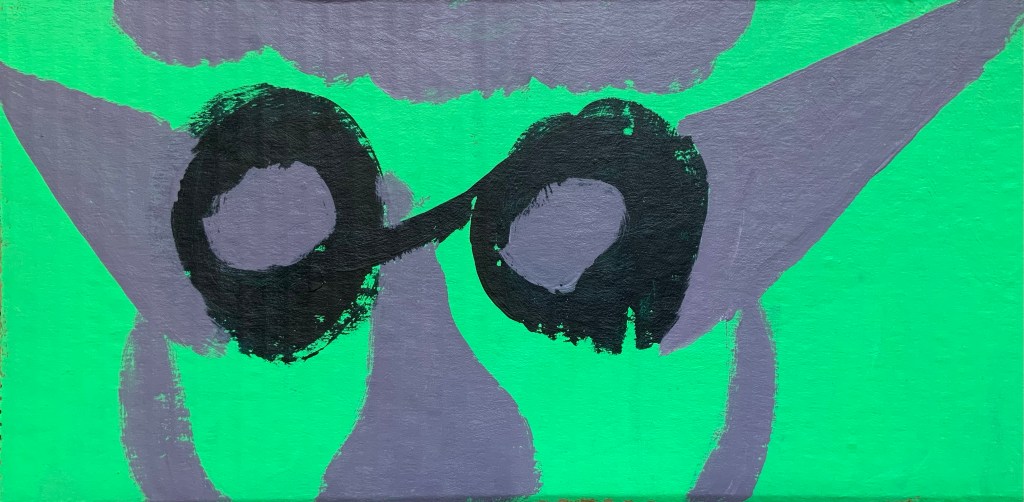
Bent like Beckham, rich as Croesus. This Bud’s for you, now let ‘em fleece us. He marinated in the sauce, pronounced himself the biggest boss. “I’m fed up with your utter gall. Zip it now and kick the ball.”
The arc of history tends to rhyme: Look away, there is no crime.
Postscript: Breaking news from Colorado Springs, USA. Massacre at a gay club: 5 dead, 18 wounded, and counting.
FIFA’s president, Gianni Infantino, during his pre-World Cup news conference on Saturday in Doha, Qatar. Fabrice Coffrini/Agence France Presse — Getty Images.
“I feel 200 percent in control of this World Cup.”
(FIFA lord Gianni Infantino)
With four games per day in the opening group stage, all played in what is effectively a single city-state, Infantino said the movement of large groups of fans within such a compact environment carried greater risks if they were fueled by beer.
(Tariq Panja, “On Eve of World Cup, FIFA Chief Says, ‘Don’t Criticize Qatar; Criticize Me,’” New York Times, 11-19-22)
Two-hundred-percent control is a lot of clout. History is on Infantino’s side. Booze is recorded as uncorking a bit of hyper fan-zest in annals of the beautiful game.
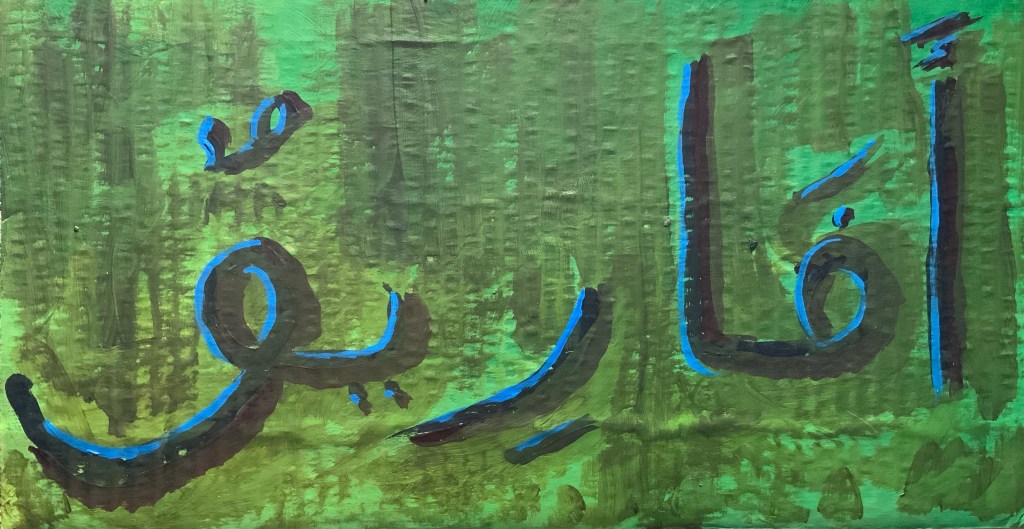
The language has astonishing sweep and granularity that are explicit and penetrative to a degree redolent of lore and legend. The open-sesame to Arabic’s magic for this English speaker is Wright’s majestic grammar. (1) Here, of an early morning on this date in this place, settling with a mug of coffee and oat milk into my ongoing tour of the broken plurals, I encounter the following:
“Sometimes there is even a treble formation;firqaẗ(un), a band, a party or sect…”
The “treble formation,” meaning the three possible plurals for the term, are: firaq(un), ‘afrāq(un), ‘afārīq(un).
‘afārīq(un)
Wright continues:
“Such secondary plurals can be properly used only when the objects denoted are at least nine in number, or when their number is indefinite.” (1)
“Properly used”: be still my heart. What this rule has in common with poetry is that it seduces with strangeness, yet eludes unspooling into paraphrase and applicability. What exactly are the “objects” to be counted? Bands themselves, or the individuals comprising them? But does it matter? What’s gleaned about another language culture’s approach to multiplicity is glorious: To describe several of a thing is contingent on the measure of its more-than-oneness.
It’s possible that Wright’s record on this point, as on others, is archaeological; the linguistic fact, however, and the wonder of it, stand recognized and felt. It broadens the mind and quickens the sympathies to take note of distinctions that fellow humans have made, and do make, in talking about their world.
Notes (1) W. Wright, A Grammar of the Arabic Language, Simon Wallenberg Press, 2007. Reprint of the classic work first published in 1874, and updated in 1896, ii, 232, D. (2) My character set is this: ‘ a ā A i ī u ū ay aw b t ẗ ṯ j ḥ ẖ d ḏ r z s š ṣ ḍ ṭ ẓ ^ ḡ f q k l m n h w y
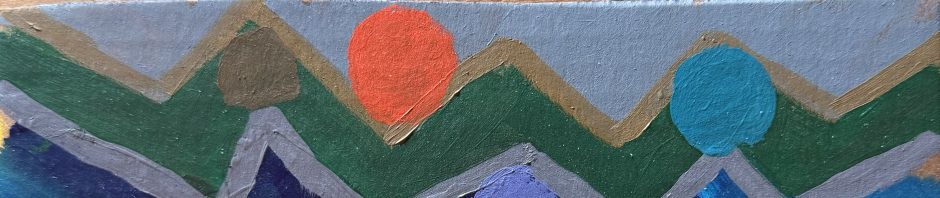
My illustration is an abstraction derived from the layout of structures and spaces on my squat down by the Big Muddy. The turgid Waddy Loopy is a conduit of Texas Hill Country drainage that lumbers past me on its way to do a bay dump south of here. (See note.)
What a body wanted for his abstraction was clout: hard-edge pigment-power with boss saturation. What a body got was the loose-goose-dookie translucency of tinted water, aka acrylic. Fool, gesso up the cardboard first! Ignore that voice. The point of smearing cardboard is to smear cardboard.
Note Say “waddy” in Arabic, you’ve said the word for “river valley.” Guadix, Guadiana, Guadalquivir, Guadalete, Guadarrama, Guadalajara, Guadalmena, and yes, Guadalupe are rivers in old Spain. The “lupe” part may be from Latin “lupus” for “wolf,” a mashup from the elbow-rubbing of Semitic and Latin dialects in the good olde tymes. I christen my river The Guadalobo. The etymology has the pleasantly bogus plausibility of popular wisdom.
“It’s like being in Las Vegas, but somehow worse.”
(Swedish COP27 Delegate)
It’s possible the fossil-lobby-infested, desultory yak-a-thon held at a glittering tourist watering hole in The Tonino Lamborghini International Convention Center — let me repeat that for its delicious music: The Tonino Lamborghini International Convention Center — will sing from the same hymn sheet as the previous 26 COP-outs. The name of the tune is “What Happens in Sharm el-Sheikh Stays in Sharm el-Sheikh.”
Even the cloud cover of a sickened planet can have its silver lining, however. This one is the opportunity afforded to learn more Arabic, ever to be seized upon by your humble blagueur who is devoted to the monuments of poetry in this “infinitely rich and highly articulated language” of “a people so conservative and tenacious of antiquity as the Arabs.” (1)
The verb šarama (yašrimu) means to split, slit or slash something. Its verbal noun šarm (pl. šurūm), meaning cleft, crack, split, rift, slit, slot, can also be taken as a “cleft,” etc., in a coastline, hence the extended sense of small bay, inlet.
The title šayẖ (pl. šuyūẖ, ‘ašyāẖ, mašyaẖa(ẗ), mašāyiẖ, mašā’iẖ) comes from verb šāẖa (yašīẖu), to grow old, attain a venerable age. Hans Wehr’s first translation for it is an elderly, venerable gentleman. It has wide application as an honorific in various guises across the Arabic-speaking world. Sheik, adopted by English, is one of the 13 possibilities listed by Wehr.
Sharm el-Sheikh.
So in šarmu-š-šayẖi, which is “Sharm el-Sheikh” transliterated with case endings and the definite article assimilated to the sun letter, we have initially “the small bay of the elderly, venerable gentleman.” Shall we Vegas-ize Sharm el-Sheikh and call it “Sheik’s Cove”? Cocktails at 5 in the Rudolph Valentino Room. (2)
(“‘Like Vegas, but worse’: Sharm el-Sheikh fails to charm COP27 delegates,” theguardian.com, 11-11-22)
Notes (1) The words are those of Sir Hamilton Gibb and R.A. Nicholson, respectively, quoted by A.J. Arberry in the introduction to his Arabic Poetry: A Primer for Students, Cambridge University Press, 1965. (2) An old rule of proper composition says you shouldn’t number your notes unless you have more than one. Here’s the second note.
Considering the toll it takes on me to construct a writing boiled down to within an inch of its life about something I think, punctuate it punctiliously, then figure out too late what I’ve said, much less thought, if anything, it got my attention when Darryl Pinckney said that Elizabeth Hardwick was “a writer who composed prose like poetry.” This doesn’t mean her prose was “poetic,” God grant. I prefer it to mean that her prose partakes of the “exquisite compression and technical precision” that Dwight Garner elsewhere attributes to poetry. That way in my dreams go I on the page.
Of several delicious reminiscences cited in the review of Pinckney’s memoir about Hardwick, there’s one whose sprightly wickedness on the part of a woman who loved gossip keeps cracking me up (note the parentheses; they enhance the mischief):
(“Gossip, according to Hardwick, was merely ‘analysis of the absent person.’”)
Then there’s this: “As Hardwick once put it, ‘Reading was such a wonderful thing that to have made a life around the experience was almost criminal it was so fortunate.’” That’s for you, cherished reader. You know who you are.
(Maggie Doherty, “”Elizabeth Hardwick’s Master Class on Literature and Life,” New York Times, 10-23-22; Dwight Garner and Parul Sehgal, “19 Lines That Turn Anguish Into Art,” New York Times, 6-18-21)
Curators have increasingly come to recognize the depth and complexity of Jennifer Guidi’s art. “It’s more than it initially appears,” said one museum director. Credit… Alex Welsh for The New York Times.
The comment attributed to a museum director about Jennifer Guidi’s painting reminded me of Mark Twain’s remark that Wagner’s music is “better than it sounds.”
“I’m thinking of color as a way to connect — a way to engage — that invites people into a sense of aliveness,” Guidi said. “More colors. More dots. More energy. More vibrant. More vibration.”
A bit of fun can be had with the dulcet, polka-dot-and-moonbeam language of this review. Where’s the harm? Gentle bemusement is the rhetorical reward when movers and shakers of the arts community rally around an artist in furtherance of the addition of zeros to her work’s financial accomplishments.
One of her paintings, “Elements of All Entities,” sold last fall at Christie’s for $625,000, more than four times the low estimate of $150,000 (her work sells privately for $100,000 to about $500,000).
“Till Sunbeams Find You (Painted White Sand, Orange, Pink, Hot Pink, Yellow, Turquoise, Lavender and Purple, Black Fill),” 2021-22. Credit… Alex Welsh for The New York Times.
“She is straddling the space between the spiritual and the hallucinatory… They’re very much these meditations on the ambience and the atmosphere of our West Coast environs — where the sky meets the sea”… “She quietly absorbs the world around her and distills it into meditative and hypnotic, often pulsating imagery.”
“The Various Planes on Being and Life (Painted Natural Sand, Red-Orange-Yellow-Blue-Purple-Dark Purple Mountain, Painted Black Sand, Yellow, Red, Pink, Green and Orange, Painted Black Sand, Blue, Yellow, Green, Pink, Black Ground),” 2022. Credit… Alex Welsh for The New York Times.
(Robin Pogrebin, “Where the Sky Meets the Sea: Jennifer Guidi Leans Into Beauty,” New York Times, 11-4-22)
Cézanne’s Sugar Bowl, Pears, and Blue Cup (1865-70) is a conventional depiction of a still life (Credit: Alamy).
[His] early Sugar Bowl, Pears and Blue Cup (1865-70)… shows Cézanne seeing and painting in a relatively traditional way. Apart from the rougher handling of paint, it is a close relative of traditional scenes like Harmen Steenwyck’s…
(Matthew Wilson)
I confess to a predilection for the earlier work of certain well known painters versus the output on which their reputations rest. Mondrian is a good example. His severe geometry is reverence-triggering, but I’ve seen paintings he made on his journey to the mature work that I could cozy up to, putting it blandly.
The early still life shown above isn’t recognizable as a Cézanne to my eye, nor as a “conventional depiction,” though yes, perhaps painted “in a relatively traditional way,” as viewed by an observer able to compare it to a little known baroque-era work of 1640.
What sets Cézanne’s still life apart is precisely that “rougher handling of paint” — the slathered impasto modeling, the inky backdrop, and the quality of oozing light, captured as if on the fly, and left almost dripping from the vessels. Damn if it’s not remarkably fine and relatable!
(Matthew Wilson, “The painter who revealed how our eyes really see the world,” theguardian.com, 10-18-22)
Below is jargon improvised for gauging how a translation navigates its source text. Note how the verbiage is strewn with hedging adverbials, conceding a priori that the labels are judgments, which by definition are subjective, privative, compromised, blinkered and fallible. (See “U.S. Supreme Court.”)
Congruent: matches the source text fairly closely, with minimal liberties taken for readability. Omissive: suppresses elements of the source text without obvious justification. Expansive: adds interpretive structure or content not discernible in the source text but plausibly deriving from it. Inventive: carries the “expansive” element to a level not obviously supported by the source text. Transgressive: departs from the source text in a way that arguably betrays the poem’s letter or spirit.
Omissive was added late. It’s a watchword for the position that loss must entail gain; if the translation discards a feature of the source text which the target language is capable of emulating, a benefit should be realized from the curtailment. If gain is perceptible, the translation accrues congruency; if not, it steers a tick in the remiss direction.
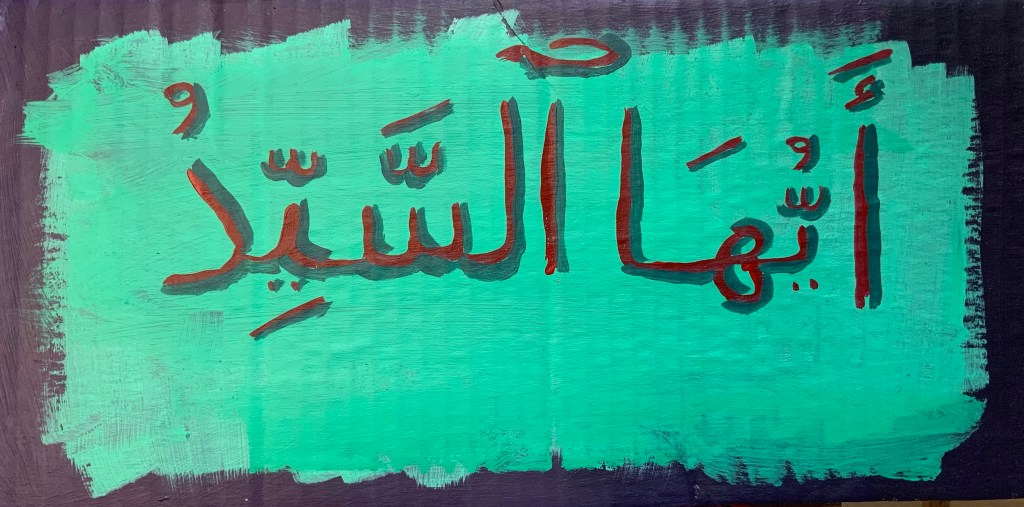
The first line of the section of Gilgamesh’s Snake titled “The Lost Beginning” by Gareeb Iskander (1) attracts attention. It’s a vocative construct.
O master! ‘ayyuhā-s-sayyidu Master! (2)
The vocative is a Hey, you, listen up! utterance involving a particle — ‘O’ in English, ‘ayyuhā in Arabic — followed by a noun or pronoun — here, sayyidun, master, sir, lord, chief. (3) Iskander leaves out the particle in its translation, perhaps from a desire not to sound mannered or highflown. However, sayyidun connotes prestige. It comports well with prefacing by “O.” The formal tone isn’t amiss contextually, and the source text is respected. Iskander’s translation could be tagged Omissive.
Here’s a smattering of Wright’s exposition on the vocative (4):
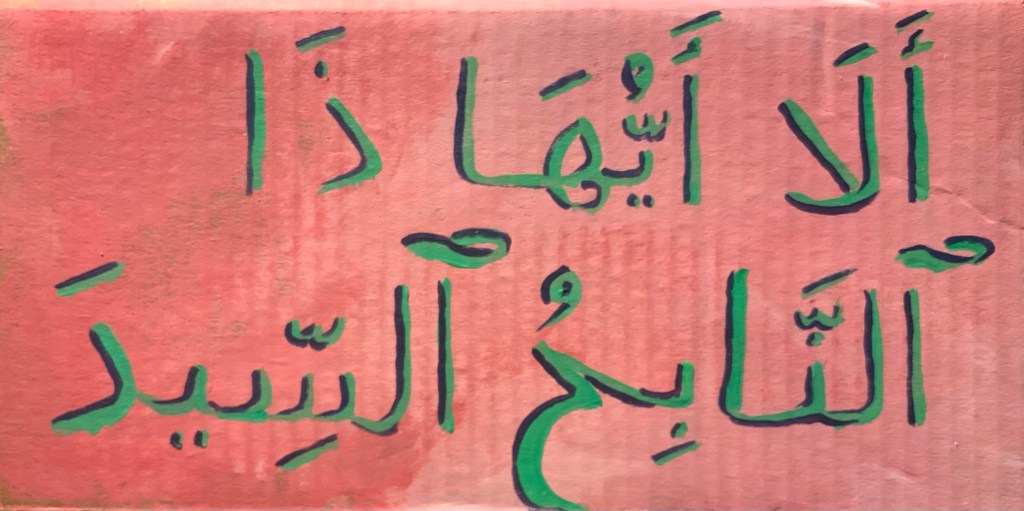
“‘ayyuhāandyā ‘ayyuhā… require after them a noun, singular, dual or plural, defined by the article, and in the nominative case… The demonstrative ḏā is also admissible….”
Wright illustrates the construction with Arabic phrases translated into fragrant period English. Here are three of them: Thou there, come forward!; O thou there, whose soul passion(or grief) is killing; O thou there, who barkest at (revilest) the Bènū ‘s Sīd.
Thou there, come forward!; O thou there, whose soul passion(or grief) is killing.O thou there, who barkest at (revilest) the Bènū ‘s Sīd.
Notes
(1) Gilgamesh’s Snake and Other Poems, Ghareeb Iskander, Bilingual Edition, Translated from the Arabic by John Glenday and Ghareeb Iskander, Syracuse University Press, 2015. (2) The published translation (“Iskander”) is in italics beneath my rendering and transliteration using this jury-rigged character set: ‘ a ā A i ī u ū ay aw b t ẗ ṯ j ḥ ẖ d ḏ r z s š ṣ ḍ ṭ ẓ ^ ḡ f q k l m n h w y. (3) Hans Wehr, A Dictionary of Modern Written Arabic, Edited by J. Milton Cowan, Cornell University Press, 1966. (4) W. Wright, A Grammar of the Arabic Language, Simon Wallenberg Press, 2007. Reprint of the classic work first published in 1874, and updated in 1896.









 EthicalDative
Is Soccer Sick? I Keep Hearing of Catarrh
Bent like Beckham, rich as Croesus.
This Bud’s for you, now let ‘em fleece us.
He marinated in the sauce,
pronounced himself the biggest boss.
“I’m fed up with your utter gall.
Zip it now and kick the ball.”
The arc of history tends to rhyme:
Look away, there is no crime.
Postscript: Breaking news from Colorado Springs, USA. Massacre at a gay club: 5 dead, 18 wounded, and counting.
(c) 2022 JMN — EthicalDative. All rights reserved