“Untitled” (detail), 2022, from Alexandre’s new show at the Shed, in latex, liquid shoe polish, graphite and acrylic on brown kraft paper. Credit… Maxwell Alexandre.
Brazilian artist Maxwell Alexandre speaks of how exposure to Kerry James Marshall’s painting made him aware of “an absence of representation. You would ask a Black kid to draw a person and he would draw a white person… Just by looking at [Marshall’s] body of work, where every character is Black, it shattered something.”
It’s intriguing to speculate what form children’s drawn depictions of persons of different race would take.
This well-spoken painter’s kitchen-sink approach to media is beguiling. His figures, brushy and flat, jump off their kraft paper with something of a fashion flair. A barefoot, disquietingly faceless male in dangling bib overalls sports a septum ring and assorted bling, along with blonde hair, as his sole discernible features.
“If I were you I’d look at me again” (2018), from “Pardo é Papel: The Glorious Victory and New Power.” The artist uses materials found in a favela, including latex, bitumen, hair relaxer, acrylic and charcoal on brown kraft paper, and borrows patterns from “Capri” [inflatable] pools found on rooftops in Rocinha. Credit… Maxwell Alexandre; via Instituto Inclusartiz and Museo de Arte de Rio.
Alexandre identifies with the “Black figuration” movement in Brazilian painting. It fills a vital gap, he says.
“… You are much likelier to be successful if you deal with this [movement] than if you want to discuss rhythm and emptiness. But you flatten the possibility of expression for young Black artists. You don’t have white figuration. Because white people have been representing the white figure for so long, they can move on to the sublime.”
“Move on to the sublime”! The lofty phrase sticks a landing. Regarding the direction his own work may take, Alexandre speculates: “It becomes abstract, which I would like to do more of.”
As would I. The way he paints his becoming mindset with words, not just shoe polish, Alexandre incites me to think of abstraction as the endpoint, a destination hard to reach, but out there.
(Arthur Lubow, “How Rollerblading Propelled Maxwell Alexandre’s Art Career,” New York Times, 10-25-22)
A healthy restored reef in the Little Choptank River is one result of the project. Photo by Oyster Recovery Partnership. [Victoria Advocate]
“Oysters are the bedrock for the vitality of our bays along the mid and upper Texas coast… They are essential to the health of our fish and wildlife, water quality, commercial and recreational fishing, tourism and coastal economies.”
(Carter Smith, Director of Parks and Wildlife)
It may be a sign of the times that the restored reef illustrating the article is in Maryland, not Texas, but never mind. A lesson gleaned from the account of the oyster’s vital role is that nature, given half a chance, can unfuck what we foul.
(Leo Bertucci, “State closes parts of Matagorda, San Antonio bays to oyster harvesting,” victoriaadvocate.com, 10-27-22)
Angela Lansbury (1925 – 2022): Actor Patrick Healy, theater reporter and deputy Opinion writer for The New York Times, recounts how the actor gamely and gracefully confronted the vulnerabilities of advancing age in pursuing her long career (1).
In the past year, I reached out to her team about whether she would write a piece for The Times… I heard back words of thanks from her, and kind regrets that the realities of age and memory would prevent her from writing.
There would be no covering-up by Ms. Lansbury, no ghostwritten pieces; if she could do the work, she would, and if she couldn’t — well, then.
(1) Patrick Healy, “A Phone Call With Angela Lansbury Changed Me,” New York Times, 10-15-22.
Peter Schjeldahl (1942 – 2022): Art Critic Peter Schjeldahl credited a leaning towards poetry for his “not knowing what I have to say until I’ve said it.” A knack for waxing luminously obscure didn’t fade when “the art criticism ate the poetry,” as he put it. (1)
“I define contemporary art as every work of art that exists at the present moment… We look with contemporary eyes. What other eyes are there?…”
A reader could be left guessing as to where exactly an artist lay in his estimation. “Mr. Schjeldahl had… no real urge to pass judgment,” writes William Grimes, obit writer and book critic for The New York Times.
“In a way, the advancement of opinions is the least interesting thing about criticism for me,… but it’s one of the essentials to launch you into a situation, into a conversation.”
In a towering takedown of Schjeldahl in 1991 (cited by Grimes), the editor of The New Criterion conceded sniffily that he was often “witty and not infrequently astringently perceptive.” (2)
Alan Rickman (1946 – 2016): Actor The third death features in a book review. (1) Dwight Garner, book critic for The Times, appraises “MADLY, DEEPLY: The Diaries of Alan Rickman,” (2) and opines without animus that they are “fantastically dull” (his italics). The piece doesn’t discredit the distinguished British actor in any way. Garner doubts that Rickman would have wanted the diaries published. Their appearance gives a seasoned reviewer the opportunity to show his stuff.
“… The entries are rarely fleshed out,” Garner writes. “Much of it reads like an aide-memoire, quickly jotted notes one might return to later for a different sort of book.”
Garner tosses off a nugget parenthetically:
(If Rickman had written “The Metamorphosis,” it would have been one line: “Woke as bug.”)
(1) When I first drafted this note as a solo post, I titled it “A Walk on the Terse Side.” It’s so fetching a title, I couldn’t bear to let it pass unnoted. (2) Dwight Garner, “Alan Rickman’s Diaries: Bread Crumbs of a Fast-Moving Life,” New York Times, 10-17-22.
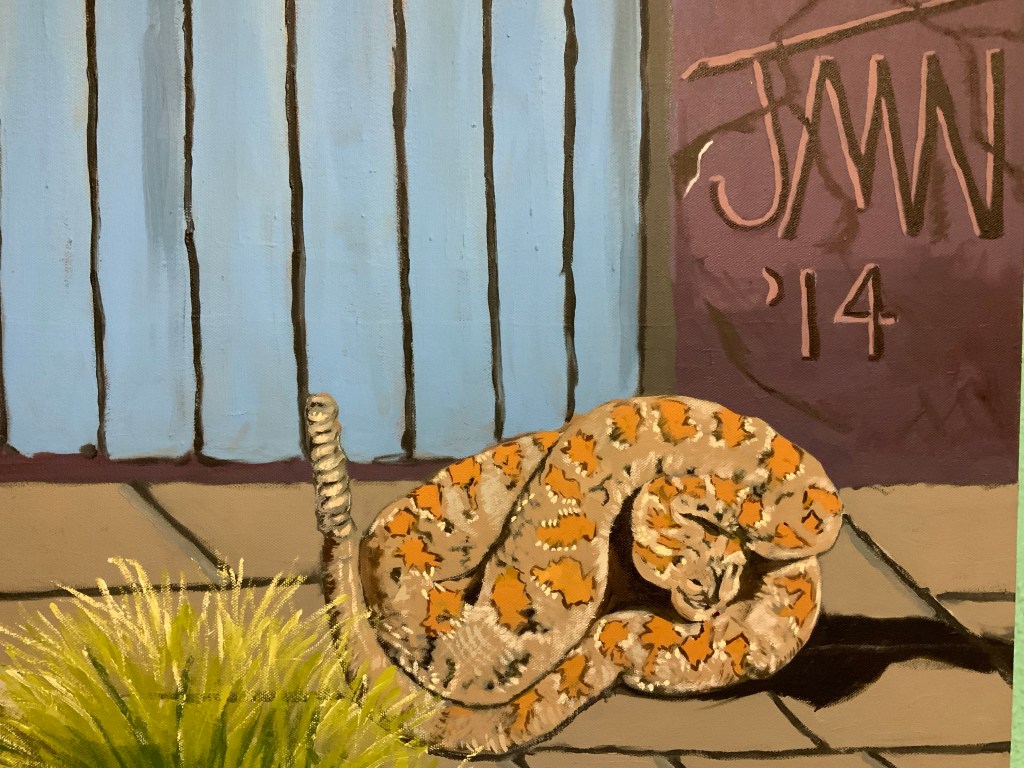
Detail, “Blue Gate,” oil on canvas, 48 x 48 in., (JMN, 2014),
I share my neck of the world with rattlesnakes, water moccasins, copperheads, coral snakes (red-on-yellow, kill a fellow) and cottonmouths. I can’t tell a moccasin from a cottonmouth — they frequent water, and I don’t. When I see one of the others, I know its name. On rare encounters with any of them, the first word that comes to mind is Snake! — followed by a respectful parting of ways by a magnificent creature left to live out its destiny in the natural order, and me.
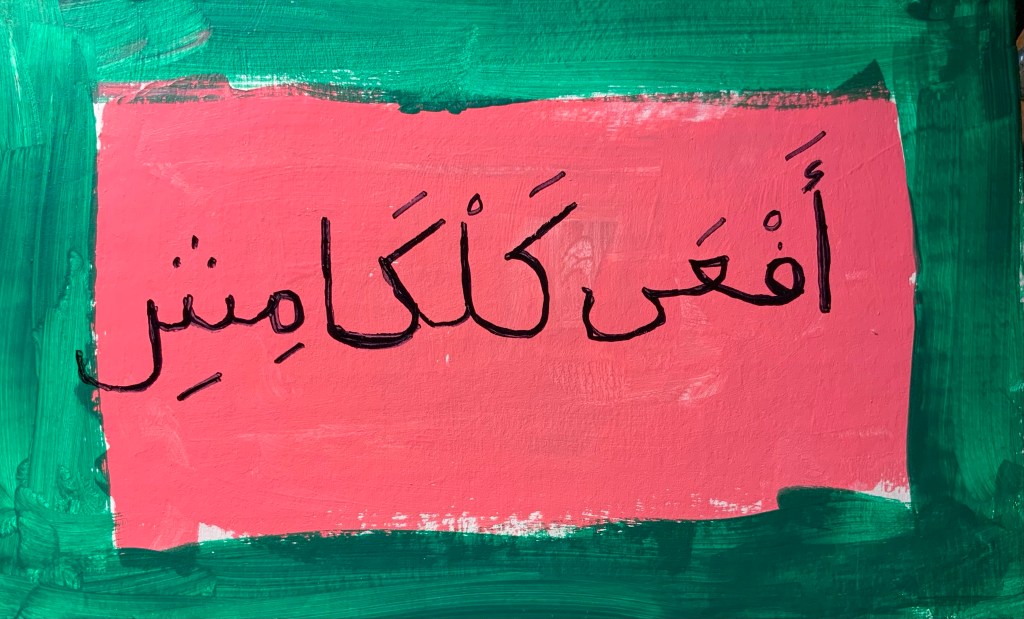
The Arabic title of “Gilgamesh’s Snake” (1) is ‘af^ā kalkāmiši.
‘af^ā kalkāmiši.
Hans Wehr (2) gives possible translations of ‘af^ān as: adder, viper, asp. Website http://www.wordhippo.com lists the following possibilities: boa, serpent, adder, worm.
The translation “snake” appears in two other Wehr entries: ḥayyaẗun (snake, serpent, viper) and ṯu^bān (snake).
ḥayyaẗun | ṯu^bān.
Why didn’t Ghareeb Iskander title his poem ḥayyaẗu kalkāmiši or ṯu^bānu kalkāmiši? I’m not equipped to know if the question is valid, much less answer it. The Arabic-speaking poet chose his word. Due respect.
As for the the English version of the title, if the choice is adder, viper, asp, boa, serpent or worm, why choose snake? In the translator’s shoes, I would think like this: Worm is an outlier. Serpent carries too much biblical baggage. Adder, asp, or boa would titillate a roomful of herpetologists. Why not Gilgamesh’s Viper? Viper has poetry power, a two-pronged, sonic bite plus lots of innuendo. That’s the problem, however; it’s too aggressive, too front-loaded for the poem’s trajectory. I can see why snake was chosen. Dictionaries guide, translators decide.
May I pose a quibble that turns on structure, not lexicon? The phrase “Gilgamesh’s Snake” uses the mainstream English possessive construction. But English can express a relation of ownership (or origin) with a prepositional phrase, as well. “The Snake of Gilgamesh” reflects the Arabic genitive: ‘af^ā kalkāmiši. I’m given to reflect on the virtues of mirroring source language structure where possible when translating a poem. A translated text need not always have a comfortable, vernacular vibe. If it sounds offbeat to the reader, there’s this to consider: Poetry often takes the path less traveled.
Notes
(1) Gilgamesh’s Snake and Other Poems, Ghareeb Iskander, Bilingual Edition, Translated from the Arabic by John Glenday and Ghareeb Iskander, Syracuse University Press, 2015. (2) Hans Wehr, A Dictionary of Modern Written Arabic, Edited by J. Milton Cowan, Cornell University Press, 1966.
“Sister on South Padre,” oil on canvas, 16 x 20 in. (JMN 2022)
When I’m tempted to post something here with greater frequency than usual, I ask myself: Am I in thrall to a voracious craving for plaudits? Am I a prelapsarian Ozymandias? An attention-seeking missile? Look what I’ve thought — done! — made! — seen! BOOM!
A remnant of my freshman swoon over all things French rears its head. It’s the aphorism clung to by chaise-longue cartesians of my ilk: Je pense, donc je suis. Cogito, ergo sum. I think, therefore I am.
I couldn’t make it through the title of this post without stooping to japery. I intended to write “Je pense, donc je blogue” (“I Think, Therefore I Blog”), but “… Therefore I Jest” forced its way out. (Monsieur Allard, French guru at Trinity, stuffed our heads with essential slang.) Perhaps I couldn’t keep a straight face at the reach for loftiness.
Reading about poet Sharon Olds, I learned something I had forgotten: Don’t assume writing that expresses joy or anguish is confessional. Her interviewer, Sam Anderson, writes of the canonical stance to maintain: “‘I’ is a character, like any other — maybe especially when it seems to be telling the truth.”
… It’s paper and pen. It’s not a person. It’s a speaker’s vision of a person.
(Sharon Olds)
I must remember this when reading a certain Spanish blogger whose work I admire. Also, by the way, Olds gives me insight into why I blog.
The act of writing itself, she insists, is fun — a physical discipline that sits somewhere between drawing and dancing.
(Sam Anderson)
Olds describes herself as “kind of a fussbudget,” and the bulk of her writing never reaches the public. Her finished books tend to be slim, but “carry inside them, hidden like dark matter, the gravity of all the unpublished writing that helped make them possible.”
[Guardian caption] Birth of Venus by Sandro Botticelli, which has been used by the French fashion house Jean Paul Gaultier without permission. Photograph: World History Archive/Alamy.
… According to Italian law, any use of the country’s publicly owned art to sell merchandise requires permission and payment of a fee.
(Angela Giuffrida)
Who “owns” reproduced images pulled from Botticelli’s cloying, excessively familiar painting? The presumption to be drawn from this article is that they’re owned by the public of Italy. (!)
The Uffizi itself uses its artworks to sell merchandise in its shop…
(Ibid.)
“‘Everything sold in the Uffizi shop is of course authorised and for every item sold we receive a certain percentage,’ said [Eike Schmidt, director of the Uffizi Galleries] … ‘Do you need to wear a T-shirt with Botticelli on it? Some people like to….’”
(Angela Giuffrida, “Uffizi Galleries sue Jean Paul Gaultier over use of Botticelli images,” theguardian.com, 10-10-22)
‘Cold-thinned light’: Mont Sainte-Victoire seen from Les Lauves, 1904. Private collection.
There is almost nothing to see, and yet everything is there.
(Laura Cumming)
Cumming gives a lyrical account of her responses to Cezanne. (I learn from her that the artist dropped the acute accent from his name in his signature.) She mentions specifics of his practice: … extraordinary whites that are not white at all… There is a watercolour here where the only indication of the lemon on a tray is a shapely blank, touched with a yellow dab; which is all, and more, than you need.
She has much to say about his brushwork: … short, straight strokes, something like striations or the delicate marks of a chisel in wood… Sometimes… more like stippling, dappling or ribboning stripes… How curious it is that these straight strokes are constantly required to account for the world’s roundness… The desire to touch the paintings is acute: to run your finger along his brushstrokes and understand their movement…
“I have never heard an admirer [of Cezanne]… give me a clear and precise account of his admiration.”
(Maurice Denis)
Cumming concludes with a noteworthy phrase: “It is worth remembering Denis’s remark to release yourself from the burden of exegesis at Tate Modern.” [my bolding]
An interesting feature of a translation is how “faithful” it is to the source text. Faithfulness (a slippery term) tends to be a matter of degree, to fluctuate as the translation goes forward. The translator, sailing his small boat, tacks as necessary to maintain a heading. Gauging how he inhabits the wind needs a vocabulary. Here’s one I’ve devised for comment on translated text:
Congruent: matches the source text fairly closely, with minimal liberties taken for readability. Expansive: adds interpretive structure or content not discernible in the source text but plausibly deriving from it. Inventive: carries the “expansive” element to a level not obviously supported by the source text.
Note the adverbs “fairly,” plausibly” and “obviously” used above; they signal choppy waters respecting rigor and consistency of application.
There’s a fourth and final label to be used sparingly because it suggests that the translation betrays the poem in some way — a bold allegation. The label is Transgressive.
This excerpt from ‘Song’ (1) applies the labels line-by-line for illustrative purposes. In practice, there’s little need to mark congruency — it’s the departures from it that illuminate. (The published version is in italics.)
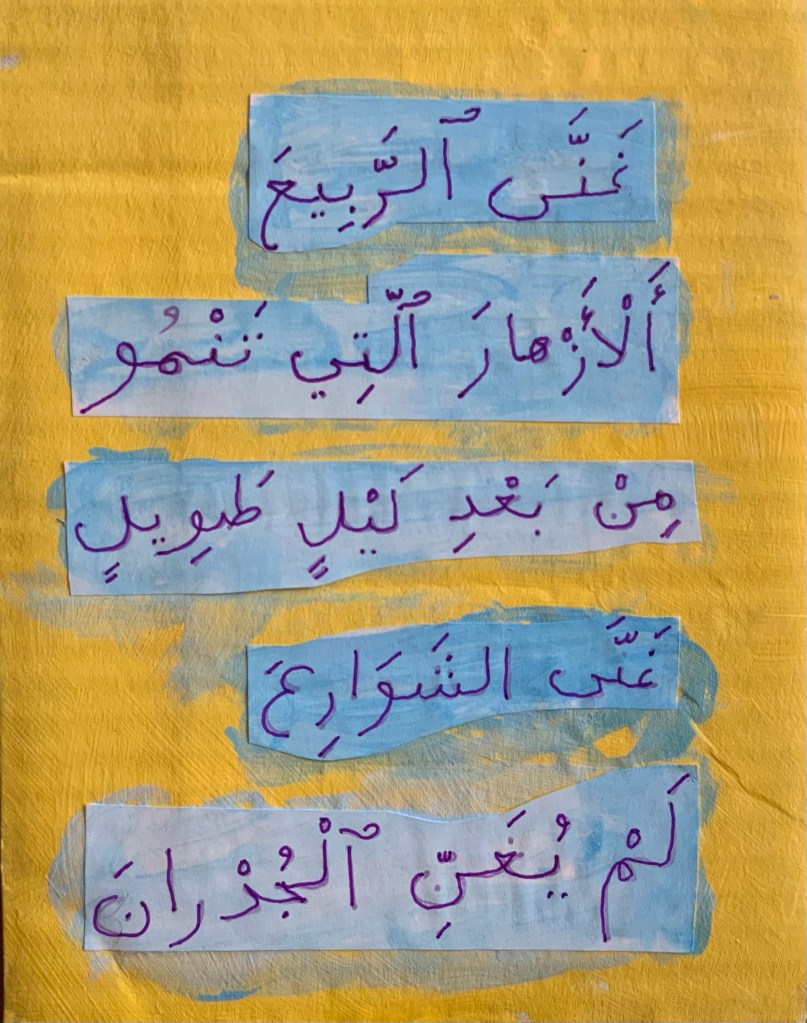
Sang the spring — [ḡannā-r-rabī^a —] He sang springtime — [Congruent]
the flowers that grow [‘al-azhāra-l-latī tanmū] the flowers that open themselves [Expansive. Root n-m-w of tanmū is only “grow,” but the suggestion of “opening,” as in blooming is congenial to the context. I find the reflexive verb “open themselves” oddly specific. On the other hand, “grow” is flat and general. The poet was capable of writing the equivalent of “opening themselves” in Arabic, and did not. To what extent the translator is entitled to groom his rendering to make it spicier or more attractive to the ear of the target reader is a delicate issue. I cautiously favor submissiveness to the tone and tenor of the source so far as the translator can apprehend and reflect these.]
after a long night. [min ba^di laylin ṭawīlin] after a long night. [Congruent]
Sang the streets, [ḡannā-š-šawāri^a] He sang the streets [Congruent]
did not sing the walls. [lam yuḡanni-l-judrāna] but he wouldn’t sing the hindering walls. [Inventive verging on Transgressive. The Arabic is starkly declarative and unconditioned preterite. The coordinating “but” is absent; in the translation it introduces a contrast.“Wouldn’t” lends a suggestion of rebellious intent, of refusal, a willful withholding of song by the singer. “Hindering” isn’t an exclusive trait of walls; they can also protect. It’s possible the epithet volunteered here becomes meaningful later in the poem. If so, is it fair for the translation to get ahead of things? If it doesn’t find subsequent validation, “hindering” seems all the more unsolicited.]
A pause for meditation: Hemingway thought he admired Dostoyevsky’s writing, but knew no Russian. It was translator Constance Garnett’s carved down version of the Russian’s prose into a trimmer English shape that constituted what the American was exposed to. He liked those short, declarative sentences that Dostoyevsky didn’t write. (2)
To be continued.
————-
Notes
(1) Gilgamesh’s Snake and Other Poems, Ghareeb Iskander, Bilingual Edition, Translated from the Arabic by John Glenday and Ghareeb Iskander, Syracuse University Press, 2015. (2) David Remnick, “The Translation Wars,” The New Yorker, 10-30-05): https://www.newyorker.com/magazine/2005/11/07/the-translation-wars





 EthicalDative
The Case for Rhythm and Emptiness
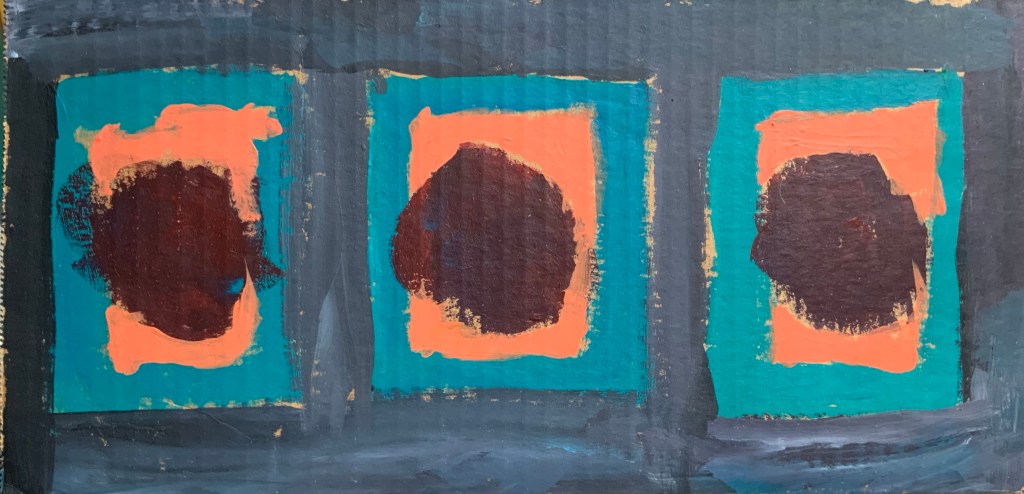
Brazilian artist Maxwell Alexandre speaks of how exposure to Kerry James Marshall’s painting made him aware of “an absence of representation. You would ask a Black kid to draw a person and he would draw a white person… Just by looking at [Marshall’s] body of work, where every character is Black, it shattered something.”
It’s intriguing to speculate what form children’s drawn depictions of persons of different race would take.
This well-spoken painter’s kitchen-sink approach to media is beguiling. His figures, brushy and flat, jump off their kraft paper with something of a fashion flair. A barefoot, disquietingly faceless male in dangling bib overalls sports a septum ring and assorted bling, along with blonde hair, as his sole discernible features.
Alexandre identifies with the “Black figuration” movement in Brazilian painting. It fills a vital gap, he says.
“… You are much likelier to be successful if you deal with this [movement] than if you want to discuss rhythm and emptiness. But you flatten the possibility of expression for young Black artists. You don’t have white figuration. Because white people have been representing the white figure for so long, they can move on to the sublime.”
“Move on to the sublime”! The lofty phrase sticks a landing. Regarding the direction his own work may take, Alexandre speculates: “It becomes abstract, which I would like to do more of.”
As would I. The way he paints his becoming mindset with words, not just shoe polish, Alexandre incites me to think of abstraction as the endpoint, a destination hard to reach, but out there.
(Arthur Lubow, “How Rollerblading Propelled Maxwell Alexandre’s Art Career,” New York Times, 10-25-22)
(c) 2022 JMN — EthicalDative. All rights reserved