Benjamin Colman, the curator of the exhibition, standing next to a Corvette Stingray Racer and Ed Ruscha’s “Standard Station, Amarillo, Texas.” Credit… Nick Hagen for The New York Times; Ed Ruscha, Hood Museum of Art.
… The D.I.A. exhibition set out to communicate the journey that started with a designer’s vision… For instance, the ’70 Barracuda is seen not only as a production model on display but also in a development sketch, rendered in Prismacolor on vellum in 1967 by Milton Antonick, a Chrysler designer. Mr. Colman describes this image of the car’s tail end as “a humble drawing, an informal working document” that serves to bridge the gap between a styling concept and the final product made of sheet metal.
Milton Antonick, “Barracuda Rear Form Sketch for Clay Development,” 1967 Credit… Milton Antonick Collection.
The discipline of creating a car’s look is today known as design, but in earlier times… the creators of curvaceous fenders and chrome flourishes were called stylists. “It was a matter of looking to how the practitioners described themselves in the era,” Mr. Colman said. “We felt it important to keep the historical language.”
A 1970 Plymouth Barracuda. Credit… Nick Hagen for The New York Times.
“… These cars represent what I think has been a higher level of optimism in America. The world is changing, and we might be highlighting the end of an era, the moment just before the meteor wiped out the dinosaurs.”
(Norman Mayersohn, “‘A Love Letter to Detroit’ on Vellum and Chrome,” NYTimes, 11-26-20)
Epilogue: Mr. Colman, the exhibition’s curator, commutes to work by bicycle.
Vice President-elect Kamala Harris wore a white pantsuit with a white pussy-bow blouse when she and President-elect Joseph R. Biden Jr. spoke on Saturday night. Credit… Erin Schaff/The New York Times.
The pussy-bow blouse: the quintessential working woman’s uniform in the years when they began to flood into the professional sphere; the female version of the tie; the power accessory of Margaret Thatcher, the first female British prime minister.
(Vanessa Friedman, “Kamala Harris in a White Suit, Dressing for History,” NYTimes, 11-8-20)
[XCIX] Otros días vendrán, será entendido Other days will come, there will be heard el silencio de plantas y planetas the silence of plants and planets. ¡y cuántas cosas puras pasarán! And so many pure things will happen! ¡Tendrán olor a luna los violines! Violins will have a scent of moon!
El pan será tal vez como tú eres: Bread will be, perhaps, the same as you: tendrá tu voz, tu condición de trigo, it will have your voice, your condition of wheat, y hablarán otras cosas con tu voz: and other things will speak with your voice: los caballos perdidos del Otoño. the lost horses of Autumn.
Aunque no sea como está dispuesto Although it may not be as stipulated el amor llenará grandes barricas love will fill enormous casks como la antigua miel de los pastores, like the ancient honey of the shepherds,
y tú en el polvo de mi corazón and you in the dust of my heart (en donde habrán inmensos almacenes) (where there will be immense storage vessels) irás y volverás entre sandías. will come and go among the watermelons. (Pablo Neruda. English translation by JMN)
Veinte poemas de amor y una canción desesperada. Cien sonetos de amor 1924, Pablo Neruda y Herederos de Pablo Neruda 1994, Random House Mondadori Cuarta edición en U.S.A: febrero 2004
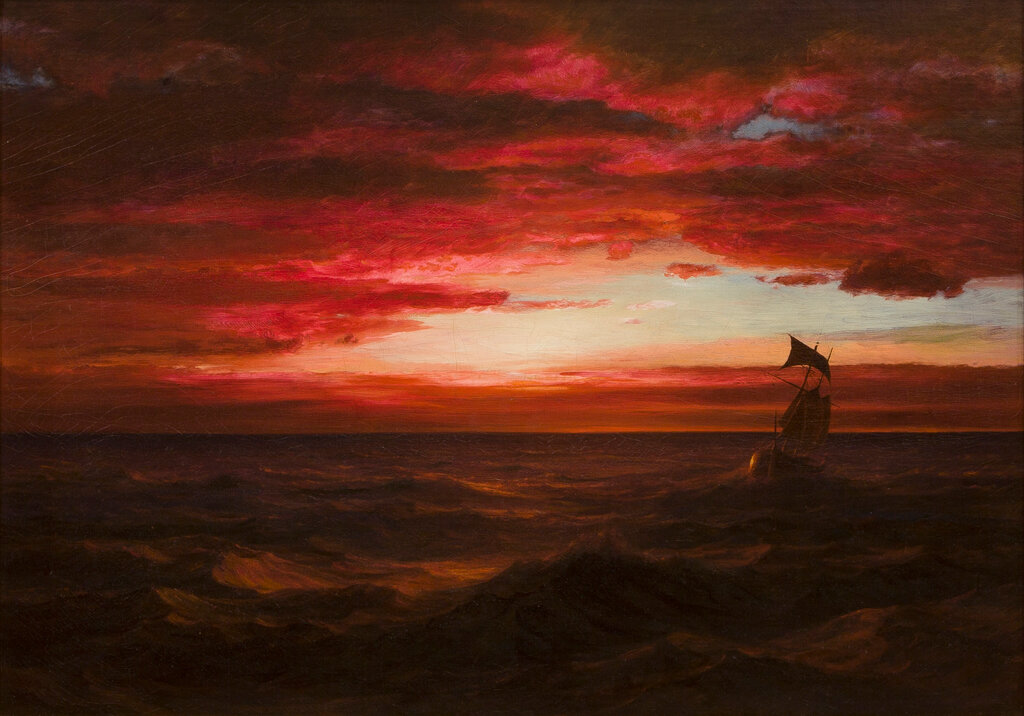
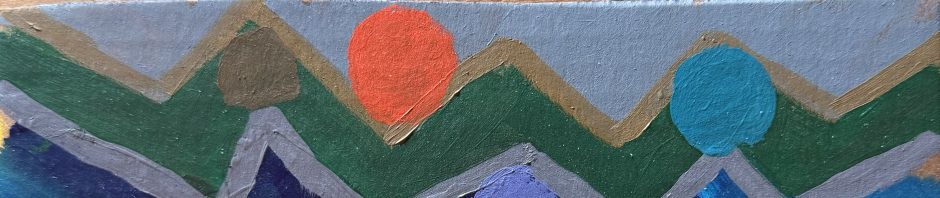
“Knots Bound,” oil on canvas, 16 x 20 in. (JMN 2020)
[C] En medio de la tierra apartaré In the midst of the earth I will separate las esmeraldas para divisarte the emeralds in order to spot you, y tú estarás copiando las espigas and you will be copying the ears of grain con una pluma de agua mensajera. with a pen of messengering water.
¡Qué mundo! ¡Qué profundo perejil! What a world! What a profound adornment! ¡Qué nave navegando en la dulzura! What a boat sailing in sweetness! ¡Y tú tal vez y yo tal vez topacio! And you perhaps and I perhaps topaz! Ya no habrá división en las campanas. There will no longer be division in the bells.
Ya no habrá sino todo el aire libre, There will be nothing but the open air, las manzanas llevadas por el viento, the apples carried by the wind, el suculento libro en la enramada, the succulent book in the arbor,
y allí donde respiran los claveles and there where the carnations breathe fundaremos un traje que resista we will make a suit that holds up la eternidad de un beso victorioso. to the eternity of a triumphant kiss.
(Pablo Neruda. English translation by JMN)
Veinte poemas de amor y una canción desesperada. Cien sonetos de amor 1924, Pablo Neruda y Herederos de Pablo Neruda 1994, Random House Mondadori Cuarta edición en U.S.A: febrero 2004
The glowing translucent glass exterior of the Nancy and Rich Kinder Building by Steven Holl Architects is characterized by porosity and opens to seven gardens. It contains the museum’s modern and contemporary art collection, 25 percent of which is Latin American and Latino. Credit… Peter Molick.
Mari Carmen Ramírez, curator of Latin American art at the Museum of Fine Arts, Houston, has focused on collecting its less traveled avenues. “We have bet on artists who were not that well known in the U.S. or who had absolutely no market presence but we knew how important they were for art history,” she said.
The Colombian artist Fanny Sanín, a pioneer of geometric abstraction, created “Acrylic No. 5,” 1973, acrylic on canvas, at the Museum of Fine Arts, Houston. Credit… Fanny Sanin and Museum of Fine Arts, Houston.
Fanny Sanín was born in 1938 in Bogotá, Colombia, educated in London, and has been based in New York since 1971… “She’s a very interesting hinge figure who has never really entered the mainstream,” said Ms. Ramírez, who found the large-scale painting “Acrylic No. 5” (1973) hanging on the bedroom wall of Ms. Sanín’s small Manhattan apartment…
Elsa Gramcko’s “Oráculo,” from 1964, gears and diverse industrial materials on wood, the Museum of Fine Arts, Houston. Credit… Estate of Elsa Gramcko and Museum of Fine Arts, Houston.
Virtually unknown outside Venezuela, where she spent her life (1925-94), Elsa Gramcko was largely self-taught and a pioneer of incorporating industrial refuse as an art material.
(Hilarie M. Sheets, “Inspiration from South of the Border Moves Center Stage in Houston,” NYTimes, 11-13-20)
This article reports a sad event, the snatching of a family dog by a mountain lion.
That misfortune notwithstanding, it solves a longstanding puzzle for me by clarifying that mountain lions, pumas, cougars, panthers, and catamounts are the same animal, i.e. different names for the same large cat.
Mountain lions (Puma concolor) are a large cat species native to the Americas, with a range stretching from Canada’s Yukon Territory to the Strait of Magellan in the south. In the U.S., they are mostly found in 14 western states, inhabiting environments including mountains, forests, deserts and wetlands.
This has led me to reflect on an opposite problem I’ve had with Spanish, which is the paucity of its lexicon for “elk” and “moose”; both are called “alce.” It does, however, distinguish “caribou” as “caribú.”
(Aristos Georgious, “Mountain Lion Snatches Family Dog As They Sat in Idaho Hot Spring,” Newsweek, 11-11-20)
Lord Kilclooney, crossbench peer in the UK House of Lords, tweeted:
“What happens if Biden moves on and the Indian becomes President. Who then becomes Vice President?”
Later he tweeted:
“I’m very fond of India myself, I’m a member of the British India all-party group, I have two Indians (tenants) in my flats here in London and there’s nothing racist in it whatsoever.”
Here is narrative from a 1960 American novel. A character ascends a staircase to the mezzanine of a house to join another person there:
There comes to me in the ascent a brief annunciatory syllable in the throat stopped in the scrape of a chair as if, having signaled me and repented of it, it had then to pass itself off as but one of the small day noises of the house. Off the landing is a dark little mezzanine arranged as a room of furniture. It is a place one passes twenty times a day and no more thinks of entering than of entering a picture, nor even looking at, but having entered, enters with all the oddness of entering a picture, a tableau in depth wherein space [is] untenanted and wherefrom the view of the house, the hall and dining room below, seems at once privileged and strange. Kate is there in the shadows. (“The Moviegoer,” Walker Percy)
The passage has a limbic resonance: allusive, sly, eccentric, cryptic, contortive, shaded. It unfamiliarizes the prosaic, imbues it with the surprise of something painted at a swoopish angle, out of kilter; privileged and strange, indeed, whatever that quite means.
“The single most important thing we want to achieve is for President Obama to be a one-term president.” (Mitch McConnell, in October 2010)
OZYMITCHIAS Regnant canker, excrescent knob, coonskin gerrymandarin of the scrotal void, inverted rictus of obstructionism, hollowed be thy name! Where laws go to die, malignant solon, turdiform conniver, is in thy fiddlebusted, chambered morgue.
In the republic of the mean, the ornery, fair, Ozymitchias, thou never wert. Look upon his deeds, Democracy, And weep the sacred trust his wiles pervert. (JMN)
New York-born Jordan Nassar has Palestinian family roots. His show’s title “I Cut the Sky in Two” is from a poem by Etel Adnan, “the distinguished Lebanese-American painter and poet, and a touchstone for Mr. Nassar.”
He is best known for his embroidery work, some of it in collaboration with female Palestinian artisans.
Jordan Nassar’s “A Yellow World A Blue Sun,” from 2020, hand-embroidered cotton on cotton. Credit… Jordan Nassar and James Cohan.
… [Nassar] employs tatreez, Palestinian cross-stitch embroidery, to generate fields of ornate geometric patterns and interrupt them with insets of evocative, abstract landscapes — hills and valleys, the sun and sky..
Jordan Nassar’s “Bab Al-Zuhur (Gate of Flowers),” from 2020, hand-flamed glass beads, steel, wire. Credit… Jordan Nassar and James Cohan.
This exhibition adds a new form: sculptures of glass beads, handmade in a style practiced in Hebron in the West Bank and mounted on undulating steel lattices, that depict landscapes in the same vein as the embroideries.
(“4 Art Gallery Shows to See Right Now,” NYTimes, 11-11-20)
From Concept to Chrome
“Detroit Style: Car Design in the Motor City, 1950-2020,” an exhibition at the Detroit Institute of Arts, opens this month and runs through next June.
… The D.I.A. exhibition set out to communicate the journey that started with a designer’s vision… For instance, the ’70 Barracuda is seen not only as a production model on display but also in a development sketch, rendered in Prismacolor on vellum in 1967 by Milton Antonick, a Chrysler designer. Mr. Colman describes this image of the car’s tail end as “a humble drawing, an informal working document” that serves to bridge the gap between a styling concept and the final product made of sheet metal.
Credit… Milton Antonick Collection.
The discipline of creating a car’s look is today known as design, but in earlier times… the creators of curvaceous fenders and chrome flourishes were called stylists. “It was a matter of looking to how the practitioners described themselves in the era,” Mr. Colman said. “We felt it important to keep the historical language.”
“… These cars represent what I think has been a higher level of optimism in America. The world is changing, and we might be highlighting the end of an era, the moment just before the meteor wiped out the dinosaurs.”
(Norman Mayersohn, “‘A Love Letter to Detroit’ on Vellum and Chrome,” NYTimes, 11-26-20)
Epilogue: Mr. Colman, the exhibition’s curator, commutes to work by bicycle.
(c) 2020 JMN