Wrangling among logocrats in the Anglo-Empyrean over how to pronounce something in the common language that separates us is good for a brief detox from the trumpical pandemia.
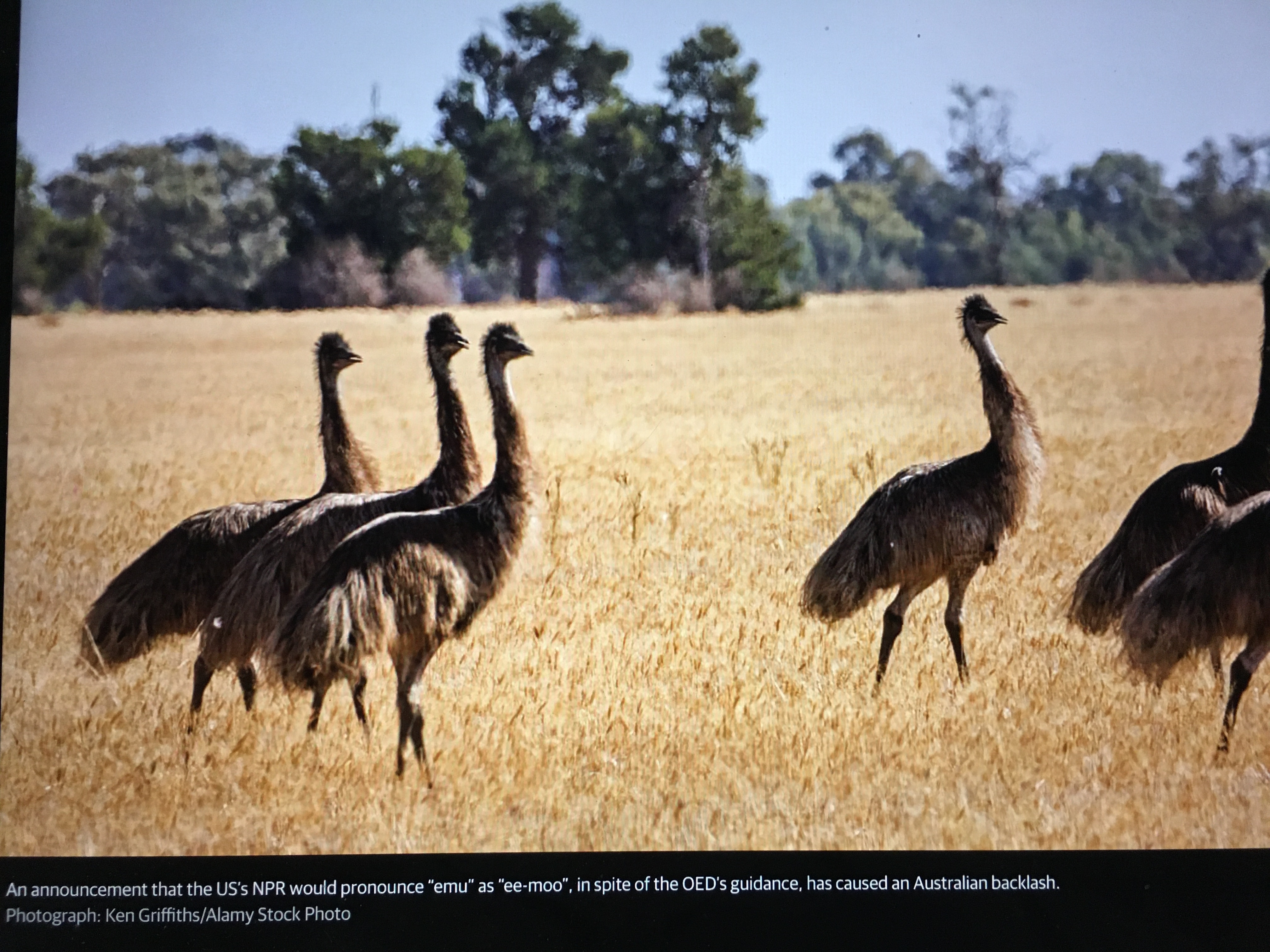
In August a Twitter-turd toss from Down Under landed on National Public Radio for pronouncing “emu” to rhyme with “poo” instead of “pew.”
(A few Texans have imported this native Australian and tried to reimagine it as a monetizable meat-bird. I don’t know that the enterprise has prospered.)
“Emu” is said to be an anglicised-Portuguese name in the first place. Who needs it?
According to reporting from NITV, the Warlpiri mob call emus “yankirri”, and the people of both the Gamilaraay and Wiradjuri nations referred to the bird as “thinawan” or “dinawan”.
(Matilda Boseley, “Ee-moo?! NPR’s ‘absurd’ pronunciation starts new emu war in Australia,” theguardian.com, 8-24-20)
I say let the native nations have the last word. It’s their bird.
(c) 2020 JMN






 EthicalDative
‘Burden of Representation’
Roberta Smith writes of the Rothko painting that it “presents a glowing stack in brown, red and black on a red ground.”
She describes the Church painting as “an expanse of shockingly deep red sky with a little sun peeping over a choppy black sea tossing a dark ship.”
Smith describes the colors of both paintings as “blunt” and compares them as follows:
Unburdened by representation, Rothko’s suspended blocks of autonomous color accentuate the strangeness of Church’s palette, especially the array of lavenders, pinks and yellows in his skies.
I always profit from Roberta Smith’s art criticism by feeling that I’ve seen art works (even those I like such as these two) a little more clearly after reading her comments. Her phrase “burden of representation” is striking. In my own modest easel practice, the greater challenge would be to paint non-representationally. In those territories, truly, there be dragons.
(c) 2020 JMN