Rosalía performing in Madrid in December. Credit… Juanjo Martin/EPA, via Shutterstock.
Jorge Carrión’s article was translated by Erin Goodman, and appeared in the NYTimes on January 26, 2020, entitled “Rosalía and the Art of the Remix.”
Rosalía is new to me, but personal and professional ties to Catalonia and Spain incline me towards her, the more so in view of her absorption of flamenco into her style.
Rosalía, whose full name is Rosalía Vila Tobella, was 13 when she first became spellbound by the music of Camarón de la Isla — a legendary Spanish Romani flamenco singer. She went on to spend a decade training with the flamenco virtuoso, José Miguel “El Chiqui” Vizcaya, before releasing “Los Ángeles,” which she described as “it’s flamenco and it’s not.” The vocal-driven concept album, which melds traditional styles with modern influences, propelled the genre forward.
Carrión pushes back cogently on purists and appropriation-criers who scold artists for straying from norms or crossing cultural boundaries. “Cultural crossover is not limited to Spanish artists,” he writes, calling it “[these] porous, promiscuous phenomena.”
Artistic expression cannot be limited by geopolitical borders nor copyright. Many of today’s artists are aesthetic nomads. Their work embodies, whether intentional or not, the intersection of art and globalization — the remix. No material, rhythm nor narrative can escape the remix because craft and imagination do not belong to one singular community, and nothing that is human is alien.
“Homo sum, humani nihil a me alienum puto.” I am human, and I think nothing human is alien to me. I remembered the saying from college Latin, but I needed Google to remind me that it’s Terence.
Due to social distancing, there were only two dozen or so reporters in the White House press briefing room. Photograph: Brendan Smialowski/AFP via Getty Images.
Dr. Anthony Fauci, director of the National Institute of Allergy and Infectious Diseases, has publicly corrected or qualified presidential assertions about the coronavirus threat on multiple occasions. Trump was asked why Fauci was absent from Monday’s lengthy press briefing.
Trump said: “I was just with him … he’s at the task force meeting right now.” Does he agree with you about the need to reopen the economy soon? Trump: “He doesn’t not agree.”
(David Smith, “Trump’s push to shorten coronavirus shutdown proves the captain is flying blind,” theguardian.com, 3-23-20)
This essay by Ai Weiwei, published in the NYTimes on January 13, 2020, was translated by Perry Link from the Chinese. (“Capitalism and ‘Culturecide’,” NYTimes).
I learn here that Ai Weiwei’s father, Ai Qing, was a poet who was banished for 20 years to Xinjiang, a “vast northwest area in China,” for having expressed himself too freely through his poetry.
It’s noted that Xinjiang is the home of the Uighurs, a Muslim ethnic group. About a million Uighurs have been sent to “‘re-education camps’ where they have been forced to denounce their religion and to swear fealty to the Communist Party of China.”
It’s also noted that numerous multinational corporations have factories in Xinjiang. They include Volkswagen, Siemens, Unilever and Nestlé.
Supply chains for Muji and Uniqlo depend on Xinjiang, and companies such as H & M, Esprit and Adidas use Xinjiang cotton… VW builds its cars in China, including the Audi, SEAT, Skoda, Bentley and Lamborghini brands under its umbrella. It has shown that it sees the future of German industry to be in China.”
Some two months after this essay appeared, we cower advisedly from what a careless president calls “the Chinese virus,” while much of what we consume is made in China — including vital generic drugs. The CEO of VW has said he knew nothing about the Uighur camps, though Ai Weiwei asserts otherwise. Supply chains that move food and medicine globally are groaning from disruption. We live in interesting times.
President Andrés Manuel López Obrador showing amulets that he says protect him from the coronavirus. Credit… Mexican Presidency/Agence France-Presse — Getty Images.
Hugging is the perfect symbol for Mr. López Obrador’s tropical populism. It portrays him as a warm man of the pueblo in contrast with the cold technocrats of what he calls “the mafia of power.” His slogan for trying to end the country’s drug war is “abrazos, no balazos,” or “hugs, not bullets.”
(Ioan Grillo, “Mexico, the Coronavirus and the Hugging President,” NYTimes, 3-23-20)
AMLO can’t catch a break. As he tries to smother narco-trafficking and femicide with hugs, a looming war on bugs — the coronavirus — now rears its head. Adding insult to irony, a gaggle of well-heeled Mexican skiers have trooped home from Vail infected with it.
On a positive note, a government social-distancing campaign has created a superhero icon named Susana Distancia, whose name is a play on “su sana distancia,” or “your healthy distance.” Ioan Grillo points out that Mexico has liabilities, but also assets, in the fight against the coronavirus.
Family networks are strong, making it easier to close schools. During recent natural disasters, I have witnessed great social solidarity… If cases of coronavirus infection do shoot up, as is likely, this solidarity could translate to help the distribution of food and support for affected families.
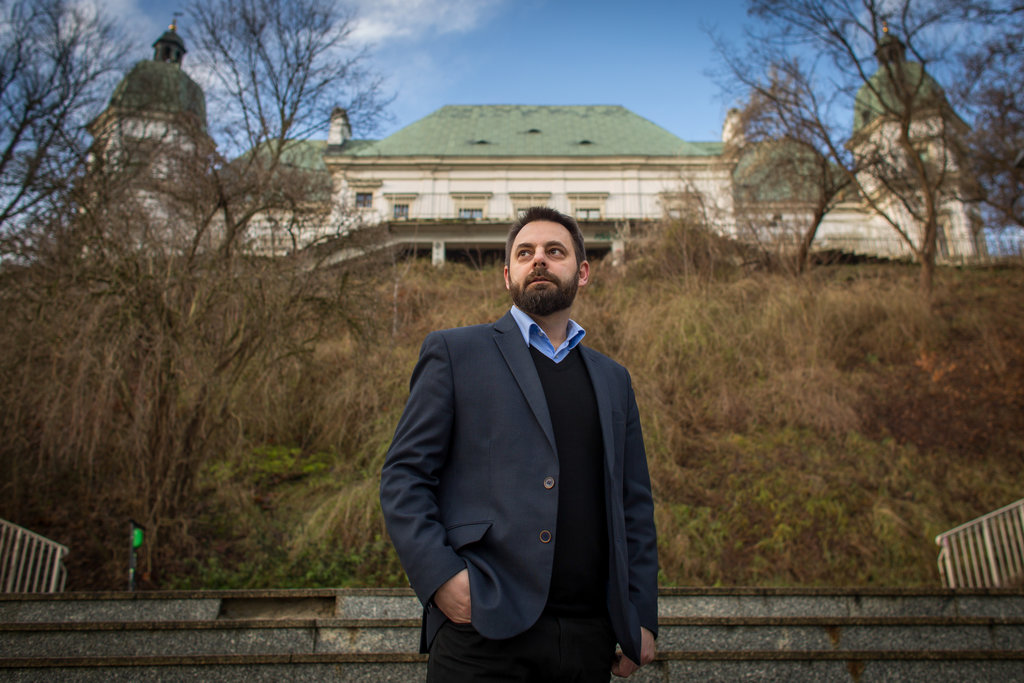
Piotr Bernatowicz, the new director of the Ujazdowski Castle Center for Contemporary Art in Warsaw, says Polish art is dominated by the left. Credit… Anna Liminowicz for The New York Times.
Piotr Bernatowicz is the new director of a leading Warsaw art museum, the Ujazdowski Castle Center for Contemporary Art. For three decades it has exhibited Poland’s leading experimental artists and hosted work by “international stars,” according to this article (Alex Marshall, “A Polish Museum Turns to the Right, and Artists Turn Away,” NYTimes, 1-8-2020).
“Scythe” by Henryk Blachnio, from the exhibition “The Power of Secrets” at the Ujazdowski, running through March 29. Credit… Anna Liminowicz for The New York Times.
Mr. Bernatowicz says artists who do not “make work about fighting climate change and fascism, or promoting gay rights” are marginalized. He wishes to “promote artists who have other views: conservative, patriotic, pro-family.”
His plans are making the museum into another battleground in Polish culture wars that “pit liberals against the governing populist Law and Justice Party, as well as other conservative groups,” according to the article.
[Karol] Radziszewski posing in front of a self-portait from his series “1989,” in which the artist depicts himself as Cinderella. Credit… Anna Liminowicz for The New York Times.
… Some art world figures said it will be difficult to find enough right-wing works to show. “I don’t know what a conservative artist is,” Malgorzata Ludwisiak, the Ujazdowski’s previous director, said. “If it means painting like in the 19th century — a lady on a horse — well, it’s not contemporary art.”
Mr. Bernatowicz says, “I hope within the next seven years, the situation will change.” (He has been appointed for a term of seven years — “far longer than normal.”)
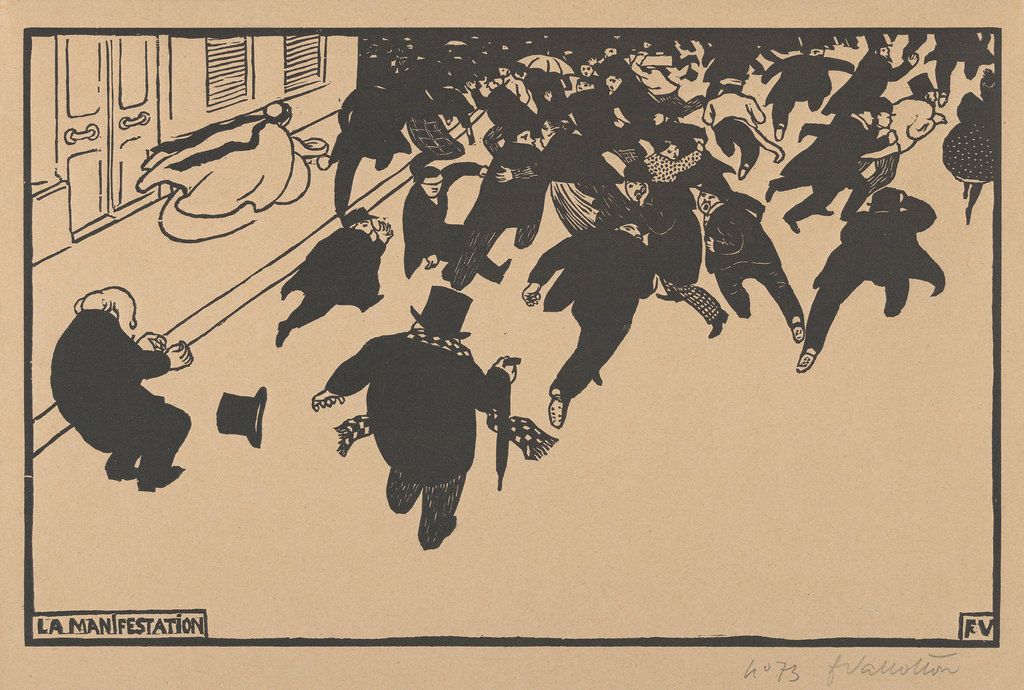
“The Demonstration” (1893), woodcut on paper, in the show “Félix Vallotton: Painter of Disquiet” at the Metropolitan Museum. Credit…The Metropolitan Museum of Art.
Roberta Smith remarks that by a certain point in the show “it becomes clear why [Félix] Vallotton is not considered a first-rate painter. Perhaps he was excessively skilled with too many options at his fingertips.”
It struck me as a wry dilemma to have to cope with excessive skill, but perhaps I divine her point. She describes the Swiss painter and printmaker as “an intriguing, talented but slippery artist.”
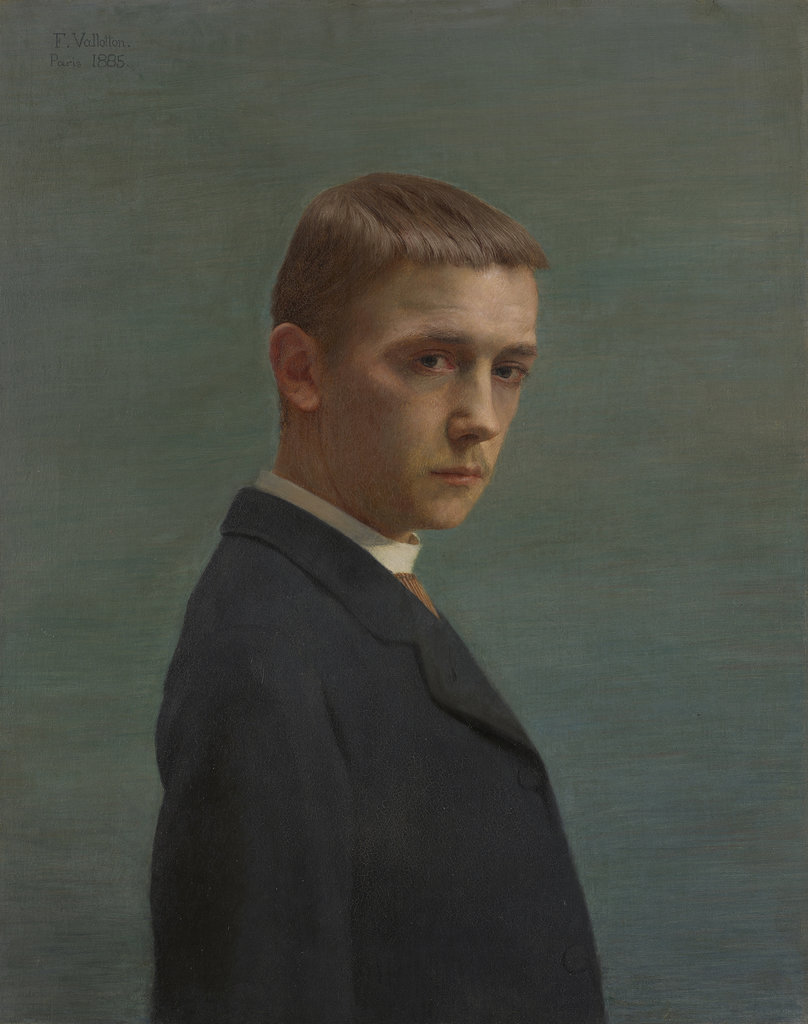
“Self-Portrait at the Age of 20,” from 1885, shows the artist looking wise beyond his years. Credit… Musée Cantonal [?] des Beaux-Arts de Lausanne.
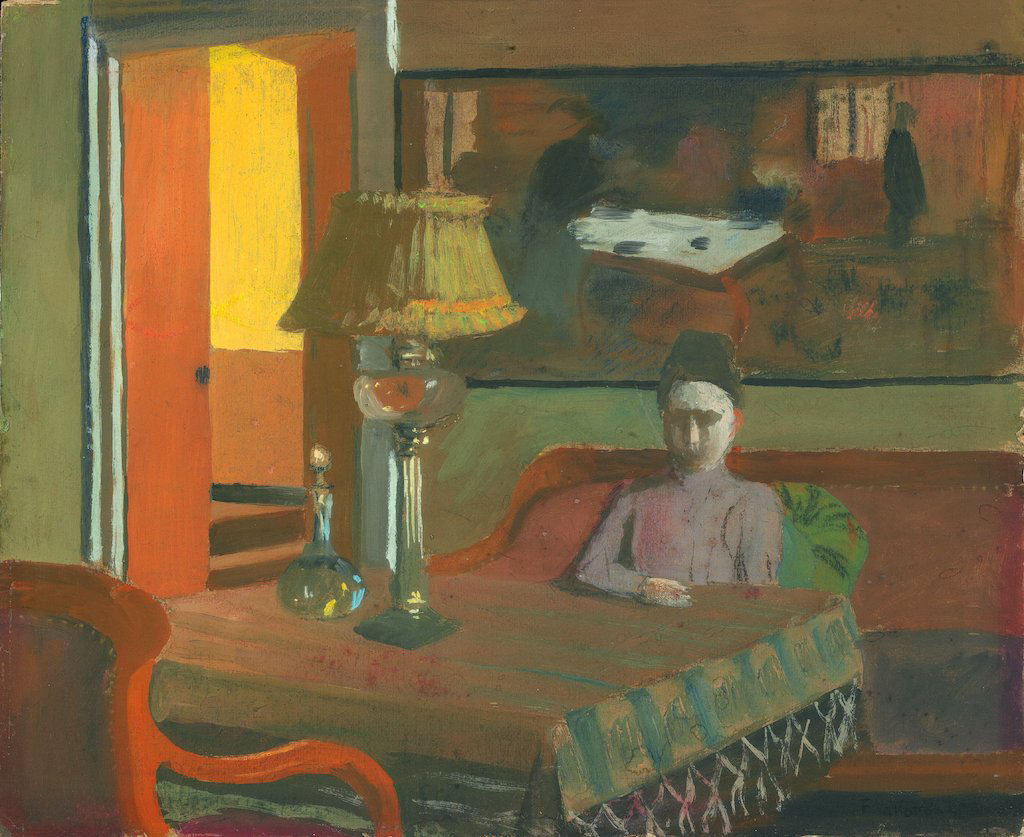
“Woman in a Purple Dress Under the Lamp” (1898). The woman was modeled by Hélène Chatenay, Vallotton’s companion of a decade. Credit…Hahnloser/Jaeggli Foundation, Villa Flora.
[The exhibition] reintroduces an artist who achieved early greatness in the relatively modest medium of prints and then either failed or declined to follow a single path in painting.
(Roberta Smith, “When He Was Good, He Was Breathtaking,” NYTimes, 1-6-20)
Side note: A substantial part of this article describes paintings that are not shown. It teases the reader and makes him wish the gorgeous verbiage were illustrated by its subject.
Senator Richard Burr at the Capitol last June. Credit…Mark Wilson/Getty Images.
Americans need leaders who rise to the occasion, not [my bolding] worry about their own pocketbooks.
(The Editorial Board, “Did Richard Burr and Kelly Loeffler Profit From the Pandemic?” NYTimes, 3-20-20)
I haven’t read this particular article, but my reflexive answer to the rhetorical query posed by the headline is, “Yes, of course!”
I’m going to engage in something more productive than confirming the obvious venality of corrupt public servants; I’m going to nitpick the syntax of the subheading cited above. It may seem a perversely trivial exercise for a brewing virus apocalypse.
Not so, I contend. Blinkered pols, hoarding hordes, flouting doubters, and concomitant ignorance, distortion, corruption, greed, incompetence, fallability, panic, delusion, and folly are readily available.
What’s in short supply is nitpicking over syntax, which I remedy here. This is the flawed subheading again for ready reference:
Americans need leaders who rise to the occasion, not worry about their own pocketbooks.
Here are three versions of it that fix the flaw:
A. Americans need leaders who rise to the occasion, not worrying about their own pocketbooks. (Adverb “not” governs an adverbial phrase of manner expressing “how” leaders rise.)
B. Americans need leaders who rise to the occasion and do not (don’t) worry about their own pocketbooks. (Adverb “not” is replaced by a negative verb phrase following a coordinating conjunction “and” introducing a dependent clause whose implied subject is a repeated “who.”)
C. Americans need leaders who rise to the occasion, not those who worry about their own pocketbooks. (Similar to B. Adverb “not” remains, but governs a dependent clause with a supplied demonstrative subject pronoun.)
The power of language and its potential to cure into poetry asserts itself the more we rise to the task of probing not ourselves and our own emotions but rather the thing outside us, the other, and its syntax.
Beppe Severgnini reminisced in early January about what he and millions of Continental Europeans have cherished about the United Kingdom.
Above all, we were mesmerized by that quaint country, where the citizens had pounds and not kilograms, restaurants served meat stew and mashed potatoes, families enjoyed donkey rides on the beach in the rain…
Because we feel the difference in atmosphere, physical and moral. “The curious, damp, blunt, good-humored, happy-go-lucky, old-established, slow-seeming formlessness of everything,” was the way the author John Galsworthy put it in 1917.
… The home of the ideas was always London: The best writing, the best films, the best music, the best soccer, the best design, arguably the best art and some of the smartest young people were there. Even the best food, lately, as people from Europe — and beyond — brought their skills and traditions.
(Beppe Severgnini, “What Now for Europeans Who Love Britain?” NYTimes, 1-6-20)
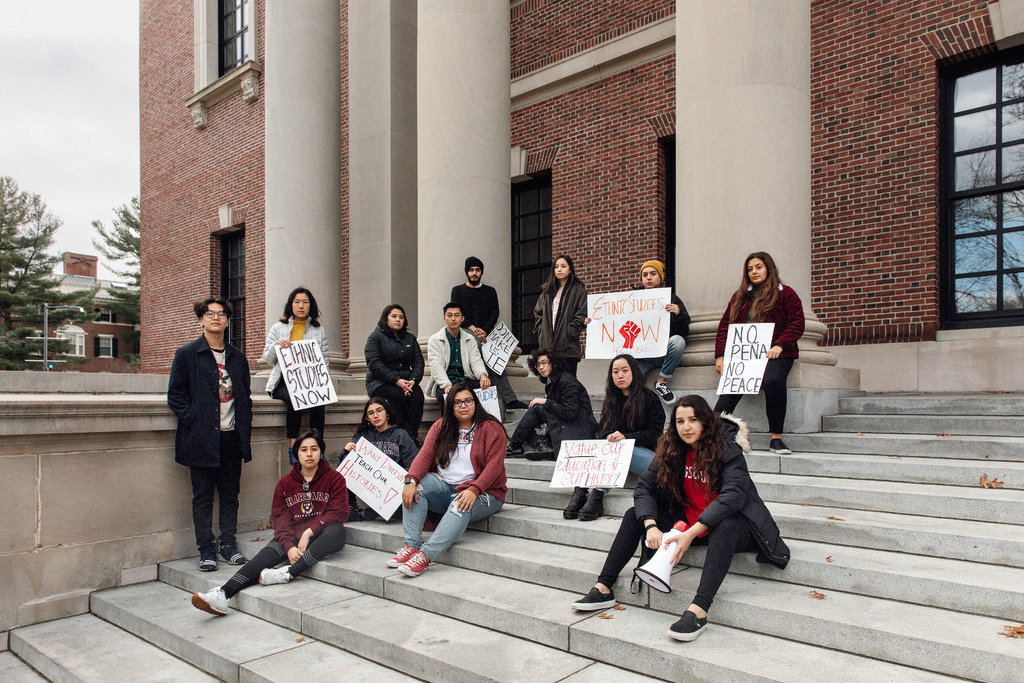
A group of students calling themselves the Harvard Ethnic Studies Coalition at the university’s Widener Library. Credit…Cody O’Loughlin for The New York Times.
Dr. García Peña has been involved in… the Department of Romance Languages and Literatures’ program in Latinx studies[my bolding]. (Latinx is a gender-neutral term for people of Latin American heritage, used commonly in academia.)
(Kate Taylor, “Denying a Professor Tenure, Harvard Sparks a Debate Over Ethnic Studies,” NYTimes, 1-2-20)
Ms. Taylor helpfully clarifies “Latinx” in her parentheses, since it’s not likely to be on everyone’s tongue. I’ve confessed before how the term nettles me; hence “redux” in the title.
Linguistically, the striving for gender freedom in woke English can collide with the ineradicable genderedness of other languages. Ecce “Latinx.”
In assimilating “Latino,” a Spanish word, English inherited the word’s masculine gender marking. Absent that marking we get “Latin,” which is native and has its uses — indeed had considerable currency in the past, along with “Hispanic,” for labeling persons of, or descended from, Spanish-speaking cultures of the Americas and Caribbean. (The proverbial “Latin lover” was not a man who cherished the orations of Cicero. He was Latinx!)
Grammatical gender follows no discernible logic. In Spanish, it ranges from la mujer (woman) and el hombre (man) to la gente (people); el pueblo (town); la sociedad (society); el ambiente (atmosphere); el mapa (map); la luz (light); el tema (theme); la catástrofe (catastrophe); el cutis (skin); la piel (skin, too); el imperio (empire); la soberanía (sovereignty); and so on.
No noun in Spanish lacks gender. Articles, as well as adjectives that are themselves susceptible to gender marking, must agree with the noun’s gender (not to mention its number). “Agree with” in grammar-talk means to adopt appropriate markings: la pared pintada (the painted wall); el vidrio pintado (the painted glass); los dibujos pintados (the painted drawings); las nubes pintadas (the painted clouds).
To import a Spanish word into English is to import its gender baggage in one form or the other: masculine or feminine — “Latino” vs “Latina.” X-ing the gender suffix creates a scratchy neologism. Perhaps “Latinx” will catch on outside ivied precincts; perhaps not.
My pickiest beef with “Latinx” concerns its combination with “studies.” I suggest that the phrase it replaces — “Latino studies” — does not mean the study of Latinx-ers who are male. (It would require the sister discipline: “Latina studies.”) Rather, “Latino” classifies that discipline whose subjects are the peoples and cultures of the Spanish-speaking Americas — just as “Bible studies” are not the study of physical Bibles, but of the biblical canon in all its aspects.
A sign points the way to a National Health Service testing service area for coronavirus assessment at University College Hospital in London. Credit…Isabel Infantes/Agence France-Presse — Getty Images.
Britain is a rich country and may fare better than others. But the N.H.S. is creaking at the seams after years of underfunding[my bolding]. A decade of cuts by successive Conservative governments has stripped the service of resources. Staff morale is low and retention is poor. We are already working at capacity.
(Jessica Potter, “I’m a Doctor in Britain. We’re Heading Into the Abyss,” NYTimes, 3-18-20)
I live in a state that’s been cherry-red since Ann Richards was defeated by ‘W’ in 1994. “Creaking at the seams after years of underfunding” is an apt descriptor for the Texas healthcare system, and indeed for the U.S. system in general. True to form, the Grand Old Party has striven mightily to splay, flay, and fillet Obamacare from the very day of its enactment, down to the present moment.
One of my projects for the new era of isolation and social distancing we live in is to research why efficient, equitable, well-functioning, robust public healthcare systems appear to be anathema to white conservatives in two “advanced” countries.
Dr. Drew Pinsky has condoned flouting the directives of public health officials. Credit…Rich Fury/Getty Images.
Related topic to explore: Why do conservatives such as Drew Pinsky, Rob Schneider, Sean Hannity, Sharyl Attkison, Jerry Falwell Jr. and Ron Paul scoff in various ways at the virus scare?
“This is not affecting people who are healthy,” Mr. Schneider said, falsely.
(Jeremy W. Peters, “From Jerry Falwell Jr. to Dr. Drew: 5 Coronavirus Doubters,” NYTimes, 3-18-30)










 EthicalDative
“Porous, Promiscuous Phenomena”
Jorge Carrión’s article was translated by Erin Goodman, and appeared in the NYTimes on January 26, 2020, entitled “Rosalía and the Art of the Remix.”
Rosalía is new to me, but personal and professional ties to Catalonia and Spain incline me towards her, the more so in view of her absorption of flamenco into her style.
Rosalía, whose full name is Rosalía Vila Tobella, was 13 when she first became spellbound by the music of Camarón de la Isla — a legendary Spanish Romani flamenco singer. She went on to spend a decade training with the flamenco virtuoso, José Miguel “El Chiqui” Vizcaya, before releasing “Los Ángeles,” which she described as “it’s flamenco and it’s not.” The vocal-driven concept album, which melds traditional styles with modern influences, propelled the genre forward.
Carrión pushes back cogently on purists and appropriation-criers who scold artists for straying from norms or crossing cultural boundaries. “Cultural crossover is not limited to Spanish artists,” he writes, calling it “[these] porous, promiscuous phenomena.”
Artistic expression cannot be limited by geopolitical borders nor copyright. Many of today’s artists are aesthetic nomads. Their work embodies, whether intentional or not, the intersection of art and globalization — the remix. No material, rhythm nor narrative can escape the remix because craft and imagination do not belong to one singular community, and nothing that is human is alien.
“Homo sum, humani nihil a me alienum puto.” I am human, and I think nothing human is alien to me. I remembered the saying from college Latin, but I needed Google to remind me that it’s Terence.
(c) 2020 JMN