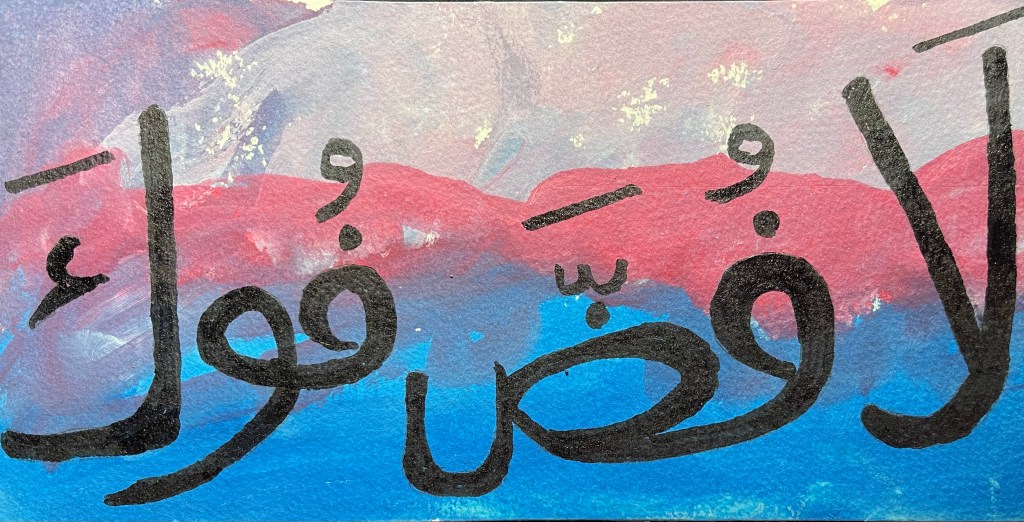
The world / was whole because / it shattered. When it shattered, / then we knew what it was.
“Formaggio” is Italian for “cheese.” The poem so titled is in Louise Glück’s book Vita Nova. On first reading I experienced the poem as an affront. The malaise it induces is apparent in its first lines (quoted above). I can climb out of my funk only through paraphrase
A thing — the very world — is affirmed intact because it broke apart, or perhaps was perceived whole in hindsight as a consequence of its disintegration. When it broke up, then we knew what it was. Those conjunctions — because, then — are consequential in the hands of a stylist as meticulous as Glück.
It never healed itself. / But in the deep fissures, smaller worlds appeared: / it was a good thing that human beings made them: / human beings know what they need, / better than any god.
In the cracks of a chronic lesion, aftermath of a cosmos splintered into unity, there appeared not shrapnel but mini-worlds created by us, and a good thing, too, for we know our needs better than any god. The theology rings true enough, but the rest is nonsense: the arc of Homo erectus’ spawn is short, and bends toward self-destruction, as current events attest.
My peevish commentary will sink of its own weight if pursued much further. Suffice it to say, the worlds we created became stores on Huron Avenue — a Chicago or Hamtramck of the mind where fish and cheese are sold — and they are visions of safety. Like a resting place, staffed by persons who could be parents, only kinder.
As tributaries feed a large river, the speaker had many lives, one or more of which were lived among flats of fruit fronting a flower shop run by one Hallie, perhaps. These life streams were absorbed into the great ocean; however, asks the speaker, If the self becomes invisible has it disappeared? A query not without interest.
The speaker thrived, lived alone, but not completely so: Strangers [were] surging around me. A strategic stanza leap punctuates a vault across poetry space to where we secretly exist; there, by apposition, is the definition of sea:
That’s what the sea is: / we exist in secret.
The speaker’s many former lives are summed in imagery as a beribboned spray of flowers held by a hand. Above the hand, stems terminate in blossoms of future; And the gripped fist — / that would be the self in the present. And that would be the poem’s conclusion.
I come to fathom poetry, not to mock it. This poem looks like a space where afflatus collides with metaphysics. Glück is one to achieve what she intends. By her own report she doesn’t rush to publish. In one poem, the speaker-poet prays not for happiness, but for another poem. Steep lyric is bracing when scalable. I didn’t summit on this one, but other peaks are still ahead.
(c) 2022 JMN — EthicalDative. All rights reserved






 EthicalDative
A Modest Proposal Regarding Neutral Reference
They is owning he and she. Example:
It even happens when the antecedent is named and sexed. Example:
The only thing that marks Jacob as masculine is the name. Baptismal names have long tended to be gender based. By weight of convention, Annunziata, Niamh, Saoirse and Siobhan are female; Jacob, Sixtus, Wulfric and Boniface are male. But nothing in the nature of names themselves precludes Mick Jagger from having been christened Siobhan, or Sinéad O’Connor Boniface.
This is where opportunity may lie. Johnny Cash sang about “a boy named Sue.” Ye and Kim have a son named North; Elon and Grimes have a son named X Æ A-12; I’ve known a Daughter of the American Revolution named Campbell. A greater practice of untraditional naming over time may see future English speakers less constrained by involuntary gender reveals that contribute to canned presumptions..
A linguist has a healthy respect for the features of sound syntax, and number agreement is one of them. Yet I’m mindful that thou, a singular second person, was ditched in favor of you, a plural second person which conveyed greater distinction. It didn’t happen in a day or without resistance. If third person he-she follows suit, giving way to a non-binary, plural they, it will be in the nature of inevitable change. Following where tested usage leads goes with the speakership.
(c) 2022 JMN — EthicalDative. All rights reserved