Sancho Panza takes a memorable pull from a companion’s proffered wineskin (“bota”) in this scene from part 2 of “Don Quijote.”
Y diciendo esto, se la puso en las manos a Sancho, el cual, empinándola, puesta a la boca, estuvo mirando las estrellas un cuarto de hora, y en acabando de beber, dejó caer la cabeza a un lado, y dando un gran suspiro, dijo: — ¡Oh hideputa, bellaco, y cómo es católico!
And so saying, he placed it [the wineskin] in Sancho’s hands, who, raising it, pressed to his mouth, was gazing at stars for a quarter hour, and when finished drinking let fall his head to one side, and giving a great sigh said, “Son-of-a-bitching bastard, that’s a catholic one!” (JMN)
Footnoting “catholic,” editor Martín de Riquer laconically prints “superior.” As a poke at human foibles and well of laughter this novel keeps on giving.
Some of my most compelling reading is that which others do for me. Here is a quotation shared with me today by a blogger who consumes more good literature than I can shake a stick at.
“…that there is no essential difference between beauty and ugliness; that they overlap and intermingle in a quite inextricable manner; that there is no saying where one begins and the other ends; that hideaousness grimaces at you suddenly from the very bosom of loveliness, and beauty blooms before your eyes in the lap of vileness; that it is a waste of wit to nurse metaphysical distinctions and a sadly meagre entertainment to caress imaginary lines; that the thing to aim at is the expressive and the way to reach it is by ingenuity; that for this purpose everything may serve, and that a consummate work is a sort of hotch-potch of the pure and the impure, the graceful and the grotesque.”
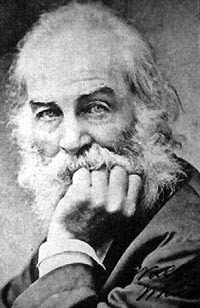
Whitman 1819 – 1892 [Image from www.allenginsberg.org]Fulton Ferry Boat (Brooklyn, New York), July 1890 via The Library of Congress, Washington DC. [Image from www.allenginsberg.org]
Versión castellana del poema “Crossing Brooklyn Ferry” (1856) de Walt Whitman English text at http://www.poetryfoundation.org Spanish Interpretation by JMN
[Translator’s note: This is the third segment of the ninth and last part of “Crossing Brooklyn Ferry.” One segment remains.] (9) Appearances, now or henceforth, indicate what you are, Apariencias, ahora o en el futuro, señalad lo que sois, You necessary film, continue to envelop the soul, Tú, película necesaria, sigue envolviendo al alma, About my body for me, and your body for you, be hung out divinest aromas, Por mi cuerpo para mí, y tu cuerpo para ti, suspéndanse los aromas más divinos, Thrive, cities—bring your freight, bring your shows, ample and sufficient rivers, Prosperad, ciudades — traed vuestra carga, traed vuestros espectáculos, ríos amplios y suficientes, Expand, being than which none else is perhaps more spiritual, Ensánchate, ser que ninguno hay que sea tal vez más espiritual, Keep your places, objects than which none else is more lasting. Guardad vuestros lugares, objetos que ninguno hay que sea más duradero.
[“I’ve Got It.” Latest New Yorker cover by Cristoph Niemann.]
Below are excerpts from Françoise Mouly’s interview with artist Christoph Niemann.
I became obsessed with drawing trees when I was a teen-ager. I took the same approach as I did when learning to draw the human body—trying to understand the structure, the weight, the proportions. But I always got lost in the details, and the results didn’t look convincing. Trees are much too complex to follow rules; each is unique, especially in the summer, and I’ve made my peace with that.
Niemann’s sketchbooks often depict trees in various degrees of abstraction.
I do keep looking to see how the masters solved trees. (I recommend Matisse, Félix Vallotton, and Wayne Thiebaud.) But I admit the most important lesson came from watching the TV host Bob Ross: if you want to draw trees, you have to loosen up and be in a good mood.
… I try to find a sweet spot, where an image that’s technically an abstract composition of shape and color is somehow legible to a viewer. The recognition doesn’t flow so much from deciphering clues as it does from tapping into unconscious visual memory. This process is hard to get right, harder to pull off than traditional representation or conceptual drawing. But I constantly show my work around and ask a single question: What do you see?
Ms. Kaufman’s later work, like this embroidered piece from 2010, dealt with religious and social divisions. She was unable to find a gallery that would show it. Jan Albert.
The savory quotation that leaps from this obituary of artist Jane Kaufman (1938 – 2021) is from Holland Cotter’s review of a 2008 retrospective at the Hudson River Museum in Yonkers, N.Y.
“It’s funky, funny, fussy, perverse, obsessive, riotous, accumulative, awkward, hypnotic,” Holland Cotter wrote in his review of that show in The Times. The Pattern and Decoration movement, he wrote, was the last genuine art movement of the 20th century, with “weight enough to bring down the great Western Minimalist wall for a while and bring the rest of the world in.”
Trained in the art programs of New York University and Hunter College, Kaufman made a sharp turn from abstract painting in the 1970s. It made her prominent in the Pattern and Decoration Movement.
She began stitching and gluing her work, using decorative materials like bugle beads, metallic thread and feathers, and employing the embroidery and sewing skills she had been taught by her Russian grandmother. By the end of the decade, she was making first luminescent screens and wall hangings, then intricate quilts based on traditional American patterns. In celebrating the so-called women’s work of sewing and crafting, she was performing a radical act, thumbing her nose at the dominant art movement of the era.
Ms. Kaufman was, a colleague said, “a wonderful artist who tirelessly worked to break down the conventions of ‘craft vs fine art.’” Jan Albert.
(Lately, as I re-read the Quixote, I find myself tilting at pugilistic rhetoric in favor of a gentler style of discourse. Is an artist necessarily “thumbing nose” at — i.e., despising — one direction when he or she opts for another?)
The last word in this appreciation is a considered affirmation by curator Anna Katz:
“It was a risk for Jane to make decorative art,” Ms. Katz added. “The term ‘decorative’ was a career killer. It still is. I think her attitude at the time was, this wasn’t the boldest thing she could do; it was the most necessary.”
(Penelope Green, “Jane Kaufman, Artist Who Celebrated Women’s Work, Dies at 83,” NYTimes, 7-15-21)
A former associate stumbled upon this blog recently and wrote to me. She had read some older posts in which I challenged certain language practice encountered in published articles.
It’s true I experimented for a time with adopting the persona of grammar nerd here, but moved beyond it. The audience for such matters is vanishingly small, which is okay. I have other passions to natter about.
What lingers with me is my colleague’s remark that she almost didn’t reach out to me from fear that I might be pesky or judgmental. She expressed in so many words a marked aversion to rubbing up against anything resembling an inquisitive or meddling grammarian. It’s pertinent that this person is a brilliant professional writer herself, and a teacher of writing. Any remark of mine about her practice would be otiose and impertinent.
I’m afraid that too much online discourse is rebarbative, leading people (and perhaps my colleague, who referred to my “web log”) to assume that what poses as criticism or critique in the cyber commons will have a belittling aspect to it, if not drip with disdain or worse. I emphatically eschew that course in spirit and, I hope, in practice.
What keeps intriguing me is where language that strays from certain norms can become obscure or cause confusion. A lucid, well-developed article in The Guardian quotes the following statement about retributive punishment:
“What seems to happen is that people come across an action they disapprove of; they have a high desire to blame or punish; so they attribute to the perpetrator the degree of control [over their own actions] that would be required to justify blaming them.”
The main clause has a plural subject “people.” The consecutive clause starting “so they attribute” introduces a singular nonspecific object “the perpetrator.” Subsequent references to the object avoid assigning it a gender by making it plural: “over their own actions” and “blaming them.” The reader is put to the extra work of realizing that the antecedent is “perpetrator” and not “people.”
A century ago it would read: “… so they attribute to the perpetrator the degree of control [over his own actions] that would be required to justify blaming him.” Choice of the masculine pronoun, of course, was an arbitrary convention.
I don’t contend that the usage in The Guardian article is somehow deplorable; only that, from a clinical perspective, it shows how extra-lingual pressures can move language in directions that are away from, not towards, clarity.
(Oliver Burkeman, “The clockwork universe: is free will an illusion,” theguardian.com, 4-27-21)
The NYTimes, as well, has sumptuous reportage on this exhibit of Medici-sponsored artworks. The portraits have a preternatural technical brilliance that’s otherworldly. “Laura Battiferri,” fingering her legible volume of Petrarch, is a creature contrived from mannerist lunacy.
An interesting wrinkle in Peter Schejeldahl’s review is that he concludes by urging the reader to “head just down the hall” to look at the work of “bohemian demiurge” Alice Neel (1900 – 1984). I’ve seen her painting elsewhere, and indeed it’s blessedly rich with oxygen.
It’s remarkable how an artist long classed as an eccentric outlier has come to seem an Old Master for present sensibilities… A frisson of nakedness infuses even her clothed subjects, whose resilience consists in being fully and, therefore, by Neel’s reckoning, lovably human… Now return to the Medici and imagine their fainting fits, were they exposed to Neel’s principled gaucherie. Art has many mansions. Today, the most compelling tend to the tumbledown.
(Peter Schjeldahl, “Power Players: The Medici at the Met,” thenewyorker.com, July 2021)
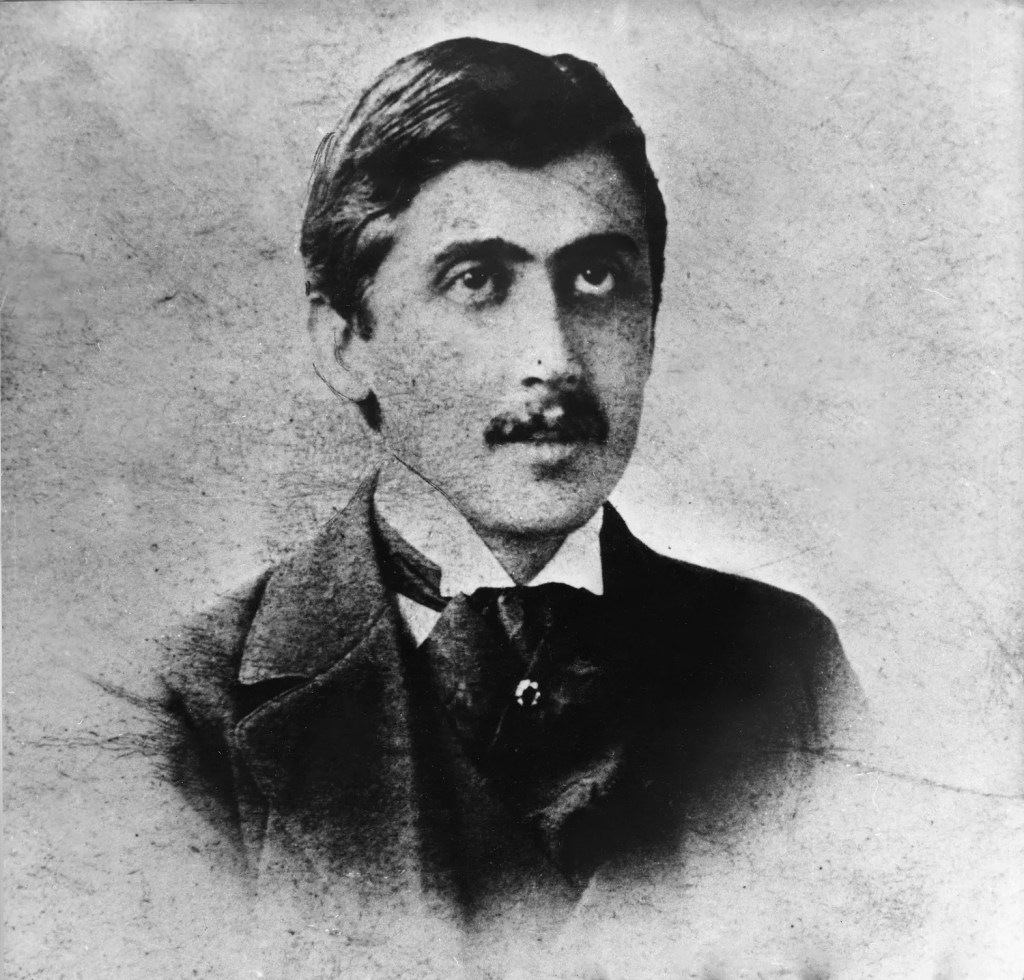
[New Yorker] Photograph by Ullstein Bild via Getty.
C. K. Scott Moncrieff (1889 – 1930) published the early-twentieth-century English version of Marcel Proust’s “A la Recherche du Temps Perdu.” Adam Gopnik reviews the first full-length biography of Moncrieff by Jean Findlay, “Chasing Lost Time: The Life of C. K. Scott Moncrieff, Soldier, Spy, and Translator.”
Findlay’s book, says Gopnik, “helps us see how someone who was not even particularly expert in the original language managed to make a great French book into a great English one.”
Moncrieff adapted Proust’s unabashed French to English sensibilities, influenced by an appreciation of Henry Jamesian allusiveness — Gopnik draws out certain affinities between the two men’s styles. What comes clear is how Moncrieff’s choices succeeded, to a degree that Joseph Conrad could think Moncrieff “a better translator than Proust was a writer.”
The article concludes with a sprightly summary:
[Moncrieff] had a thoroughly lively time in life, in that British way that is still surprising to our more earnest American minds—he has rough sex on the streets of Venice, spies for the secret service, translates his Proust and Pirandello, goes to Catholic mass, and works for the Tory party, in one big, very British, and happy entanglement of sodomy, spirituality, spying, and sociability. Far from being a Proustian acolyte perfuming the altar, he refused to be remotely pious about the great book he had brought into English literature—if anything, he seems to have generally preferred Pirandello.
(Adam Gopnik, “Why an Imperfect Version of Proust Is a Classic in English,” The New Yorker)









 EthicalDative
Sancho Panza Appreciates a Nip of Good Wine
Sancho Panza takes a memorable pull from a companion’s proffered wineskin (“bota”) in this scene from part 2 of “Don Quijote.”
And so saying, he placed it [the wineskin] in Sancho’s hands, who, raising it, pressed to his mouth, was gazing at stars for a quarter hour, and when finished drinking let fall his head to one side, and giving a great sigh said, “Son-of-a-bitching bastard, that’s a catholic one!”
(JMN)
Footnoting “catholic,” editor Martín de Riquer laconically prints “superior.” As a poke at human foibles and well of laughter this novel keeps on giving.
(c) 2021 JMN — EthicalDative. All rights reserved