Travesía (12)

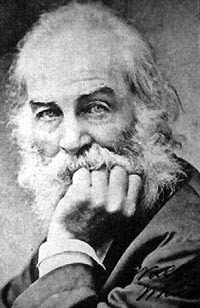
Whitman 1819 – 1892 [Image from www.allenginsberg.org]
Fulton Ferry Boat (Brooklyn, New York), July 1890 via The Library of Congress, Washington DC. [Image from www.allenginsberg.org]

Versión castellana del poema “Crossing Brooklyn Ferry” (1856) de Walt Whitman
English text at http://www.poetryfoundation.org
Spanish Interpretation by JMN

[Translator’s note: The whole of part 8 follows. The poem has 9 parts.]

(8)
Ah, what can ever be more stately and admirable to me than mast-hemm’d Manhattan?
Ah, ¿qué cosa jamás puede ser para mí más imponente y admirable que Manhattan rodeada de mástiles?
River and sunset and scallop-edg’d waves of flood-tide?
¿El río y la puesta del sol y las olas de borde festoneado del pleamar?
The sea-gulls oscillating their bodies, the hay-boat in the twilight, and the belated lighter?
¿Las gaviotas oscilando sus cuerpos, el barco de heno en el crepúsculo, y la gabarra tardía?

What gods can exceed these that clasp me by the hand, and with voices I love call me promptly and loudly by my nighest name as I approach?
¿Qué dioses pueden superar a éstos que me estrechan la mano, y con voces que amo me llaman de inmediato a todo volumen por mi nombre íntimo cuando me acerco?
What is more subtle than this which ties me to the woman or man that looks in my face?
¿Qué cosa es más sutil que esto que me ata a la mujer o al hombre que me mire en la cara?
Which fuses me into you now, and pours my meaning into you?
Lo que me fusiona con vosotros ahora, y os vierte mi significado en las entrañas?

We understand then do we not?
De modo que entendemos, ¿verdad?
What I promis’d without mentioning it, have you not accepted?
Lo que yo prometía sin mencionarlo, ¿no lo habéis aceptado?
What the study could not teach—what the preaching could not accomplish is accomplish’d, is it not?
Lo que no pudo enseñar el estudio — lo que no pudo lograr la predicación, está logrado, ¿no es así?

(c) 2021 JMN — EthicalDative. All rights reserved

Posted in Anthology | Tagged , , , , | Leave a comment

‘Inclusive Writing’

The French controversy over “inclusive writing” has surfaced.*

Cole Stangler, “France Is Becoming More Like America. It’s Terrible,” NYTimes, 6-2-21.
Annabelle Timsit, “The Push to Make French Gender-Neutral,” http://www.theatlantic.com, 11-24-17.

Here are examples that have been cited:

les musicien·ne·s (the musicians)
les idiot·e·s (the idiots)

This accommodation is meant to overcome a tradition of gendered languages that requires a roomful of musicians or idiots to be lumped into a masculine noun (les musiciens, les idiots) if there’s a single male amongst them. It uses a character variously called the “median-period” or “midpoint” (obtained on my Apple keyboards with shift+option+9) to confer equitable simultaneity upon the gender markers. Purists will still perceive a precedence issue, since the masculine marker comes first in this system.

I’m not sure how inclusive writing is meant to be read aloud, if at all.

Inclusive writing would work thus in Spanish:

lo·a·s músico·a·s (the problem is compounded by the gendered definite article: los, las)
lo·a·s idiotas (“idiots” is conveniently inclusive in Spanish)

English is comparatively ungendered. “Aviatrix” crashed long ago, and “actress” has largely assimilated to “actor.” There’s still a problem: traditional usage prescribes masculine pronouns and qualifiers for generic reference even with mixed assemblages.

Example: Each member of the jury must leave his phone at the door.

Contemporary usage is moving to “Each member of the jury must leave their phone at the door.”

Arguably, coopting the plural qualifier for a singular entity achieves perceived neutrality; however, it introduces (in my view) a potential for ambiguity of reference in other contexts.

Example: One of my friends said they were going to photograph their house. Who is photographing whose house?

I have often used the workaround “his or her,” but it can prove unwieldy in complex sentences:

“Anyone who wishes to raise his or her seatback table to give himself or herself more room may do so provided he or she no longer wants refreshment service.”

(c) 2021 JMN — EthicalDative. All rights reserved

Posted in Commentary | Tagged , , , , | Leave a comment

Adoration of the Cat

This gallery contains 1 photo.

A hoary plot line of melodrama reduces the hero and heroine to dire straits; they’ve tried everything in their power to escape doom; the soundtrack crescendos in a minor key. “Pray,” he says. “It’s in God’s hands. Only a miracle … Continue reading

More Galleries | Tagged , , , , , | Leave a comment

Exponential Obscurity Rectified*

*Scruple dictates that I confess to having added to the fog of blather by blatantly erring in my attempt to run the numbers in the original post. A bright lad has shown me the light, and the revised numbers do indeed bear out Ms. Tufecki’s example of the imposing power of exponentiality.

Zeynep Tufecki’s NYTimes guest essay asserts the mathematical essence of the E-word being slung portentously by the credentialed Covid commentariat:

Increased transmissibility is an exponential threat. If a virus that could previously infect three people on average can now infect four, it looks like a small increase. Yet if you start with just two infected people in both scenarios, just 10 iterations later, the former will have caused about 40,000 cases while the latter will be more than 524,000, a nearly 13-fold difference.

(Zeynep Tufecki, “Covid’s Deadliest Phase May Be Here Soon,” NYTimes, 5-28-21)

Tufecki’s instantiation has a touch of the abstruse to it. Here’s how I run her numbers:

The “former” case:

(1) 2×1=2; (2) 2×3=6; (3) 6×3=18; (4) 18×3=54; (5) 54×3=162; (6) 162×3=486; (7) 486×3=1458; (8) 1458×3=4374; (9) 4374×3=13,122; (10) 13,122×3=39,366

The “latter” case:

(1) 2×1=2; (2) 2×4=8; (3) 8×4=32; (4) 32×4=128; (5) 128×4=512; (6) 512×4=2048; (7) 2048×4=8192; (8) 8192×4=32,768; (9) 32,768×4=131,072; (10) 131,072×4=524,288

I see startling difference, but how does Tufecki get her answers? What am I missing? “What we have here is a failure to communicate.”

C’mon, experts! Bring it home. We’re swamped already by a fog of blather from pandemonic cacaphones. Infect us with some clarity.

(c) 2021 JMN — EthicalDative. All rights reserved

Posted in Commentary, Quotations | Tagged , , , , | Leave a comment

Shows and Prose

Along comes more NYTimes torqued and taut art talk of the sort that sweeps me up.

Darrel Ellis, “Untitled (Self-Portrait),” circa 1990-91, ink and wash on paper.
Credit… Darrel Ellis Estate and Candice Madey.

… Several gorgeous self-portraits made toward the end of his life. Their precision is astonishing… It’s clear that what most interested Ellis about ink was the tones it offered, from glittering black to smokey gray. WILL HEINRICH

Kunle Martins’s “SoiL,” from 2021, graphite and charcoal on found cardboard. Credit… Kunle Martins, Bortolami and 56 Henry; Kristian Laudrup.

… Delicate graphite and charcoal portraits of friends, often on found cardboard, creating an intimate assembly of a downtown demimonde… Tender evocations, attentive but unidealized, like an especially faithful frottage, or a Tom of Finland given a cold shower. MAX LAKIN

Keltie Ferris’s “s=t=r=e=a=m=s” (2020-21), oil and vinyl paint on canvas in the artist’s frame. Credit… Keltie Ferris.

Ferris’s paean to the transportive possibilities offered by drawing… showcases how a sense of movement can be conveyed through artistic restraint. Rejecting a hard disciplinary line between drawing and painting, Ferris revels in that more exhilarating space that emerges between mediums, which allows instinct and intuition to take the lead. TAUSIF NOOR

(“5 Art Gallery Shows to See Right Now,” NYTimes, 5-20-21)

(c) 2021 JMN — EthicalDative. All rights reserved

Posted in Quotations | Tagged , , , , , , , , | Leave a comment

Sparring With Blushes

When I was able to sign off the final proofs … I literally wept with joy’ … Professor James Diggle, holding the Cambridge Greek Lexicon. Photograph: Sir Cam.

“My English is chaste, and all licentious passages are left in the obscurity of a learned language.” (Edward Gibbon)

In the Middle Ages, several women poets of Arab Spain (al-Andalus) were known for their erotic and satiric verses composed with explicit diction in classical Arabic meters. Western scholars who took notice at all of these texts often quoted the explicit passages in Latin. Gibbon’s chasteness lived on in the twentieth century, I discovered as I, a striving scholar, strove to translate the verses.

Change is blowing in the winds of classicism. Led by Cambridge professor James Diggle, a team of intrepid lexicographers has updated HG Liddell and Robert Scott’s 1889 “Intermediate Greek-English Lexicon.”

The new dictionary’s editors “spare no blushes”, Diggle said, when it comes to the words that “brought a blush to Victorian cheeks”. The verb χέζω (chezo), translated by Liddell and Scott as “ease oneself, do one’s need”, is defined in the new dictionary as “to defecate” and translated as “to shit”; βίνέω (bineo) is no longer “inire, coire, of illicit intercourse”, but “fuck”; λαικάζω (laikazo), in the 19th-century dictionary translated as “to wench”, is now defined as “perform fellatio” and translated as “suck cocks”.

Antiquated and offensive language also gets a makeover. While Liddell and Scott defined βλαύτη (blaute) as “a kind of slipper worn by fops”, in the Cambridge Greek Lexicon it is described as “a kind of simple footwear, slipper”; κροκωτός (krokotos) is no longer defined as “a saffron-coloured robe worn by gay women”, but as a “saffron gown (worn by women)”.

(Alison Flood, “First English dictionary of ancient Greek since Victorian era ‘spares no blushes,’” theguardian.com, 5-27-21)

The Cambridge team’s massive achievement helps the uproarious ancients break free of stodgy and queenish taint.

(c) 2021 JMN — EthicalDative. All rights reserved

Posted in Commentary, Quotations | Tagged , , , , , , | Leave a comment

‘A Fisherman Holds Up a Trout He Caught’

A fisherman holds up a trout he caught. Contributed photo by Bink Grimes. [Victoria Advocate]

El hijo de su madre has stumbled upon an El Dorado of found poetry in the “Outdoors” fishing column of a local newspaper. Bink Grimes’s lavish rundown of the piscatory scene pulses with staccato verve, inside lingo, and riptide granularity. I’ve cherrypicked it for its sparkle. The title “Gone Fishing” is my contribution, but the catch is Bink’s.

GONE FISHING
The topwater bite has been good early over sand and grass.
Back lake areas are holding good numbers of trout
on soft plastics and scented baits under corks.

A mixture of mud, shell and grass has been even better
along the south shoreline with the stiff winds.

Sand and grass humps are holding lots of little minnows,
and being about to work the moon and tide has led to good catches.
Big trout have been caught and released while drifting.
Tides have ushered in streaky green water on the east end
and the fish have been hanging on the color change.

Wading back lakes with gold spoons and small topwaters has paid off for reds.
The stirred-up, off-colored water actually gets reds going.
Anglers anchored on the edges of flats have caught reds on cut shad or skip jacks.

It’s hard to talk about anything but red snapper.
Kingfish are just about everywhere.
The jetty out to 200 feet of water is holding kings
while drifting ribbon eels and trolling divers.

Cobia continue to impress around rigs or any other shady structure.
Lots of ling have followed red snapper to the surface around wrecks.
Captains have had a rod ready to pitch to a fat ling when it appears.

Please enjoy yourself on the water
while treating our bays and estuaries like the upmost respect.

(Bink Grimes, “Good catches despite rains and high tides,” Victoria Advocate, 5-24-21)

(c) 2021 JMN — EthicalDative. All rights reserved

Posted in Commentary, Quotations | Tagged , , , , , , , | Leave a comment

E Pluribus Nihil

Archaeologists of the far future sifting through America’s plastic ashes will peg the collapse of its civilization to two insidious language events:

(1) When America dissolved “talking about problems” into “having conversations around issues.”

(2) When America demoted “national” security to “homeland” security.

***

~ “Write beautifully what people don’t want to hear.” (Frederick Seidel)

Quedo de Vds. S.S.S.Q.E.S.M.

(c) 2021 JMN — EthicalDative. All rights reserved

Posted in Commentary | Tagged , , , , , , | 2 Comments

Adverb Rebellion

This passage from a fellow blogger (cap doff to) caught my eye:

Reality? Well it starts to mock back at your face, you get surrounded by the clouds of regret, cry on the ashes of your pretentious bliss and feel agitated on being abandoned by the people you highly think of.

(Shubhi Rawat, “The City Dwellers,” Perception, shubhangirawat.wordpress.com, May 2, 2021)

The passage dances with an out-of-kilter vivacity that mocks back at my face. I like it, and it made me rise from the ashes of my pretentious bliss to ponder adverbs.

What’s exotic about “highly think of” versus “think highly of”? No obvious rule leaps to mind.

Most adverbs are flexible as to where they may occur in the sentence: “I think deeply about the problem”; “I think about the problem deeply”; etc.

What’s in play, as I see it, is that in the formula “think highly of” the adverb is a cloaked adjective. It confers the attribute of being estimable on the object of the preposition rather than commenting on the nature of the thinking. It says, sneakily, “In my thoughts I attribute to the following entity an elevated status.” That message is puckishly flustered in “highly think of.”

Where they’re actually being themselves, adverbs almost always weaken an argument. They’re the Angostura Bitters ™ of style; use them by the drop, if at all.

Quedo de Vds. S.S.S.Q.E.S.M.

~ “Write beautifully what people don’t want to hear.” (Frederick Seidel)

(c) 2021 JMN — EthicalDative. All rights reserved
Posted in Commentary, Quotations | Tagged , , , , , | Leave a comment

Semicolon Rebellion

Use a semicolon to separate two independent clauses — i.e., two sentences that work on their own — which are closely sequential:

“I finished a painting today; it went better than I thought it would.”

Or in order to separate items in a series that would be particularly unwieldy with only commas, often because the items contain commas:

“Today I ate three desserts: a tiny cookie, which was free with my espresso; a bigger cookie, which was unfortunately a little dry; and a milkshake, which maybe took things too far.”

(Adapted from Lauren Oyler, “The Case for Semicolons,” NYTimes, 2-9-21)

“Write beautifully what people don’t want to hear.” (Frederick Seidel)

(c) 2021 JMN — EthicalDative. All rights reserved

Posted in Commentary, Quotations | Tagged , , , , , , | Leave a comment