Mr. Wiley is well known for “Slant Step.” “It was a “beautiful, pathetic object,” he once said, and it spoke to the part of him that discerned the most value in objects of no value.
It’s a pleasure to meet William T. Wiley, who moved and shook in a West Coast “funk art” scene while steering clear of wealth and fame. It’s no surprise that agreement on what exactly defined the funk art movement was nugatory. For example: “It wasn’t, for starters, redolent of New York in the heyday of Minimalism.”
Based at the University of California, Davis, [Wiley] shared his idiosyncratic wisdom, or “Wiz-dumb,” as he called it… He exhorted his students to remain open to everything, except for theory or ideology.
Mr. Wiley was enamored of question marks, which appeared in a number of his paintings, like this one, “Modern Art Teacher.” Credit… William T. Wiley.
Wiley’s Weltanschauung emits a whiff of California cool that’s quaintly boomerish — like praying for peace. This article evokes the vibe in alluding to “a now-vanished scene informed by Mr. Wiley’s communitarian spirit.” It must be said, an artist whose idea of real life was “to go salmon fishing or deal with tree limbs” has found purpose.
Reading the Stains” (1971). Mr. Wiley used words to complement a drawing style that was rooted in the most accessible forms of visual culture: comics, road maps and children’s book illustration. Credit… William T. Wiley/Hosfelt Gallery and Parker Gallery.
This tribute leaves me with a sole sticking point:
Mr. Wiley’s affection for Western lore and the myth of the lone rider was undercut by an opposing fascination with the meditative proclivities of the Far East. He was a devotee of Zen Buddhism, in which he was deeply read, and his friends wondered whether it explained his permanent air of detached mellowness.
I’m far from understanding why devotion to Zen is perceived to “undercut” and oppose affection for cowboy mythology.
(Deborah Solomon, “William T. Wiley, ‘Funk Artist’ Who Spurned Convention, Dies at 83,” NYTimes, 5-5-21 )
Jules Olitski’s “Mushroom Perfume” (1962) in the show “Jules Olitski: Color to the Core” at Yares Art. Credit… Estate of Jules Olitski/Licensed by VAGA at Artists Rights Society (ARS), New York; Yares Art.
Like a pig rooting for truffles I harvest luscious phrases from Roberta Smith’s art critiques.
After “he jumped on the Color Field painting bandwagon,” Jules Olitski (1922 – 2007) created works that “mess with space and scale in a visceral, almost sculptural way.”
His paintings have “wall power” and “come at us with cartoonish verve.”
They “tacitly ignore the medium’s physical limits, implying that the image extends far beyond the canvas….”
Fanny D” (1960), the show’s first painting, suggests brightly colored eggs contained by a pink basket, nest or teething ring — that careers across a lavender field. Credit… Estate of Jules Olitski licensed by VAGA at Artists Rights Society (ARS), New York; Yares Art.
Olitski’s shapes “give us formalism at its most ferocious and most fun.” A critic who compares a shape to a “teething ring” is no slouch at fun. And it takes caliber to call a background “very pushy.”
Fair Charlotte” (1961), two orbs galvanized by a very pushy background of egg-yolk yellow. Credit… Estate of Jules Olitski/Licensed by VAGA at Artists Rights Society (ARS), New York; Yares Art.
Could the fact that “[Olitski’s] paintings have sometimes been called feminine” explain their appeal to my womanish nature? Not wholly; the man in me is on board with them too.
(Roberta Smith, “The Great Beginning of Jules Olitski,” NYTimes, 1-28-21)
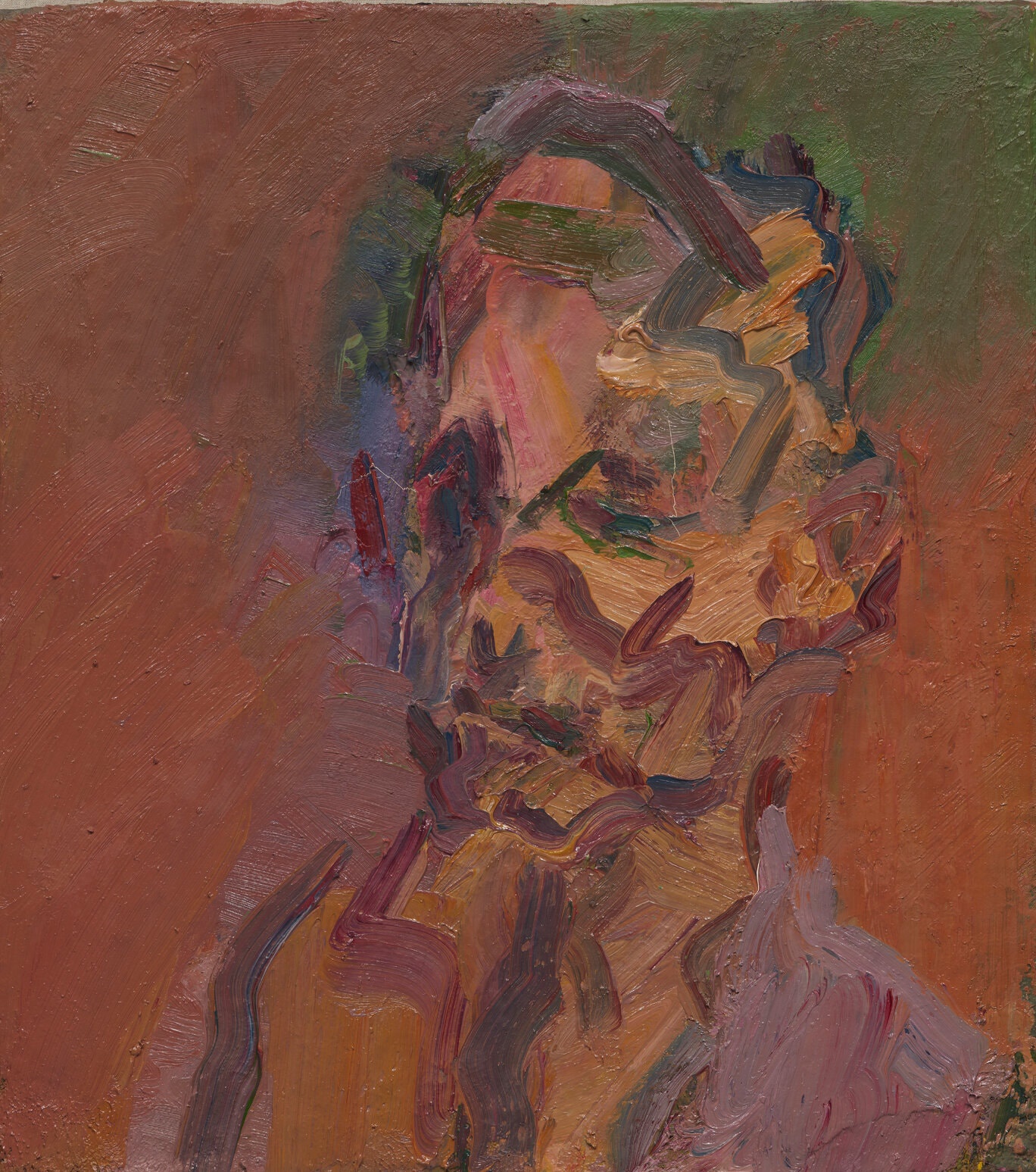
Auerbach’s “Portrait of William Feaver” (2007). Credit… Frank Auerbach and Marlborough Fine Art, London and Luhring Augustine.
The paintings of 90-year-old Frank Auerbach, “last surviving member of a pathfinding generation of postwar British figurative painters,” are up my alley. Auerbach’s iterative pigment attacks are savage and astonishing, and Jason Farago is always good for a blue-streak of commentary.
Viscid, murky… paintings… not the sort you love at first sight… burned oranges and sallow yellows, the dirty browns and olives of a filthy bus window… a narrow band of brown and ocher smears, only a bit differentiated from a background of bilious blue-green…
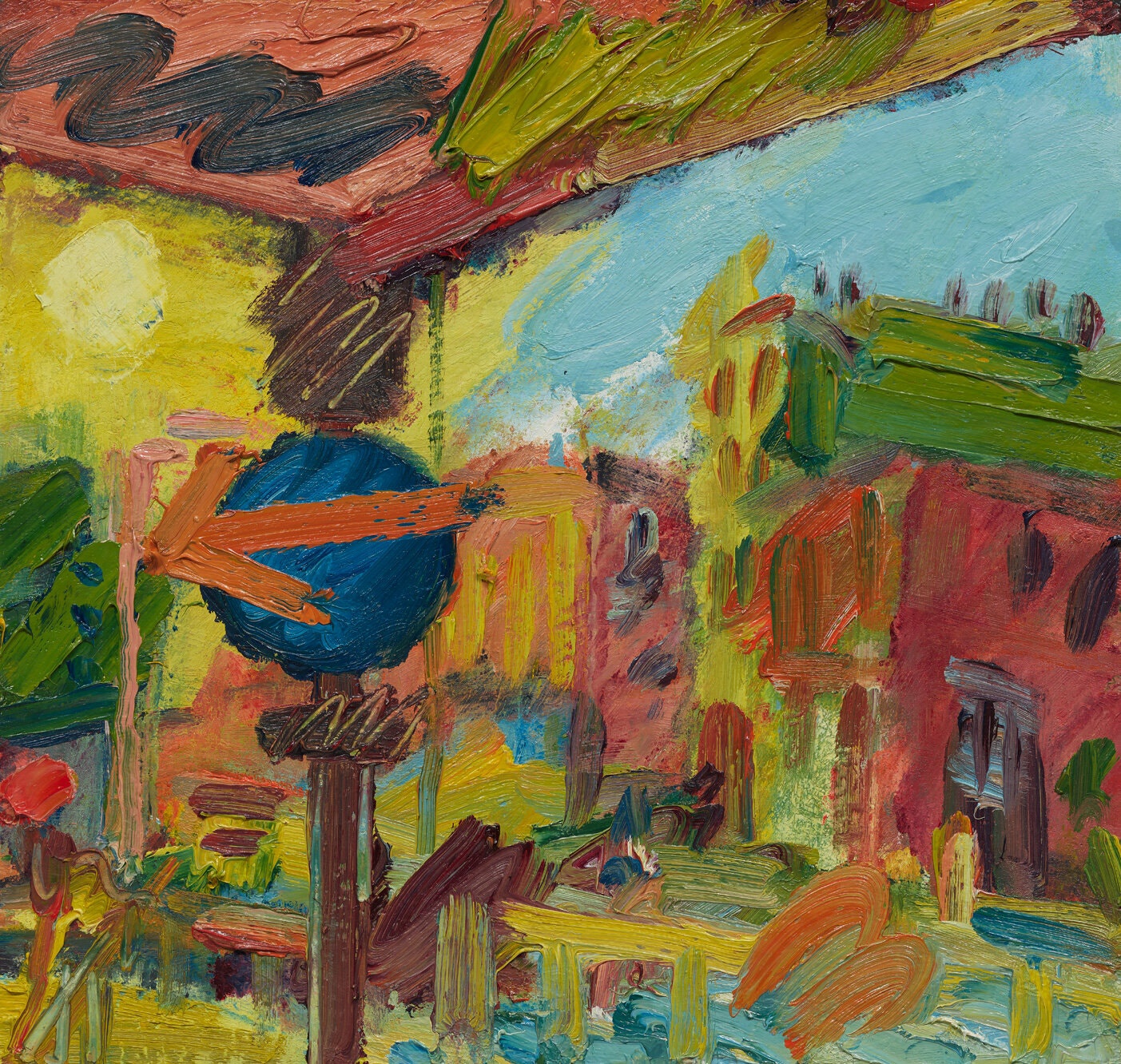
“The Awning I,” from 2008, depicts a streetscape in Auerbach’s North London neighborhood. Credit… Courtesy the artist and Marlborough Fine Art, London and Luhring Augustine, New York.
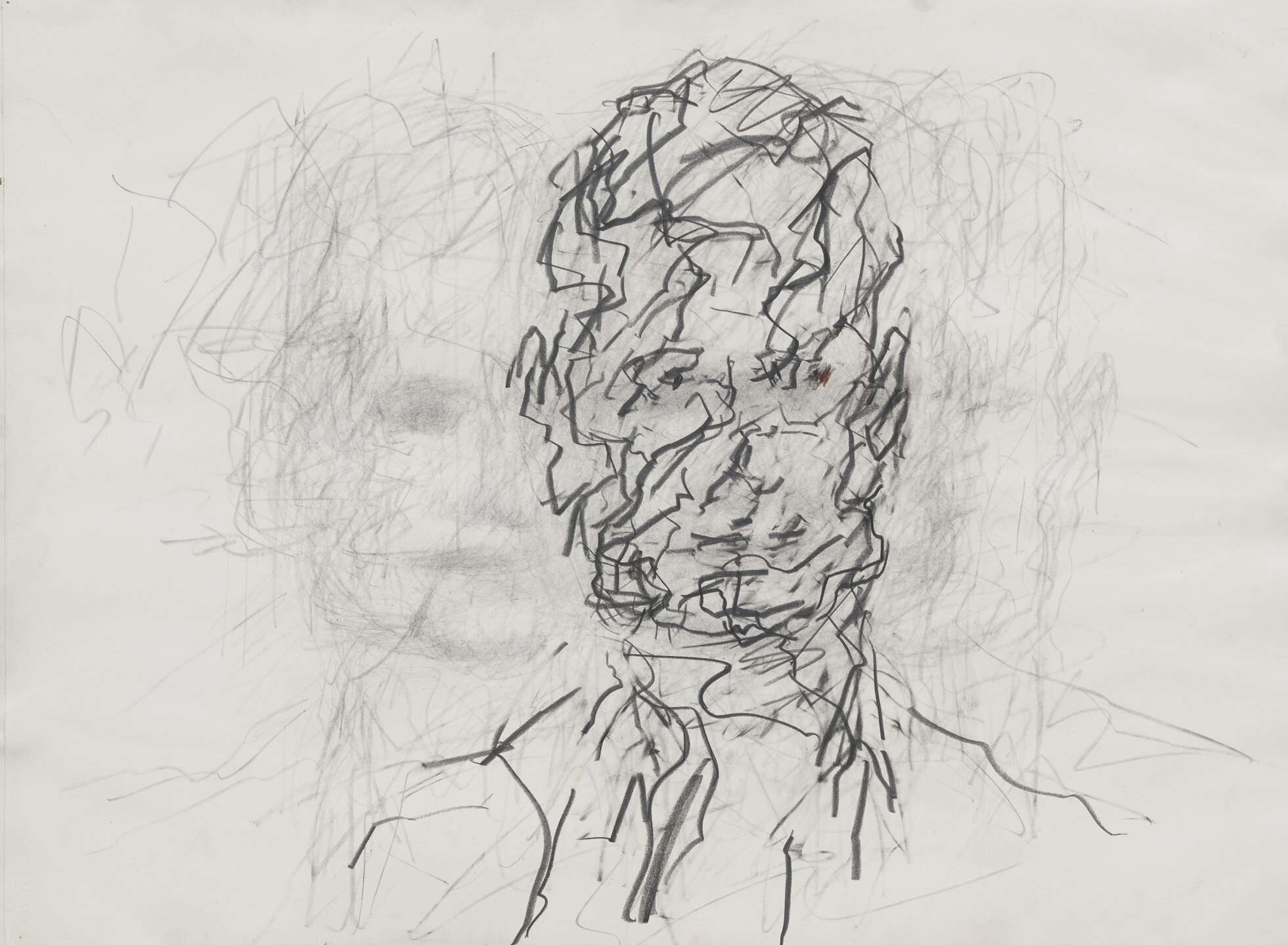
… Fluid, vigorous lines, full of zigzags and hairpin turns, applied with an almost vulgar density… a hard-to-interpret helix of sickly, mossy yellow-green: a calligraphic whirlwind that, from another painter, would read as a gesture of impertinence.
“Head of David Landau” (2006), a charcoal drawing of another of Auerbach’s frequent sitters. Credit… Frank Auerbach and Marlborough Fine Art, London and Luhring Augustine.
Farago’s ear fails him only when he writes “gloopy glory”; the glory is “goopy.”
(Jason Farago, “The Gloopy Glory of Frank Auerbach’s Portraits,” NYTimes, 1-21-21)
‘Eton has long provided potent lessons in elitism and how it works.’ Boris Johnson and David Cameron at a Conservative association dinner in Oxford in 2006. Photograph: David Hartley/Rex/Shutterstock.
…The vanities of posh men… centre on an ancient system that trains a narrow caste of people to run our affairs….
Ever questing to penetrate British lingo, I wobble over “public” versus “private” education in the kingdom’s parlance. In my country, private school is where the wealthy go, and public school is for the rest of us. It’s a system straightforwardly corrupt and named. In contrast, John Harris’s terminology respecting the UK variant seems crucivalent and meanderish to me. Perhaps that’s how the lords wish it.
… This is essentially a story about privilege, and the shamelessness and insensitivities that come with it. More specifically, it centres on the renaissance of an archetype that has been nothing but trouble: the ambitious, dizzyingly confident public schoolboy[my emphasis], convinced of his destiny but devoid of any coherent purpose… Brexit, let us not forget, is a direct result of the latter-day dominance of politics by the privately educated[my emphasis].
(John Harris, “Britain’s overgrown Eton schoolboys have turned the country into their playground,” theguardian.com, 5-2-21)
Fulton Ferry Boat (Brooklyn, New York), July 1890 via The Library of Congress, Washington DC. [Image from www.allenginsberg.org]
Versión castellana del poema “Crossing Brooklyn Ferry” (1856) de Walt Whitman English text at http://www.poetryfoundation.org Spanish Interpretation by JMN
[Translator’s note: The whole of part 7 follows. Of the poem’s 9 parts this short one has its peculiar thorniness. The elfish spin Whitman places on his queries and hedging averments — “as good as” and “for all” — dares my Spanish. “Who knows… but” reeks of subjunctive mood, but I’ve groped with moot outcomes for Spanish-sounding phraseology that puts the tone across. Whether or not my dependent clauses cut the mustard, ¿quién sabe?] (7) Closer yet I approach you, Cada vez más me acerco a vosotros, What thought you have of me now, I had as much of you—I laid in my stores in advance, La consideración que ahora tengáis de mí, tanta tuve yo de vosotros — acumulé mis reservas por adelantado, I consider’d long and seriously of you before you were born. Pensé larga y seriamente en vosotros antes de que nacierais.
Who was to know what should come home to me? ¿Quién iba a saber lo que hubiera de domiciliarse en mí? Who knows but I am enjoying this? ¿Quién sabe que yo no disfrute esto? Who knows, for all the distance, but I am as good as looking at you now, for all you cannot see me? ¿Quién sabe que, pese al extremo de lejanía, yo no os contemple ahora, dado que no me podéis ver a mí?
[The New Yorker article’s illustrating image and caption:] “As always, but especially when it comes to describing the numinous, the inadequacy of language is not only a problem for readers, but for writers, too. Image from Hulton Archive / Getty”
Like cartooning, the act of translation has proven dangerous at times. For his role in putting Christian scriptures into English, John Wycliffe’s long-dead bones were dug up, burnt, and chucked into the river by order of churchmen.
… The act of translation itself entails certain claims about the nature of sacred literature. The vernacular, for instance, was once so scandalous that church authorities dug up John Wycliffe’s bones, four decades after his death, setting fire to his skeleton and dumping what was left of him into the River Swift to punish the memory of the man who wanted to make the Bible available in English.
(Casey Cep, “What We Can and Can’t Learn from a New Translation of the Gospels,” The New Yorker, 4-28-21)
The arc of demented piety is brow-furrowing and bends towards homicide. As an impertinent translator of Pablo Neruda I count it a blessing that he has a non-faith-based following.
Veinte poemas de amor y una canción desesperada. Cien sonetos de amor 1924, Pablo Neruda y Herederos de Pablo Neruda 1994, Random House Mondadori Cuarta edición en U.S.A: febrero 2004
[LXXXIII] Es bueno, amor, sentirte cerca de mí en la noche, It’s good, love, to feel you near me in the night, invisible en tu sueño, seriamente nocturna, invisible in your sleep, seriously nocturnal, mientras yo desenredo mis preocupaciones while I untangle my preoccupations como si fueran redes confundidas. as if they were confounded nets.
Ausente, por los sueños tu corazón navega, Absent, through dreams your heart sails, pero tu cuerpo así abandonado respira but your body thus abandoned breathes buscándome sin verme, completando mi sueño seeking me sightlessly, completing my dream como una planta que se duplica en la sombra. just as a plant repeats itself in shadow.
Erguida, serás otra que vivirá mañana, Standing tall, you’ll dawn among the living, pero de las fronteras perdidas en la noche, but something of the borders lost at night, de este ser y no ser en que nos encontramos of this to be and not to be in which we dwell,
algo queda acercándonos en la luz de la vida keeps on moving us closer in life’s light como si el sello de la sombra señalara as if the stamp of shadow had branded con fuego sus secretas criaturas. with fire her undercover creatures.
Veinte poemas de amor y una canción desesperada. Cien sonetos de amor 1924, Pablo Neruda y Herederos de Pablo Neruda 1994, Random House Mondadori Cuarta edición en U.S.A: febrero 2004
A glance tells me this blog started in April 2018. This is April 2021. An anniversary month invites breaking the fourth wall for a moment. Brokenly, the endeavor here is twofold: (1) to practice writing; (2) to practice translating. I … Continue reading →
Fulton Ferry Boat (Brooklyn, New York), July 1890 via The Library of Congress, Washington DC. [Image from www.allenginsberg.org]
Versión castellana del poema “Crossing Brooklyn Ferry” (1856) de Walt Whitman English text at http://www.poetryfoundation.org Spanish Interpretation by JMN
[Translator’s note: I’ve arbitrarily divided part 6 into 3 segments. The third of the three segments follows. The poem has 9 parts.]
[6.3] [I] Was one with the rest, the days and haps of the rest, Unido fui con los demás, los días y sucesos de los demás, Was call’d by my nighest name by clear loud voices of young men as they saw me approaching or passing, Llamado de mi nombre familiar fui en voz alta y clara por los chavales cuando me veían acercar o pasar, Felt their arms on my neck as I stood, or the negligent leaning of their flesh against me as I sat, Sentí sus brazos en el cuello estando yo de pie, o bien el apoyo casual de sus carnes contra mí cuando me sentaba, Saw many I loved in the street or ferry-boat or public assembly, yet never told them a word, Vi a multitudes que amaba en la calle o en el buque o en la asamblea pública, y no les dije jamás palabra, Lived the same life with the rest, the same old laughing, gnawing, sleeping, Viví la misma vida que los demás, el mismo reír, roer, dormir, Play’d the part that still looks back on the actor or actress, Hice el papel que todavía recuerda al actor o a la actriz, The same old role, the role that is what we make it, as great as we like, El viejo papel de siempre, el papel que resulta ser lo que hacemos de él, tan grande como deseamos, Or as small as we like, or both great and small. O tan pequeño como deseamos, o bien grande y pequeño a la vez.








 EthicalDative
‘A Beautiful, Pathetic Object’
It’s a pleasure to meet William T. Wiley, who moved and shook in a West Coast “funk art” scene while steering clear of wealth and fame. It’s no surprise that agreement on what exactly defined the funk art movement was nugatory. For example: “It wasn’t, for starters, redolent of New York in the heyday of Minimalism.”
Wiley’s Weltanschauung emits a whiff of California cool that’s quaintly boomerish — like praying for peace. This article evokes the vibe in alluding to “a now-vanished scene informed by Mr. Wiley’s communitarian spirit.” It must be said, an artist whose idea of real life was “to go salmon fishing or deal with tree limbs” has found purpose.
This tribute leaves me with a sole sticking point:
I’m far from understanding why devotion to Zen is perceived to “undercut” and oppose affection for cowboy mythology.
(Deborah Solomon, “William T. Wiley, ‘Funk Artist’ Who Spurned Convention, Dies at 83,” NYTimes, 5-5-21 )
(c) 2021 JMN