How Are Posh Men Educated?

…The vanities of posh men… centre on an ancient system that trains a narrow caste of people to run our affairs….

Ever questing to penetrate British lingo, I wobble over “public” versus “private” education in the kingdom’s parlance. In my country, private school is where the wealthy go, and public school is for the rest of us. It’s a system straightforwardly corrupt and named. In contrast, John Harris’s terminology respecting the UK variant seems crucivalent and meanderish to me. Perhaps that’s how the lords wish it.

… This is essentially a story about privilege, and the shamelessness and insensitivities that come with it. More specifically, it centres on the renaissance of an archetype that has been nothing but trouble: the ambitious, dizzyingly confident public schoolboy [my emphasis], convinced of his destiny but devoid of any coherent purpose… Brexit, let us not forget, is a direct result of the latter-day dominance of politics by the privately educated [my emphasis].

(John Harris, “Britain’s overgrown Eton schoolboys have turned the country into their playground,” theguardian.com, 5-2-21)

(c) 2021 JMN

Posted in Commentary, Quotations | Tagged , , , , , , , , , , , | Leave a comment

Travesía (11)

Versión castellana del poema “Crossing Brooklyn Ferry” (1856) de Walt Whitman
English text at http://www.poetryfoundation.org
Spanish Interpretation by JMN

[Translator’s note: The whole of part 7 follows. Of the poem’s 9 parts this short one has its peculiar thorniness. The elfish spin Whitman places on his queries and hedging averments — “as good as” and “for all” — dares my Spanish. “Who knows… but” reeks of subjunctive mood, but I’ve groped with moot outcomes for Spanish-sounding phraseology that puts the tone across. Whether or not my dependent clauses cut the mustard, ¿quién sabe?]
(7)
Closer yet I approach you,
Cada vez más me acerco a vosotros,
What thought you have of me now, I had as much of you—I laid in my stores in advance,
La consideración que ahora tengáis de mí, tanta tuve yo de vosotros — acumulé mis reservas por adelantado,
I consider’d long and seriously of you before you were born.
Pensé larga y seriamente en vosotros antes de que nacierais.

Who was to know what should come home to me?
¿Quién iba a saber lo que hubiera de domiciliarse en mí?
Who knows but I am enjoying this?
¿Quién sabe que yo no disfrute esto?
Who knows, for all the distance, but I am as good as looking at you now, for all you cannot see me?
¿Quién sabe que, pese al extremo de lejanía, yo no os contemple ahora, dado que no me podéis ver a mí?

(c) 2021 JMN. All rights reserved

Posted in Anthology | Tagged , , , , | Leave a comment

The Wrath of Divines

Like cartooning, the act of translation has proven dangerous at times. For his role in putting Christian scriptures into English, John Wycliffe’s long-dead bones were dug up, burnt, and chucked into the river by order of churchmen.

… The act of translation itself entails certain claims about the nature of sacred literature. The vernacular, for instance, was once so scandalous that church authorities dug up John Wycliffe’s bones, four decades after his death, setting fire to his skeleton and dumping what was left of him into the River Swift to punish the memory of the man who wanted to make the Bible available in English.

(Casey Cep, “What We Can and Can’t Learn from a New Translation of the Gospels,” The New Yorker, 4-28-21)

The arc of demented piety is brow-furrowing and bends towards homicide. As an impertinent translator of Pablo Neruda I count it a blessing that he has a non-faith-based following.

(c) 2021 JMN

Posted in Commentary, Quotations | Tagged , , , , , , , , , , | 2 Comments

Neruda LXXXIII

Veinte poemas de amor y una canción desesperada. Cien sonetos de amor
1924, Pablo Neruda y Herederos de Pablo Neruda
1994, Random House Mondadori
Cuarta edición en U.S.A: febrero 2004

[LXXXIII]
Es bueno, amor, sentirte cerca de mí en la noche,
It’s good, love, to feel you near me in the night,
invisible en tu sueño, seriamente nocturna,
invisible in your sleep, seriously nocturnal,
mientras yo desenredo mis preocupaciones
while I untangle my preoccupations
como si fueran redes confundidas.
as if they were confounded nets.

Ausente, por los sueños tu corazón navega,
Absent, through dreams your heart sails,
pero tu cuerpo así abandonado respira
but your body thus abandoned breathes
buscándome sin verme, completando mi sueño
seeking me sightlessly, completing my dream
como una planta que se duplica en la sombra.
just as a plant repeats itself in shadow.

Erguida, serás otra que vivirá mañana,
Standing tall, you’ll dawn among the living,
pero de las fronteras perdidas en la noche,
but something of the borders lost at night,
de este ser y no ser en que nos encontramos
of this to be and not to be in which we dwell,

algo queda acercándonos en la luz de la vida
keeps on moving us closer in life’s light
como si el sello de la sombra señalara
as if the stamp of shadow had branded
con fuego sus secretas criaturas.
with fire her undercover creatures.

Veinte poemas de amor y una canción desesperada. Cien sonetos de amor
1924, Pablo Neruda y Herederos de Pablo Neruda
1994, Random House Mondadori
Cuarta edición en U.S.A: febrero 2004

[English translation by JMN.]

(c) 2021 JMN. All rights reserved

Posted in Anthology | Tagged , , , | Leave a comment

Word of Thanks

This gallery contains 1 photo.

A glance tells me this blog started in April 2018. This is April 2021. An anniversary month invites breaking the fourth wall for a moment. Brokenly, the endeavor here is twofold: (1) to practice writing; (2) to practice translating. I … Continue reading

More Galleries | Tagged , , , | 2 Comments

Travesía (10)

Versión castellana del poema “Crossing Brooklyn Ferry” (1856) de Walt Whitman
English text at http://www.poetryfoundation.org
Spanish Interpretation by JMN

[Translator’s note: I’ve arbitrarily divided part 6 into 3 segments. The third of the three segments follows. The poem has 9 parts.]

[6.3]
[I] Was one with the rest, the days and haps of the rest,
Unido fui con los demás, los días y sucesos de los demás,
Was call’d by my nighest name by clear loud voices of young men as they saw me approaching or passing,
Llamado de mi nombre familiar fui en voz alta y clara por los chavales cuando me veían acercar o pasar,
Felt their arms on my neck as I stood, or the negligent leaning of their flesh against me as I sat,
Sentí sus brazos en el cuello estando yo de pie, o bien el apoyo casual de sus carnes contra mí cuando me sentaba,
Saw many I loved in the street or ferry-boat or public assembly, yet never told them a word,
Vi a multitudes que amaba en la calle o en el buque o en la asamblea pública, y no les dije jamás palabra,
Lived the same life with the rest, the same old laughing, gnawing, sleeping,
Viví la misma vida que los demás, el mismo reír, roer, dormir,
Play’d the part that still looks back on the actor or actress,
Hice el papel que todavía recuerda al actor o a la actriz,
The same old role, the role that is what we make it, as great as we like,
El viejo papel de siempre, el papel que resulta ser lo que hacemos de él, tan grande como deseamos,
Or as small as we like, or both great and small.
O tan pequeño como deseamos, o bien grande y pequeño a la vez.

[End of part 6]

(c) 2021 JMN. All rights reserved

Posted in Anthology | Tagged , , , , | Leave a comment

Travesía (9)

Versión castellana del poema “Crossing Brooklyn Ferry” (1856) de Walt Whitman
English text at http://www.poetryfoundation.org
Spanish Interpretation by JMN

[Translator’s note: I’ve arbitrarily divided part 6 into 3 segments. The second of the three segments follows. The poem has 9 parts.]

[6.2]
I too knitted the old knot of contrariety,
Yo también tejí el viejo nudo de contrariedad,
Blabb’d, blush’d, resented, lied, stole, grudg’d,
Despotriqué, me ruboricé, me resentí, mentí, robé, envidié,
Had guile, anger, lust, hot wishes I dared not speak,
Tuve artimañas, enfado, lujuria, deseos calientes que no me atreví a decir,
Was wayward, vain, greedy, shallow, sly, cowardly, malignant,
Fui caprichoso, vanidoso, avaro, superficial, taimado, cobarde, maligno,
The wolf, the snake, the hog, not wanting in me,
El lobo, la culebra, el puerco, no faltando en mí,
The cheating look, the frivolous word, the adulterous wish, not wanting,
La mirada infiel, la palabra frívola, el anhelo adúltero, no faltando,
Refusals, hates, postponements, meanness, laziness, none of these wanting,
Rechazos, odios, aplazamientos, mezquindad, pereza, ninguno de ellos faltando,[…]

(c) 2021 JMN. All rights reserved

Posted in Anthology | Tagged , , , , | Leave a comment

Travesía (8)

Versión castellana del poema “Crossing Brooklyn Ferry” (1856) de Walt Whitman
English text at www.poetryfoundation.org
Spanish Interpretation by JMN

[Translator’s note: I’ve arbitrarily divided part 6 into 3 segments. The first of the three segments follows. The poem has 9 parts.]

[6.1]
It is not upon you alone the dark patches fall,
No es sobre ti sólo que caen las tachas oscuras,
The dark threw its patches down upon me also,
La oscuridad lanzó sobre mí también sus tachas,
The best I had done seem’d to me blank and suspicious,
Lo mejor que yo hubiera logrado me parecía vacío y dudoso,
My great thoughts as I supposed them, were they not in reality meagre?
Mis supuestas grandes ocurrencias, ¿no eran en realidad ínfimas?
Nor is it you alone who know what it is to be evil,
Tampoco eres tú sólo quien sabe lo que es ser malo,
I am he who knew what it was to be evil,
Soy yo quien supo lo que era ser malo,[…]

(c) 2021 JMN. All rights reserved

Posted in Anthology | Tagged , , , , | Leave a comment

‘Miner of Difficult Truths’

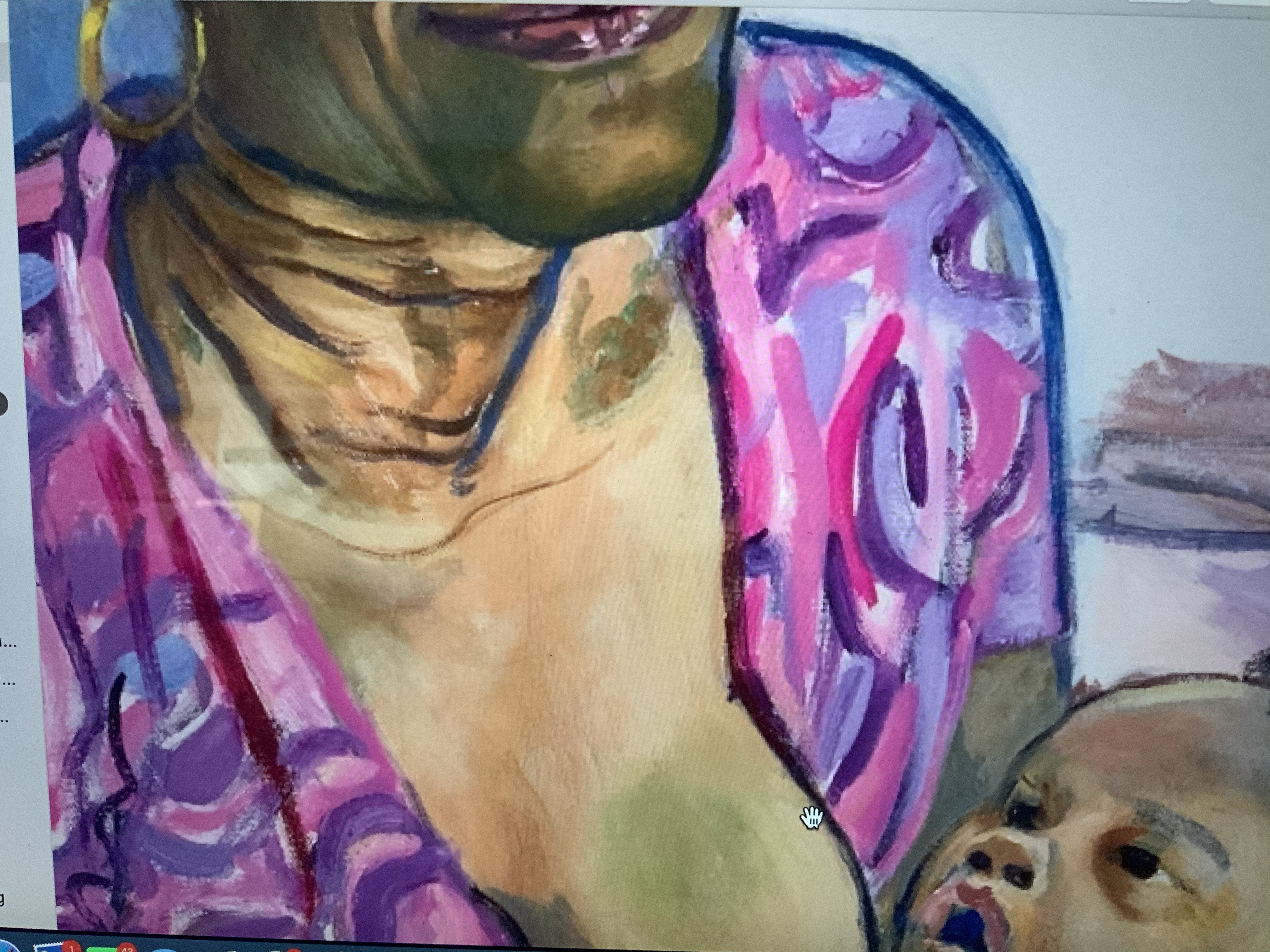
I can study all day Alice Neel’s brushwork and modeling of flesh and features, how she gestures at her subjects’ surroundings with casual precision. Her “Carmen and Judy” has a frank, womanly exactness and searing intimacy that The New Yorker’s pages show, and Hilton Als’ words ponder, with greater authority than I command here:

These great, almost unbearable late works bear witness to a bravura without a trace of self-consciousness. You can see it in “Carmen and Judy” (1972), a portrait of Neel’s cleaning lady nursing her disabled child. The curators point out that it was unusual for a woman of color to expose her body to the artist in this way, and I can vouch for that. Privacy is one of the few defenses there is against poverty and racism. But Carmen was no doubt able to reveal herself to Neel because she knew that Neel would see what she needed to see: Carmen’s trust, Judy’s dependence, all those years of living in a difference that was not difference to the artist, who had her own years of loss, of children’s love, of trying to render this and so much more in works that would continue to live, despite the darkness of her obscurity and then the light of her fame. Looking at Carmen look at Neel, and thus at us, is like staring straight at the sun. We can’t do it, but we try anyway.

One of her early influences was the work of Robert Henri, a founder of the Ashcan School—a movement that challenged the bourgeois prettiness of the work of the American Impressionists. The Ashcan School focussed on what the Impressionists left out—poverty, dereliction, ugliness. Neel’s developing realism went further. She was not Ashcan but emotional gutbucket, a miner of difficult truths.

(Hilton Als, “Alice Neel’s Portraits of Difference,” thenewyorker.com, April 26 & May 3, 2021 Issue)

(c) 2021 JMN

Posted in Commentary, Quotations | Tagged , , , , , , , , | 2 Comments

A-Theology

A poke at Ludwig’s nonsense adumbrates an a-theology that circumvents the mortiferous belch of cassock-and-biretta evangels.

There’s an amount of life which abounds so abundantly it’s incommensurate with measurement. It amounts to the livelong life force of aliveness that explodes our skulls like an AR-15 would when we try to seize it. It’s the-world-is-everything-that-is-the-case of matter that moves. Not the source of this or that somethingness, but the very ness of it, the preposition in infinity, the suffixing titty of finite. It’s what’s between the equals sign in algebra class.

So it be nameless I name it anyway The amount with a capital T.

Occasionally I kill a few sugar ants while washing dishes. Not on purpose; it’s simply a wrong-place-wrong-time situation for them.

Sugar ants are micro-tiny. Have you seen one? Its carcass is a quasi-speck. Yet I’ve watched teams of them toil relentlessly to hoist a crumb to their lair a league distant in ant world. And when not craning or bulldozing, they haul ass like Lamborghinis.

Here’s the crux of the matter then, the ology part:

The amount beyond origin that can squirt such vitality into a creature the size of a pinhead deserves respect, does it not? Does the portion of life snuffed from the sugar ant not flow from The amount? And my portion too? Is not sister ant my brother in shared life, and I its, for The amount’s bloody sake! And does not The amount not grow less from the ant’s loss, or mine, but rather reclaim our portions and stay the same? Maybe, maybe not?

That’ll do for gospel and scripture.

(c) 2021 JMN

Posted in Anthology, Commentary | Tagged , , , , , , , | Leave a comment